A Boutique Escape in the Heart of Brussels

Fresh from an extensive redesign, 9Hotel Chelton combines contemporary interiors, wellness facilities and an enviable location, making it an appealing base for both business and leisure travellers exploring the Belgian capital.

Brussels is often celebrated for its grand architecture, world-class museums and thriving European business district, yet tucked away just moments from the city’s political heart is a boutique hotel that offers a quieter, more relaxed way to experience the Belgian capital.

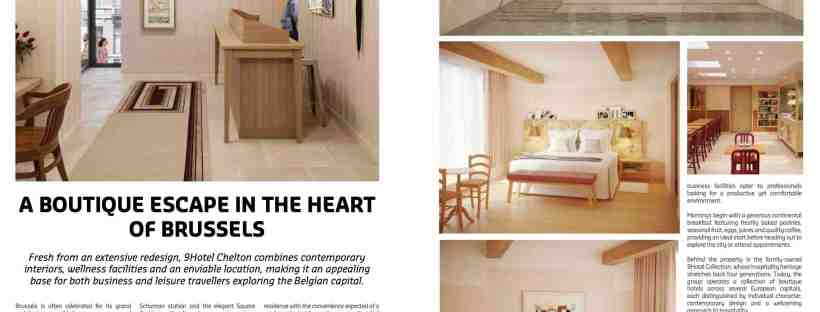
Reopened following an extensive redesign, 9Hotel Chelton presents a contemporary retreat where thoughtful design meets everyday comfort. Located near Brussels-Schuman station and the elegant Square Ambiorix, the four-star property enjoys easy access to both the city’s European institutions and many of its cultural attractions, making it equally suited to business travellers and weekend explorers.

The interiors, reimagined by renowned designer Bruno Borrione, embrace clean lines, warm textures and understated elegance. The hotel’s 49 guestrooms blend the welcoming atmosphere of a country residence with the convenience expected of a modern city hotel, creating spaces that feel both comfortable and refined.

One of the property’s standout features is its wellness offering. Guests can unwind in the indoor swimming pool, recharge in the fitness area or enjoy the sensory showers after a day spent discovering Brussels or attending meetings nearby. A 24-hour honesty bar adds to the relaxed atmosphere, while dedicated coworking spaces and business facilities cater to professionals looking for a productive yet comfortable environment.

Mornings begin with a generous continental breakfast featuring freshly baked pastries, seasonal fruit, eggs, juices and quality coffee, providing an ideal start before heading out to explore the city or attend appointments.

Behind the property is the family-owned 9Hotel Collection, whose hospitality heritage stretches back four generations. Today, the group operates a collection of boutique hotels across several European capitals, each distinguished by individual character, contemporary design and a welcoming approach to hospitality.

For travellers seeking a stylish boutique address that balances convenience with comfort, 9Hotel Chelton is one of those understated discoveries worth adding to the Brussels shortlist. Whether visiting for business, a cultural city break or simply passing through one of Europe’s most vibrant capitals, it offers a contemporary base from which to experience the city at a more relaxed pace.

A Journey Through Time, One Gallery at a Time

Discovering the Natural History Museum Abu Dhabi through Gen Z Eyes

By Natasha Dury

I have a habit that surprises people whenever I travel. While some visitors plan their itineraries around shopping districts or beach clubs, I look for museums and experience centres. They tell me more about a destination than almost anything else, revealing its history, culture and ambition in ways that stay with me long after I’ve returned home.

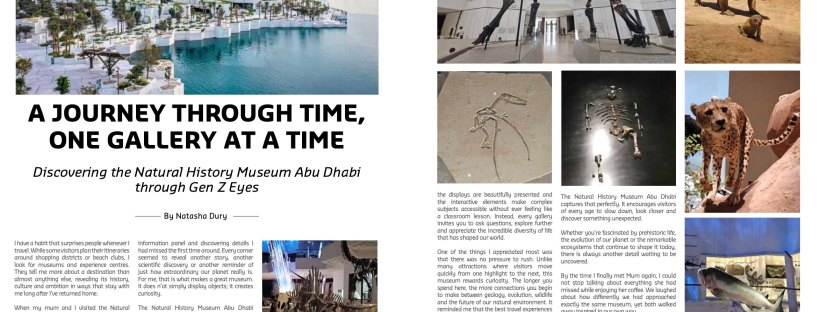
When my mum and I visited the Natural History Museum Abu Dhabi with our best friends, we both expected to enjoy it. What we didn’t expect was to experience it so differently. After about two hours of exploring, mum was ready to relax with a coffee, convinced she had seen the highlights. I was only just getting started and went along with my friends to see more.

Five hours later, I was still moving through the galleries, revisiting exhibits, reading every information panel and discovering details I had missed the first time around. Every corner seemed to reveal another story, another scientific discovery or another reminder of just how extraordinary our planet really is. For me, that is what makes a great museum. It does n’ot simply display objects; it creates curiosity.

The Natural History Museum Abu Dhabi has been designed as an immersive journey rather than a collection of exhibits. From the moment you step inside, you are encouraged to explore at your own pace. The spaces flow naturally from one discovery to the next, making it easy to lose track of time as millions of years of Earth’s history unfold around you.

As someone who genuinely enjoys learning, I loved that the museum never felt overwhelming. The storytelling is engaging, the displays are beautifully presented and the interactive elements make complex subjects accessible without ever feeling like a classroom lesson. Instead, every gallery invites you to ask questions, explore further and appreciate the incredible diversity of life that has shaped our world.

One of the things I appreciated most was that there was no pressure to rush. Unlike many attractions where visitors move quickly from one highlight to the next, this museum rewards curiosity. The longer you spend here, the more connections you begin to make between geology, evolution, wildlife and the future of our natural environment.

It reminded me that the best travel experiences aren’t always about seeing more—they’re about understanding more.

I think that’s something many people in my generation value. We don’t just want photographs of the places we visit; we want experiences that leave us with new perspectives. Museums have become destinations in their own right because they combine education, technology, storytelling and design in ways that feel engaging rather than traditional.

The Natural History Museum Abu Dhabi captures that perfectly. It encourages visitors of every age to slow down, look closer and discover something unexpected. Whether you’re fascinated by prehistoric life, the evolution of our planet or the remarkable ecosystems that continue to shape it today, there is always another detail waiting to be uncovered.

By the time I finally met Mum again, I could not stop talking about everything she had missed while enjoying her coffee. We laughed about how differently we had approached exactly the same museum, yet both walked away inspired in our own way.

Perhaps that is the museum’s greatest achievement. It doesn’t ask visitors to experience it in a particular way. Whether you spend two hours exploring the highlights or five hours immersing yourself in every gallery, it rewards your curiosity.

As for me, I already know I will be back. Because somehow, I still don’t think I have seen everything.

Rediscovering the Soul of Georgia

Shereen Shabnam

Returning to Georgia is a little like meeting an old friend. The familiar warmth is still there, but every conversation reveals something new. On my first visit, the dramatic journey to Kazbegi, with its soaring mountain landscapes and the iconic Gergeti Trinity Church framed by snow-capped peaks, left an unforgettable impression. This time, however, I deliberately stepped beyond the country’s best-known highlights to discover new regions, hidden experiences and a slower, more authentic side of one of the Caucasus’ most captivating destinations.  

There is something wonderfully effortless about travelling through Georgia. Distances are manageable, the scenery changes dramatically within a few hours, and every stop introduces another chapter in the country’s rich history.

My journey began in Tbilisi, a city I never tire of returning to. Even after previous visits, the Georgian capital always feels fresh. The old town, with its colourful timber balconies, cobbled streets and eclectic architecture, blends centuries of history with an unmistakably youthful energy. Every corner seems to reveal another hidden courtyard, artisan gallery or café filled with locals lingering over coffee.

Dinner on my arrival at Oilibuli Restaurant was the perfect start to Georgian hospitality. Like every meal throughout the journey, it reinforced why Georgian cuisine deserves far more global recognition. From traditional family recipes to contemporary interpretations, every meal became an experience rather than simply another stop on the itinerary.

Leaving Tbilisi behind, we headed east into Kakheti, Georgia’s celebrated wine region. Rolling vineyards stretched towards the Caucasus Mountains while sleepy villages appeared almost untouched by time. Our destination was Sighnaghi, affectionately known as the City of Love.

Small enough to explore on foot, Sighnaghi possesses a romantic charm that few European towns can rival. Its beautifully restored pastel houses, ancient defensive walls and sweeping valley views make it easy to understand why visitors linger here far longer than planned. Walking along the old fortifications, I found myself pausing repeatedly to absorb the endless landscape unfolding below.

Nearby, the remarkable Kvareli tunnel offered one of the most unusual grape curation experiences I have encountered. Originally constructed as a military tunnel during the Soviet era, it has since been transformed into an immense underground drinks cellar where thousands of bottles mature naturally beneath the earth.

The evening concluded at Lopota Lake Resort & Spa, nestled in the peaceful Lopota Valley. Surrounded by vineyards, forests and mountain ridges, the expansive resort feels less like a hotel and more like its own destination. As daylight faded across the lake, it became one of those rare places where silence itself becomes part of the luxury.

The following morning, curiosity led us to the Caucasus’ first outlet village for retail therapy before another afternoon immersed in Georgian hospitality followed by one of the journey’s greatest surprises, Dashbashi Canyon. While Georgia’s mountain scenery often dominates travel brochures, this spectacular volcanic gorge offers an entirely different perspective on the country’s natural diversity. Lush greenery cascades down dramatic cliffs towards waterfalls hidden below, while the now-famous glass sky bridge provides an unforgettable viewpoint suspended high above the canyon floor.

After a night in Tblisi, our adventure then shifted west towards Kutaisi, one of Georgia’s oldest continuously inhabited cities. Along the way, Prometheus Cave revealed a hidden underground world sculpted over millions of years. Towering stalactites, shimmering stalagmites and softly illuminated chambers create an almost surreal landscape that feels closer to fantasy than geology. Walking through the vast caverns is a reminder that some of nature’s greatest masterpieces remain hidden beneath our feet.  

Kutaisi itself quickly became one of my favourite discoveries. We experienced Gemo Fest, the Georgian National Tourism Administration’s travelling gastronomic festival celebrating regional food traditions and local producers. Although I will save the country’s remarkable cuisine for another story, the festival offered a fascinating glimpse into how proudly Georgians preserve their culinary heritage.  

Our boutique hotel, immediately charmed me with its intimate atmosphere, but it was an unexpected resident parked outside that truly caught my attention in form of a beautifully preserved powder-blue 1963 Volga. As someone who has spent decades writing about automobiles, stumbling across this elegant piece of Soviet motoring history was a delightful surprise. It felt entirely at home against Kutaisi’s timeless backdrop.

Returning to Tbilisi, I embraced one of the city’s oldest traditions at Gulo’s Thermal Spa in the historic Abanotubani district. Georgia’s famous sulfur baths have welcomed travellers for centuries, and soaking in the naturally heated mineral waters provided the perfect opportunity to slow down after several days of exploring. The experience felt authentic, restorative and deeply connected to the city’s identity.  

The same day we had lunch at Kneina, a beautifully restored traditional Georgian home where lunch is prepared by an inspiring mother-and-son team. Rather than simply serving guests, they welcome visitors into their family story.

My final full day was spent wandering through the underground market, a treasure trove of antiques, vintage cameras, memorabilia, artwork and handcrafted souvenirs. Every stall seemed to tell another story about Georgia’s complex past, and browsing became an unexpected history lesson as much as a shopping experience.

Later, I wandered once again through Old Tbilisi, where ancient churches stand comfortably alongside synagogues, mosques and colourful wooden balconies overlooking winding streets. It remains one of Europe’s most visually distinctive historic quarters, constantly inviting visitors to slow down and simply observe everyday life unfolding around them.  

My final evening ended at the wonderful Georgia House, where traditional music filled the dining room long into the night. Surrounded by locals and visitors alike, the live performances captured something difficult to describe but impossible to forget. It was the perfect farewell to a country where hospitality simply comes naturally and I hope to return for a road trip experience next, hopefully in a vintage car to add to the experience.

For More Information on Travelling in Georgia Visit – https://georgia.travel

The Rise of the Solo Journey

Why personalised itineraries and independent travel are redefining modern exploration

Shereen Shabnam

As a travel and lifestyle journalist, I have come to realise that some of the most memorable journeys rarely happen according to plan. My work often takes me across continents, from reviewing luxury hotels and test driving performance cars across challenging terrains to discovering hidden culinary gems between business meetings. Yet it is often the moments in between the schedules, launches, and itineraries that leave the strongest impression.

A recommendation from a local restaurateur in Malaysia can lead to an unforgettable street food experience in Penang, while a spontaneous detour through the winding coastal roads of Spain can transform a simple road trip into something cinematic. In Switzerland, driving through alpine passes and remote mountain villages offers a rare connection to nature and adventure, while the serenity of the Maldives provides the perfect counterbalance, a place where wellness, stillness, and reflection become part of the journey itself.

Then there is Paris, a city that remains timeless not because of its landmarks alone, but because of its atmosphere, café culture, effortless elegance, and the simple joy of wandering without purpose. Increasingly, these experiences are shaping the rise of personalised and solo travel, where the freedom to move independently allows travellers to connect more deeply with destinations, cultures, and ultimately themselves.

There was a time when solo travel was often viewed as an unconventional choice, reserved for gap-year students, or those simply unable to find company for a trip. Today, it has evolved into one of the most significant shifts in modern tourism. Across luxury travel, wellness escapes, and even corporate journeys, personalised itineraries and independent exploration are becoming deeply desirable experiences for travellers seeking something more meaningful than traditional sightseeing.

What is driving this movement is not isolation, but freedom. Travellers increasingly want the ability to shape journeys around their own interests, pace, and emotional needs rather than compromise within a group dynamic. The modern traveller is no longer simply chasing destinations; they are pursuing experiences that feel personal, immersive, and transformative.

Business travel, interestingly, has become one of the strongest catalysts for this change. Corporate trips today often extend beyond conference rooms and hotel lobbies. Spending time with local clients, colleagues, and industry professionals introduces travellers to a more authentic side of a destination. A recommendation from a local often becomes more memorable than anything in a guidebook. These interactions create a richer cultural connection and encourage travellers to explore independently during downtime, transforming work trips into deeply personal experiences.

Solo leisure travel carries a different, yet equally powerful appeal. Travelling alone cultivates confidence in ways few experiences can. Navigating unfamiliar cities, embarking on long scenic drives, and making spontaneous decisions encourage self-reliance and adaptability. Many travellers describe returning from solo journeys feeling more capable, focused, and emotionally recharged. In a world increasingly dominated by digital noise and rigid schedules, solo travel offers something increasingly rare: uninterrupted personal space.

The travel industry has recognised this shift. Luxury operators, boutique agencies, and wellness brands are now curating highly personalised solo itineraries that combine independence with comfort and security, that includes gastronomy, wellness, adventure, art, sustainability, or culture.

My favourite road trip was in Spain, particularly great for driving enthusiasts who view driving as part of the experience. From the dramatic mountain routes of Andalusia to the coastal highways stretching along the Mediterranean, Spain offers the perfect balance of scenery, culture, and spontaneity. Malaysia continues to attract independent travellers for its extraordinary culinary diversity and accessibility. I lived there for 9 years and love the refined dining in Kuala Lumpur to hawker stalls in Penang.

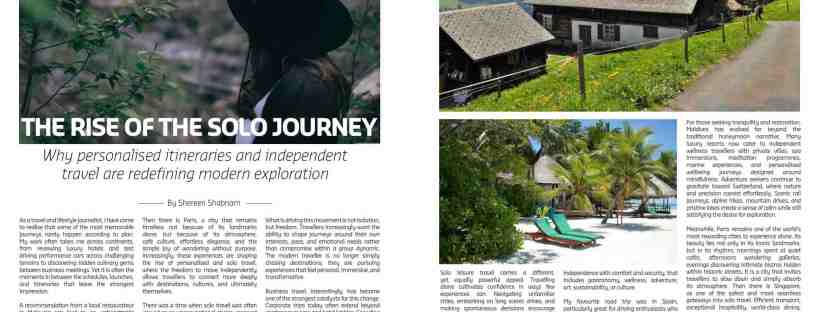
For those seeking tranquility and restoration, Maldives has evolved far beyond the traditional honeymoon narrative. Many luxury resorts now cater to independent wellness travellers with private villas, spa immersions, meditation programmes, marine experiences, and personalised wellbeing journeys designed around mindfulness. Adventure seekers continue to gravitate toward Switzerland, where nature and precision coexist effortlessly. Scenic rail journeys, alpine hikes, mountain drives, and pristine lakes create a sense of calm while still satisfying the desire for exploration.

Meanwhile, Paris remains one of the world’s most rewarding cities to experience alone. Its beauty lies not only in its iconic landmarks, but in its rhythm, mornings spent at quiet cafés, afternoons wandering galleries, evenings discovering intimate bistros hidden within historic streets. It is a city that invites travellers to slow down and simply absorb its atmosphere. Then there is Singapore, as one of the safest and most seamless gateways into solo travel. Efficient transport, exceptional hospitality, world-class dining, and a cosmopolitan energy allow travellers to move confidently while still experiencing cultural depth and diversity.

Ultimately, the rise of personalised solo travel reflects a broader evolution in how people define luxury and fulfilment. Modern travellers are placing greater value on authenticity, emotional wellbeing, flexibility, and meaningful experiences over rigid itineraries or crowded group tours and solo travel has become a powerful expression of curiosity and confidence.

Discovering the Soul of Old Spain

Chinchilla – The Hilltop Village of Kindness and History

Natasha Dury

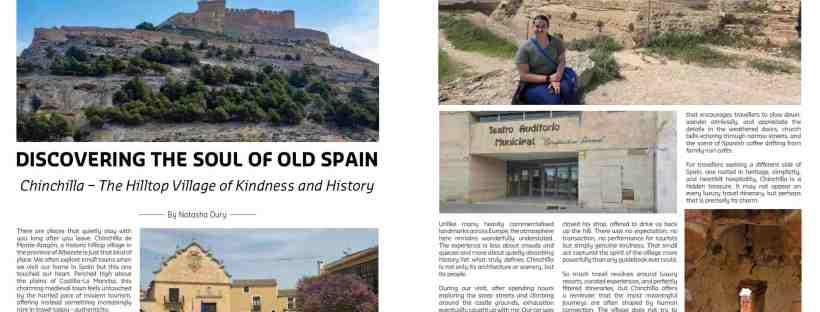
There are places that quietly stay with you long after you leave. Chinchilla de Monte-Aragón, a historic hilltop village in the province of Albacete is just that kind of place. We often explore small towns when we visit our home in Spain but this one touched our heart. Perched high above the plains of Castilla–La Mancha, this charming medieval town feels untouched by the hurried pace of modern tourism, offering instead something increasingly rare in travel today – authenticity.

Arriving in Chinchilla feels like stepping into another era. Narrow stone streets wind gently through the village, opening onto hidden squares, rustic homes, and panoramic viewpoints that stretch endlessly across the Spanish landscape. Above it all rises the magnificent Castle of Chinchilla, its imposing stone walls watching over the town like a guardian from centuries past.

The castle itself is breathtaking. Built between the 15th and 16th centuries on the remains of earlier Moorish fortifications, it carries the layered history of Spain within its walls. Standing near the fortress, with the wind moving across the hilltops and golden light washing over the old stone, there is a stillness that feels deeply cinematic.

Unlike many heavily commercialised landmarks across Europe, the atmosphere here remains wonderfully understated. The experience is less about crowds and queues and more about quietly absorbing history.Yet what truly defines Chinchilla is not only its architecture or scenery, but its people.

During our visit, after spending hours exploring the steep streets and climbing around the castle grounds, exhaustion eventually caught up with me. Our car was parked further uphill, taxis were nowhere to be found, and the climb back felt far more daunting under the afternoon sun. In many destinations, this would simply become one of those inconvenient travel moments quickly forgotten. In Chinchilla, it became something unforgettable.

The local Mercado shopkeeper, noticing our situation, did something extraordinary in its simplicity. Without hesitation, he closed his shop, offered to drive us back up the hill. There was no expectation, no transaction, no performance for tourists but simply genuine kindness. That small act captured the spirit of the village more powerfully than any guidebook ever could.

So much travel revolves around luxury resorts, curated experiences, and perfectly filtered itineraries, but Chinchilla offers a reminder that the most meaningful journeys are often shaped by human connection. The village does not try to impress loudly. Instead, it reveals itself slowly through warm conversations, old-world hospitality, and moments that feel deeply personal.

The beauty of Chinchilla also lies in its rhythm. Life moves differently here. Locals gather casually in cafés, conversations linger in quiet squares, and evenings arrive with golden sunsets spilling across ancient rooftops. It is the kind of place that encourages travellers to slow down, wander aimlessly, and appreciate the details in the weathered doors, church bells echoing through narrow streets, and the scent of Spanish coffee drifting from family-run cafés.

For travellers seeking a different side of Spain, one rooted in heritage, simplicity, and heartfelt hospitality, Chinchilla is a hidden treasure. It may not appear on every luxury travel itinerary, but perhaps that is precisely its charm.

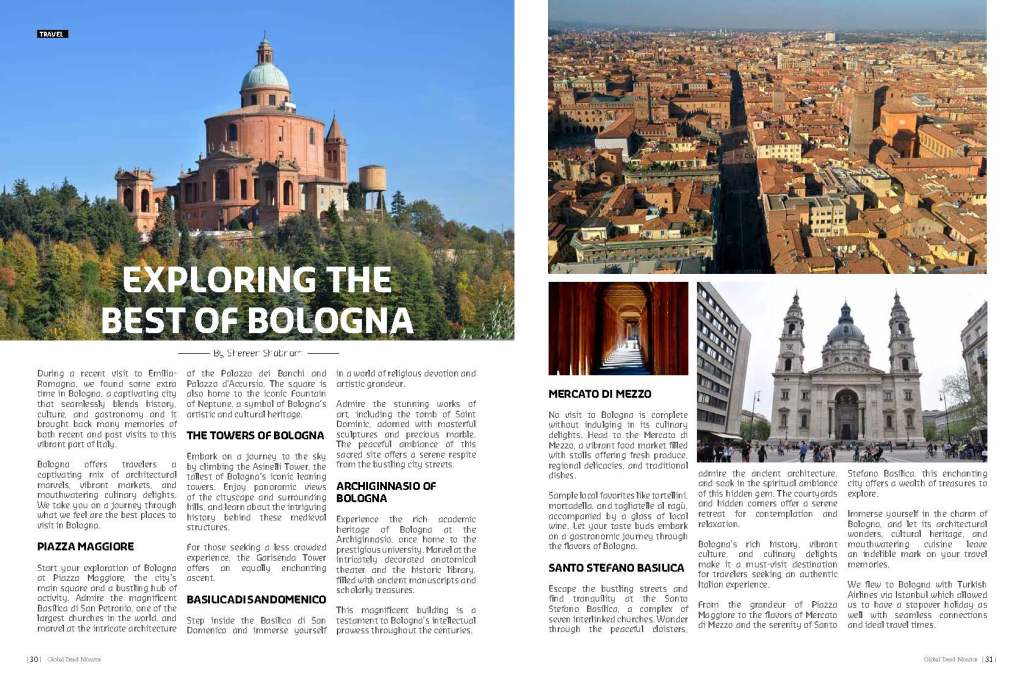
Exploring the Best of Bologna

Shereen Shabnam

During a recent visit to Emilia-Romagna, we found some extra time in Bologna, a captivating city that seamlessly blends history, culture, and gastronomy and it brought back many memories of both recent and past visits to this vibrant part of Italy.

Bologna offers travelers a captivating mix of architectural marvels, vibrant markets, and mouthwatering culinary delights. We take you on a journey through what we feel are the best places to visit in Bologna.

Piazza Maggiore

Start your exploration of Bologna at Piazza Maggiore, the city’s main square and a bustling hub of activity. Admire the magnificent Basilica di San Petronio, one of the largest churches in the world, and marvel at the intricate architecture of the Palazzo dei Banchi and Palazzo d’Accursio. The square is also home to the iconic Fountain of Neptune, a symbol of Bologna’s artistic and cultural heritage.

The Towers of Bologna

Embark on a journey to the sky by climbing the Asinelli Tower, the tallest of Bologna’s iconic leaning towers. Enjoy panoramic views of the cityscape and surrounding hills, and learn about the intriguing history behind these medieval structures. For those seeking a less crowded experience, the Garisenda Tower offers an equally enchanting ascent.

Basilica di San Domenico

Step inside the Basilica di San Domenico and immerse yourself in a world of religious devotion and artistic grandeur. Admire the stunning works of art, including the tomb of Saint Dominic, adorned with masterful sculptures and precious marble. The peaceful ambiance of this sacred site offers a serene respite from the bustling city streets.

Archiginnasio of Bologna

Experience the rich academic heritage of Bologna at the Archiginnasio, once home to the prestigious university. Marvel at the intricately decorated anatomical theater and the historic library, filled with ancient manuscripts and scholarly treasures. This magnificent building is a testament to Bologna’s intellectual prowess throughout the centuries.

Mercato di Mezzo

No visit to Bologna is complete without indulging in its culinary delights. Head to the Mercato di Mezzo, a vibrant food market filled with stalls offering fresh produce, regional delicacies, and traditional dishes. Sample local favorites like tortellini, mortadella, and tagliatelle al ragù, accompanied by a glass of local wine. Let your taste buds embark on a gastronomic journey through the flavors of Bologna.

Santo Stefano Basilica

Escape the bustling streets and find tranquility at the Santo Stefano Basilica, a complex of seven interlinked churches. Wander through the peaceful cloisters, admire the ancient architecture, and soak in the spiritual ambiance of this hidden gem. The courtyards and hidden corners offer a serene retreat for contemplation and relaxation.

Bologna’s rich history, vibrant culture, and culinary delights make it a must-visit destination for travelers seeking an authentic Italian experience. From the grandeur of Piazza Maggiore to the flavors of Mercato di Mezzo and the serenity of Santo Stefano Basilica, this enchanting city offers a wealth of treasures to explore.

Immerse yourself in the charm of Bologna, and let its architectural wonders, cultural heritage, and mouthwatering cuisine leave an indelible mark on your travel memories. We flew to Bologna with Turkish Airlines via Istanbul which allowed us to have a stopover holiday as well with seamless connections and ideal travel times.