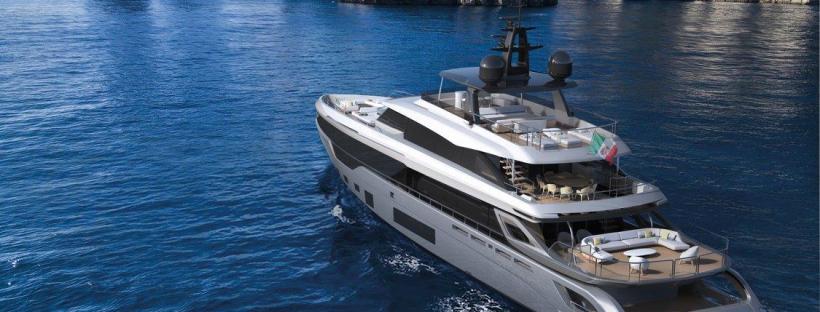
Pushing Boundaries:Azimut Grande Trideck

Not only the first three-deck yacht built by Azimut Yachts, but also its largest to date, the Grande Trideck exemplifies the Italian brand’s capacity for pushing the boundaries of design, style and construction.

The exterior design by Alberto Mancini introduces a host of innovations in terms of layout, each of which is not only the consequence of a particular design choice, but also inspires or creates further artful and original features. The idea of including an aft raised cockpit, for example, led to the development of new outdoor areas with unexpected concepts, functions and characteristics.

The interiors are designed by Achille Salvagni, who has moved away from the traditional arrangement of on-board spaces to create an environment that reflects the lifestyle of today’s owner who is seeking versatility, informality and somewhere they can truly relax and entertain guests in comfort. On that note, there is also an option of a sixth cabin on the upper deck.

The water lines are by Pierluigi Ausonio’s firm P.l.a.n.a., with a D2P® Displacement to Planing hull designed together with the Azimut Research and Development centre guaranteeing maximum efficiency at all speeds.

When it came to designing the layout of this 38.2-metre long, 7.9-metre wide yacht, the rule book was completely rewritten, and the result is a series of informal, dynamic and versatile spaces, perfect for the contemporary owner who sees their boat as a convivial place for socialising and hosting guests in a relaxed setting.

As one would expect from an Azimut flagship, the exterior lines are elegant and dynamic, but the twist comes in the form of a raised deck in the stern that creates a series of unprecedented new exterior spaces, strategically spaced out around the boat. With so many options, both owner and guests are spoilt for choice, whether they are looking to seek out quiet moments alone or spend time together in a convivial, comfortable setting.

The central idea around which the design develops is clear from the moment you step on board: the Trideck welcomes guests from the central gangway directly onto the Aft Raised Deck, which could be described almost as a mezzanine that sits slightly above the Main Deck.  The creation of this raised deck in turn opened the door to a trio of new zones: a Sea View Terrace, Beach Club and Private Patio.

Clever styling gives the exterior lines a lighter feel, creating a sensation of dynamism that is far from easy to achieve on a boat this size. The sides of the yacht are given a sense of movement and tension by the ribbing that runs continuously from the stern right through to the bow, while the exhausts and fairleads become design.

Achille Salvagni has wholeheartedly embraced Azimut’s challenge to redefine the role of space by rethinking the traditional functions of many of the boat’s areas. In completely reconsidering the way many of the internal spaces are used and abandoning preconceptions and established norms, the boat becomes a more fluid, informal environment, and a space that is genuinely conducive to relaxing. This is fostered by the way in which the height and width of the interiors are amplified, and the seamless integration with exterior zones so that they seem to flow into each other.

This atmosphere that encourages owners and guests alike to completely let go of the world outside and give themselves up to total relaxation is also a result of Salvagni’s décor, which builds on the fluidity of space, inhabiting the interiors so that they appear sculpted rather than simply filled.

The interiors also contain surprises from a layout point of view, with a private patio on the main deck fitted out as a sheltered lounge area providing access to an indoor lounge. The cut of the bow at two different angles offers a dynamic look without compromising on space by optimising the interior volumes.

The D2P® Displacement to Planing hull is designed by Pierluigi Ausonio in collaboration with the Azimut Research and Development centre, making use of proprietary CFD software, FEM analysis and tank testing. The double chine hull reduces drag at cruising speed and improves stability during displacement navigation. With two engine options rated 2400 or 2600 mHP, the Trideck delivers a top speed of 23 or 24 knots.

The entire superstructure is laminated in carbon fibre, with added vinylester and epoxy resin. This reduces the yacht’s overall weight significantly, while the combination of the D2P® hull and the carbon fibre superstructure delivers a considerable improvement in performance, with reduced consumption accompanied by greater speed and range.

Fortinet Recognized as a Visionary in the 2020 Gartner Magic Quadrant for Wired and Wireless LAN Access Infrastructure

Fortinet is the Only Company to Converge Network Security and the LAN Edge

News Summary

Fortinet® (NASDAQ: FTNT), a global leader in broad, integrated and automated cybersecurity solutions, today announced its position as a Visionary in the 2020 Gartner Magic Quadrant for Wired and Wireless LAN Access Infrastructure.

  • Gartner defines a vendor in the Visionaries Quadrantas one that “demonstrates an ability to increase features in its offering to provide a unique and differentiated approach to the market. A Visionary will have innovated in one or more of the key areas of access layer technologies within the enterprise (for example, security, management or operational efficiency). The ability to apply differentiating functionality across the entire access layer will affect its position.”
  • Fortinet believes this placement, coupled with the cybersecurity provider’s legacy as an innovator, is further reinforcement that Fortinet and its Security-driven Networking strategy delivers a unique and differentiated approach to the infrastructure market. 
  • Fortinet’s Security-driven Networking approach to wired and wireless networking provides customers with a feature-rich offering that is secure by design and not by add-on, integrates into a larger platform to reduce complexity, and increases features without additional licensing to best address IT’s long-term TCO goals.

John Maddison, EVP of Products and CMO at Fortinet said, “LAN Edge connectivity is foundational to digital innovation, but complexity often makes it difficult to support and secure. Fortinet technology simplifies management while increasing the security of the network by tightly integrating an organization’s network infrastructure and security architecture.  We believe that our ability to execute our Security-driven Networking approach enables us to offer customers a simplified, secure, accelerated network and user experience. More, we also believe our Security-driven Networking approach is why Fortinet is placed as one of two companies in the Visionary Quadrant in the 2020 Gartner Wired and Wireless LAN Access Infrastructure Magic Quadrant.”

Highlights

Fortinet’s vision is based upon the key tenets of:

  • Reduced Cost: Fortinet LAN Edge solutions reduce overall TCO and eliminates overlays by bundling features into FortiGate Next-generation Firewalls without the need for licenses. No additional license or cost is required to enable LAN Edge management, and even Network Access Control (NAC) features can be enabled and leveraged without the need for additional costly licenses.
  • Simplified Management: Fortinet LAN Edge solutions simplify management by utilizing a single management platform for LAN and network security. IT cycles are minimized by having a consolidated location to manage various aspects of the network.
  • Reduced Complexity: Fortinet LAN Edge solutions reduce complexity by centralizing LAN management and security functions into the FortiGate Next-generation Firewall. A single view of complex LAN networks makes for easier management with less worry about unintended disruptions​.

Fortinet’s approach enables a unique take on the LAN edge that leverages FortiGate Next-generation Firewall capabilities as a network controller, offering consolidated visibility and centralized management and reporting to ease management and simplify deployment and provisioning.

Fortinet Solves Customers’ Biggest LAN Challenges
Fortinet has been named a Gartner Peer Insights Customers’ Choice for Wired and Wireless LAN Access Infrastructure [1] for three years in a row. This Gartner Customers’ Choice recognition is based on the ranking of vendors by verified end-user professionals – both the number of end-user reviews and the vendor’s overall user rating are considered when determining these rankings. Fortinet believes that this additional customer validation further highlights that Fortinet’s simple, secure, and scalable approach to LAN Edge resonates with customers. Building off the power of Security-driven Networking and our industry-leading FortiGate Next-generation Firewall, Fortinet offers a LAN Edge solution that can scale to any deployment’s needs, from campus to branch to the remote worker.

  • Campus Networks: Fortinet’sLAN Edge solution creates a single consolidated configuration reducing the chance for error, and a common platform for day-to-day management of network and security. Security-driven Networking eliminates the need for additional “bolt on” solutions to integrate management and security functions.
  • SD-Branch: Security-driven Networking approach to LAN Edge allows consolidation of the three main components of the branch network (SD-WAN, Firewall/Security, and the network layer) into a single standard platform for all branches. This simplifies remote oversight and administration of distributed sites to a single converged solution per site.
  • Teleworker: Fortinet’s Security-driven Networking approach to LAN Edge works forremote wireless Access Points as well. Leveraging a central FortiGate at headquarters reduces configuration and management complexity for IT while allowing remote users to have the same experience as connecting at a corporate office.

The Knowledge Hub Pioneers Innovative Digital Learning Experiences in Egypt with Help of Aruba Technology

The Knowledge Hub Universities is a multidisciplinary educational hub hosting branches of world-class universities, each to participate with undergraduate courses in their areas of strength, providing an intellectually stimulating, enriching, and credible educational experience. TKH has deployed state of the art wired and wireless networking technology from Aruba, a Hewlett Packard Enterprise company. The solution enables utilisation of the latest digital learning tools and connected campus security systems. It offers a convenient ‘Guest Portal’ for rapid, secure and controlled internet access and delights users with seamless roaming across the campus. Network performance issues or negative feedback from staff and students have been eliminated and the system enables seamless centralised management of networks across the entire campus.

TKH was established with the purpose of offering quality learning experiences, through the development of sustainable world-class educational institutions with state-of-the-art facilities to maximize community impact. The institution aims to be a hub for world-class education in Egypt through the use of cutting-edge digital learning tools, delivered in a convenient, secure and reliable manner.

“Our flagship initiative has been setting up a multidisciplinary educational hub that host branches of leading international universities, delivering the same academic programmes offered at their mother campus and thus leading to the same, exact qualification and degrees. Providing students with the same quality of experience is pivotal to this, and technology is a fundamental enabler of these world-class experiences,” explained Hossam Ismail, IT Network Lead.

Recognising that mobility and pervasive connectivity would be essential to implementing the innovations they intended to roll out at the University, TKH’s IT team selected Aruba as their networking technology partner. “We needed exceptional wireless coverage across the entire campus,” said Ismail. “To protect the digital identities and activities of our students and staff, security was also a key requirement and Aruba was a clear industry leader in both these areas. We will be introducing several internationally acclaimed educational institutions to the region and need to ensure our environment is flexible, scalable and built on open standards. Aruba ticked all these boxes.”

Starting with the first phase of TKH, consisting of different buildings with more than 60 classrooms, 20 lecture halls & workshops and 250 staff offices as well as recreational facilities and common areas, Ismail and his IT team worked closely with Aruba to implement Layer 3 switching and wireless Access Points (APs).

“We selected Wi-Fi 6 capable solutions because as a University, we are constantly introducing the very latest innovations to ensure our students & staff have rapid access to the cutting-edge digital technologies,” said Ismail.

To deliver secure access for professors and admin staff while providing convenient wireless connectivity for visitors and guests, and to facilitate bring your own device (BYOD) for students in a controlled and uncompromisingly secure manner, the University implemented Aruba ClearPass. Ismail and his team also decided to leverage Airwave Network Management to centrally monitor and manage the entire network so that the quality and integrity of services could be maintained at consistently high levels.

For Ismail and his team, the decision to partner with Aruba has paid dividends on multiple fronts – with world-class solution design and logistics support, the flexibility to repurpose investments, and a rapid realisation of ROI on the first phase, being highlights of the engagement.

Despite the impact of COVID-19 and logistical challenges, the implementation was completed within just 8-10 weeks.

To deliver its digitally oriented curriculum, TKH makes use of several digital tools including a Learning Management System (LMS). “The Aruba solution allows students and staff to have seamless, uninterrupted access to these essential learning tools. Moreover, through orchestrated and automated user and devices authentication via ClearPass, they can use these applications on their own personal devices which greatly aids adoption and utilisation,” said Ismail.

Also using ClearPass, his team has set up a ‘Guest Portal’ that conveniently authenticates staff and students based on the same credentials registered in the University’s Active Directory. Moreover, Aruba’s solution ensures compliance by automatically conducting a health check on all devices trying to connect to the network. “If any vulnerabilities are detected, the system automatically takes remediation steps such as performing operating system and software updates. This ensures that every device that connects to our network is authenticated and secure,” said Ismail.

Based on the ‘exceptional’ experience that the University has had with Aruba – both from a technical as well as a support perspective – Ismail and his team are keen to deepen their engagement. “From implementation through to daily operation, we have never faced even a single issue with our Aruba network. This kind of performance and reliability is rare with technology deployments,” he said.

TKH is already in discussion with Aruba to extend the network for the upcoming phase of the project which will involve expansion into a further five buildings. “Our students and staff are incredibly happy with the performance and convenience of our network and associated digital services. This gives us the confidence to keep introducing Aruba solutions and new innovations that set our University apart as a pioneer,” concluded Ismail.