Discovering the Soul of Old Spain

Chinchilla – The Hilltop Village of Kindness and History

Natasha Dury

There are places that quietly stay with you long after you leave. Chinchilla de Monte-Aragón, a historic hilltop village in the province of Albacete is just that kind of place. We often explore small towns when we visit our home in Spain but this one touched our heart. Perched high above the plains of Castilla–La Mancha, this charming medieval town feels untouched by the hurried pace of modern tourism, offering instead something increasingly rare in travel today – authenticity.

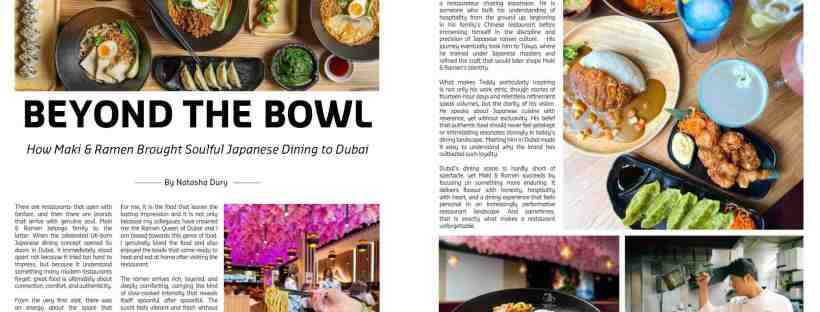
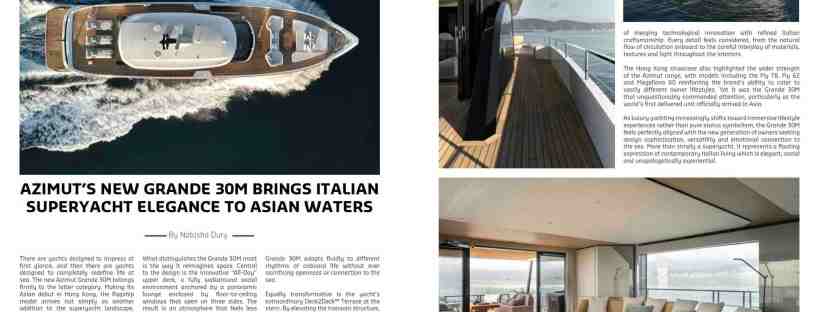
Arriving in Chinchilla feels like stepping into another era. Narrow stone streets wind gently through the village, opening onto hidden squares, rustic homes, and panoramic viewpoints that stretch endlessly across the Spanish landscape. Above it all rises the magnificent Castle of Chinchilla, its imposing stone walls watching over the town like a guardian from centuries past.

The castle itself is breathtaking. Built between the 15th and 16th centuries on the remains of earlier Moorish fortifications, it carries the layered history of Spain within its walls. Standing near the fortress, with the wind moving across the hilltops and golden light washing over the old stone, there is a stillness that feels deeply cinematic.

Unlike many heavily commercialised landmarks across Europe, the atmosphere here remains wonderfully understated. The experience is less about crowds and queues and more about quietly absorbing history.Yet what truly defines Chinchilla is not only its architecture or scenery, but its people.

During our visit, after spending hours exploring the steep streets and climbing around the castle grounds, exhaustion eventually caught up with me. Our car was parked further uphill, taxis were nowhere to be found, and the climb back felt far more daunting under the afternoon sun. In many destinations, this would simply become one of those inconvenient travel moments quickly forgotten. In Chinchilla, it became something unforgettable.

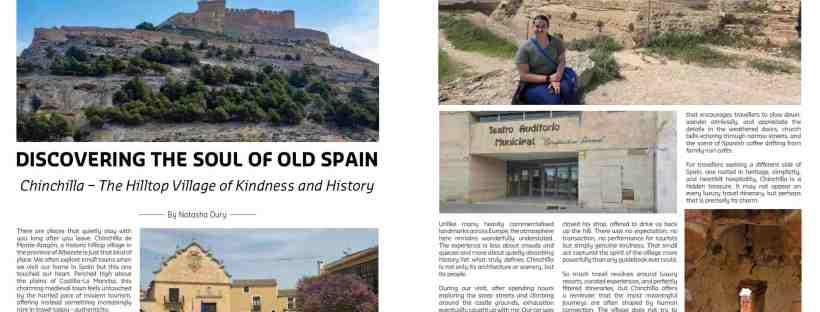
The local Mercado shopkeeper, noticing our situation, did something extraordinary in its simplicity. Without hesitation, he closed his shop, offered to drive us back up the hill. There was no expectation, no transaction, no performance for tourists but simply genuine kindness. That small act captured the spirit of the village more powerfully than any guidebook ever could.

So much travel revolves around luxury resorts, curated experiences, and perfectly filtered itineraries, but Chinchilla offers a reminder that the most meaningful journeys are often shaped by human connection. The village does not try to impress loudly. Instead, it reveals itself slowly through warm conversations, old-world hospitality, and moments that feel deeply personal.

The beauty of Chinchilla also lies in its rhythm. Life moves differently here. Locals gather casually in cafés, conversations linger in quiet squares, and evenings arrive with golden sunsets spilling across ancient rooftops. It is the kind of place that encourages travellers to slow down, wander aimlessly, and appreciate the details in the weathered doors, church bells echoing through narrow streets, and the scent of Spanish coffee drifting from family-run cafés.

For travellers seeking a different side of Spain, one rooted in heritage, simplicity, and heartfelt hospitality, Chinchilla is a hidden treasure. It may not appear on every luxury travel itinerary, but perhaps that is precisely its charm.

Royal Bahrain Concours Returns for 2026

A Celebration of Automotive Elegance, Luxury Lifestyle and Global Collecting Culture

Natasha Dury

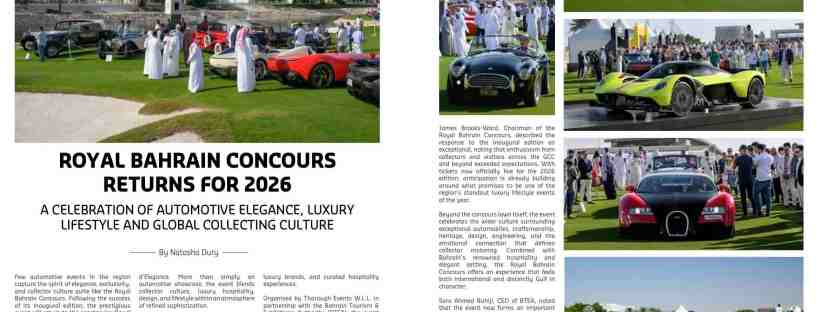
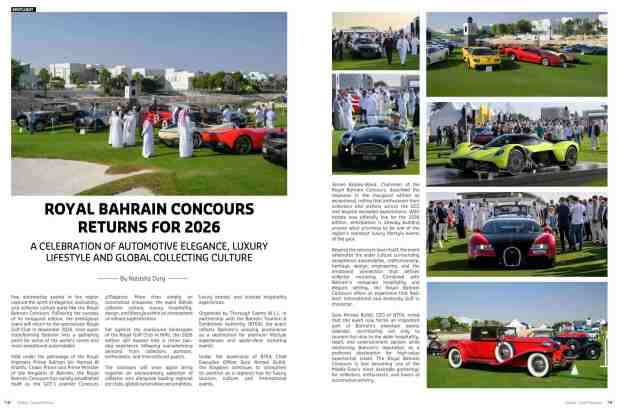
Few automotive events in the region capture the spirit of elegance, exclusivity, and collector culture quite like the Royal Bahrain Concours. Following the success of its inaugural edition, the prestigious event will return to the spectacular Royal Golf Club in November 2026, once again transforming Bahrain into a gathering point for some of the world’s rarest and most exceptional automobiles.

Held under the patronage of His Royal Highness Prince Salman bin Hamad Al Khalifa, Crown Prince and Prime Minister of the Kingdom of Bahrain, the Royal Bahrain Concours has rapidly established itself as the GCC’s premier Concours d’Elegance. More than simply an automotive showcase, the event blends collector culture, luxury hospitality, design, and lifestyle within an atmosphere of refined sophistication.

Set against the manicured landscapes of the Royal Golf Club in Riffa, the 2026 edition will expand into a richer two-day experience following overwhelming demand from collectors, partners, enthusiasts, and international guests. The concours will once again bring together an extraordinary selection of collector cars alongside leading regional car clubs, global automotive personalities, luxury brands, and curated hospitality experiences.

Organised by Thorough Events W.L.L. in partnership with the Bahrain Tourism & Exhibitions Authority (BTEA), the event reflects Bahrain’s growing prominence as a destination for premium lifestyle experiences and world-class motoring events. Under the leadership of BTEA Chief Executive Officer Sara Ahmed Buhiji, the Kingdom continues to strengthen its position as a regional hub for luxury tourism, culture, and international events.

James Brooks-Ward, Chairman of the Royal Bahrain Concours, described the response to the inaugural edition as exceptional, noting that enthusiasm from collectors and visitors across the GCC and beyond exceeded expectations. With tickets now officially live for the 2026 edition, anticipation is already building around what promises to be one of the region’s standout luxury lifestyle events of the year.

Beyond the concours lawn itself, the event celebrates the wider culture surrounding exceptional automobiles, craftsmanship, heritage, design, engineering, and the emotional connection that defines collector motoring. Combined with Bahrain’s renowned hospitality and elegant setting, the Royal Bahrain Concours offers an experience that feels both international and distinctly Gulf in character.

Sara Ahmed Buhiji, CEO of BTEA, noted that the event now forms an important part of Bahrain’s premium events calendar, contributing not only to tourism but also to the wider hospitality, retail, and entertainment sectors while reinforcing Bahrain’s reputation as a preferred destination for high-value experiential travel. The Royal Bahrain Concours is fast becoming one of the Middle East’s most desirable gatherings for collectors, enthusiasts, and lovers of automotive artistry.

Parmigiani Fleurier Captures the Spirit of Alpine Elegance

The TONDA PF Sport Chronograph Silver Verzasca Blends Precision with Refined Luxury

Shereen Shabnam

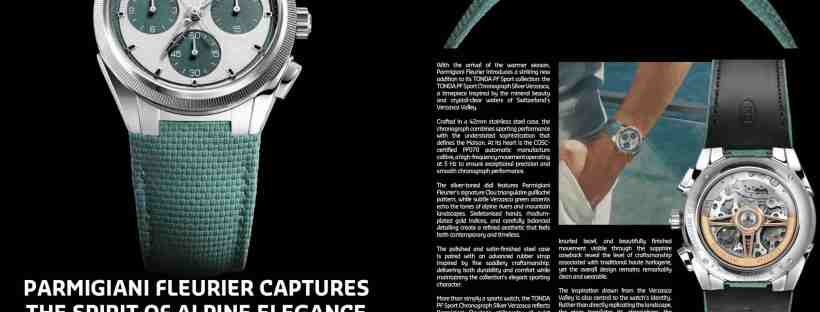
With the arrival of the warmer season, Parmigiani Fleurier introduces a striking new addition to its TONDA PF Sport collection: the TONDA PF Sport Chronograph Silver Verzasca, a timepiece inspired by the mineral beauty and crystal-clear waters of Switzerland’s Verzasca Valley.

Crafted in a 42mm stainless steel case, the chronograph combines sporting performance with the understated sophistication that defines the Maison. At its heart is the COSC-certified PF070 automatic manufacture calibre, a high-frequency movement operating at 5 Hz to ensure exceptional precision and smooth chronograph performance.

The silver-toned dial features Parmigiani Fleurier’s signature Clou triangulaire guilloché pattern, while subtle Verzasca green accents echo the tones of alpine rivers and mountain landscapes. Skeletonised hands, rhodium-plated gold indices, and carefully balanced detailing create a refined aesthetic that feels both contemporary and timeless.

The polished and satin-finished steel case is paired with an advanced rubber strap inspired by fine saddlery craftsmanship, delivering both durability and comfort while maintaining the collection’s elegant sporting character.

More than simply a sports watch, the TONDA PF Sport Chronograph Silver Verzasca reflects Parmigiani Fleurier’s philosophy of quiet luxury, where performance, craftsmanship, and design exist in complete harmony. Equally suited to a mountain escape or an elegant dinner setting, the watch captures a lifestyle defined not by excess, but by precision, balance, and effortless refinement.

What makes the Silver Verzasca particularly compelling is its ability to merge technical intensity with visual restraint. The chronograph’s integrated architecture, knurled bezel, and beautifully finished movement visible through the sapphire caseback reveal the level of craftsmanship associated with traditional haute horlogerie, yet the overall design remains remarkably clean and wearable.

The inspiration drawn from the Verzasca Valley is also central to the watch’s identity. Rather than directly replicating the landscape, the piece translates its atmosphere, the clarity of alpine light, the movement of water over polished stone, and the calm elegance of the Swiss outdoors into colour, texture, and proportion.

For collectors and enthusiasts who appreciate subtle sophistication over overt statement-making, the TONDA PF Sport Chronograph Silver Verzasca offers a modern interpretation of luxury sports watchmaking: refined, highly engineered, and quietly confident.

The One Atelier Unveils The One Capital as Tokenisation Reshapes Luxury Real Estate

Natasha Dury

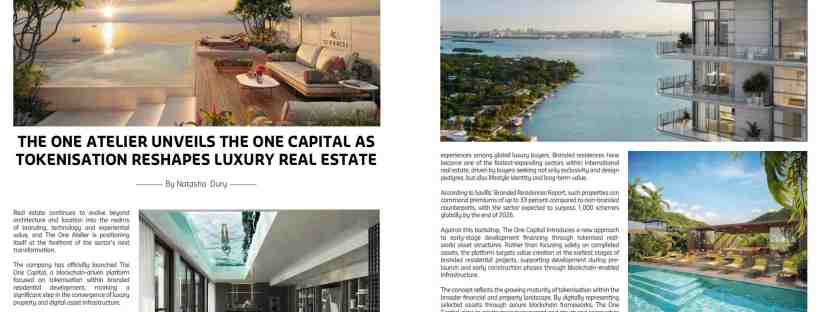
Real estate continues to evolve beyond architecture and location into the realms of branding, technology and experiential value, and The One Atelier is positioning itself at the forefront of the sector’s next transformation. The company has officially launched The One Capital, a blockchain-driven platform focused on tokenisation within branded residential development, marking a significant step in the convergence of luxury property and digital asset infrastructure.

The initiative builds upon The One Atelier’s growing portfolio of internationally recognised branded residential projects associated with some of the world’s most influential luxury names, including Karl Lagerfeld, Fendi Casa, ETRO, Armani Casa, ELLE and Dolce & Gabbana. Many of these developments have demonstrated notable value appreciation between early launch phases and market maturity, reinforcing the increasing demand for branded living experiences among global luxury buyers.

Branded residences have become one of the fastest-expanding sectors within international real estate, driven by buyers seeking not only exclusivity and design pedigree, but also lifestyle identity and long-term value. According to Savills’ Branded Residences Report, such properties can command premiums of up to 33 percent compared to non-branded counterparts, with the sector expected to surpass 1,000 schemes globally by the end of 2026.

Against this backdrop, The One Capital introduces a new approach to early-stage development financing through tokenised real-world asset structures. Rather than focusing solely on completed assets, the platform targets value creation at the earliest stages of branded residential projects, supporting development during pre-launch and early construction phases through blockchain-enabled infrastructure.

The concept reflects the growing maturity of tokenisation within the broader financial and property landscape. By digitally representing selected assets through secure blockchain frameworks, The One Capital aims to create more transparent and structured approaches to capital deployment while maintaining the governance and quality standards expected within ultra-luxury development.

For developers, the platform presents an alternative financing route capable of strengthening early cash flow structures and supporting project alignment from inception. The emphasis remains firmly on structure, transparency and long-term value creation rather than speculative technology narratives that have often overshadowed blockchain discussions in the past.

The launch also signals a wider transformation underway within branded real estate itself. Once viewed primarily as hospitality-adjacent luxury developments, branded residences are increasingly becoming sophisticated investment ecosystems where design, technology, lifestyle and finance intersect. In this context, The One Capital shows how luxury property development is adapting to a more digitally connected and globally fluid financial landscape.

Art Dubai at 20 as it Helps Shape a Cultural Capital

Natasha Dury

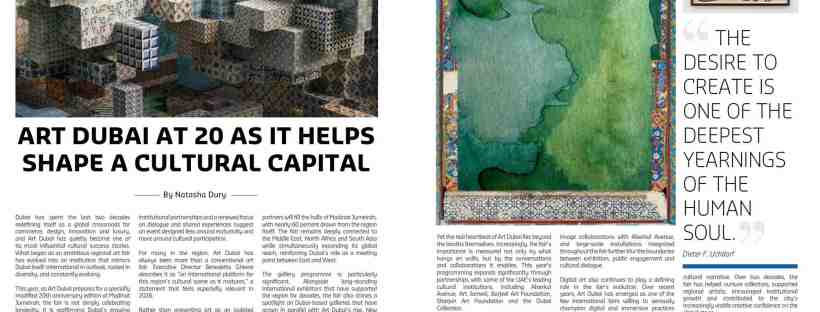
Dubai has spent the last two decades redefining itself as a global crossroads for commerce, design, innovation and luxury, and Art Dubai has quietly become one of its most influential cultural success stories. What began as an ambitious regional art fair has evolved into an institution that mirrors Dubai itself: international in outlook, rooted in diversity, and constantly evolving. This year, as Art Dubai prepares for a specially modified 20th anniversary edition at Madinat Jumeirah, the fair is not simply celebrating longevity. It is reaffirming Dubai’s growing confidence as one of the world’s most dynamic cultural capitals.

The special edition arrives during a moment of global uncertainty for the art market, yet its tone is notably optimistic. Presented in partnership with A.R.M. Holding, with Dubai Culture & Arts Authority serving as strategic partner, the fair places collaboration, accessibility and resilience at the centre of its vision. Free public entry, expanded institutional partnerships and a renewed focus on dialogue and shared experiences suggest an event designed less around exclusivity and more around cultural participation.

For many in the region, Art Dubai has always been more than a conventional art fair. Executive Director Benedetta Ghione describes it as “an international platform for this region’s cultural scene as it matures,” a statement that feels especially relevant in 2026. Rather than presenting art as an isolated luxury commodity, Art Dubai continues to position itself as part of a wider creative ecosystem, bringing together artists, galleries, collectors, institutions and audiences in ways few fairs globally have managed to sustain.

This year’s special edition reflects that ambition through a carefully curated programme spanning contemporary, modern and digital art practices. Around 75 presentations from galleries, institutions and partners will fill the halls of Madinat Jumeirah, with nearly 60 percent drawn from the region itself. The fair remains deeply connected to the Middle East, North Africa and South Asia while simultaneously expanding its global reach, reinforcing Dubai’s role as a meeting point between East and West.

The gallery programme is particularly significant. Alongside long-standing international exhibitors that have supported the region for decades, the fair also shines a spotlight on Dubai-based galleries that have grown in parallel with Art Dubai’s rise. New exhibitors join established names, creating a blend of emerging voices and internationally recognised institutions that reflects the city’s increasingly sophisticated cultural identity. In a notable response to current market pressures, the fair has also introduced an innovative risk-sharing model where gallery booth costs are linked to sales success, a move that underscores Art Dubai’s reputation for experimentation and adaptability.

Yet the real heartbeat of Art Dubai lies beyond the booths themselves. Increasingly, the fair’s importance is measured not only by what hangs on walls, but by the conversations and collaborations it enables. This year’s programming expands significantly through partnerships with some of the UAE’s leading cultural institutions, including Alserkal Avenue, Art Jameel, Barjeel Art Foundation, Sharjah Art Foundation and the Dubai Collection.

Among the highlights is “Made Forward,” a major presentation from Dubai Collection, the city’s first institutional collection of modern and contemporary art. Elsewhere, the 20th edition of the Global Art Forum, commissioned by Shumon Basar under the title “Before and After Everything,” promises the kind of cross-disciplinary discussions that have become synonymous with Art Dubai’s identity. Performance-led programming curated with Sharjah Art Foundation, moving-image collaborations with Alserkal Avenue, and large-scale installations integrated throughout the fair further blur the boundaries between exhibition, public engagement and cultural dialogue.

Digital art also continues to play a defining role in the fair’s evolution. Over recent years, Art Dubai has emerged as one of the few international fairs willing to seriously champion digital and immersive practices beyond trend-driven novelty. Its continued emphasis on digital culture reflects Dubai’s own future-facing mindset, positioning the city at the forefront of conversations surrounding technology, creativity and cultural production.

What makes this year especially compelling, however, is the sense of reflection underpinning the anniversary edition. There is a recognition that Art Dubai’s journey has become inseparable from Dubai’s broader cultural narrative. Over two decades, the fair has helped nurture collectors, supported regional artists, encouraged institutional growth and contributed to the city’s increasingly visible creative confidence on the global stage.

In many ways, the fair’s evolution mirrors Dubai’s own transformation. Both began as ambitious propositions often underestimated by outsiders. Both have grown through boldness, adaptability and a willingness to challenge conventional models. And both now occupy a position where global attention is no longer about potential, but influence.

The desire to create is one of the deepest yearnings of the human soul.” 

– Dieter F. Uchdorf-

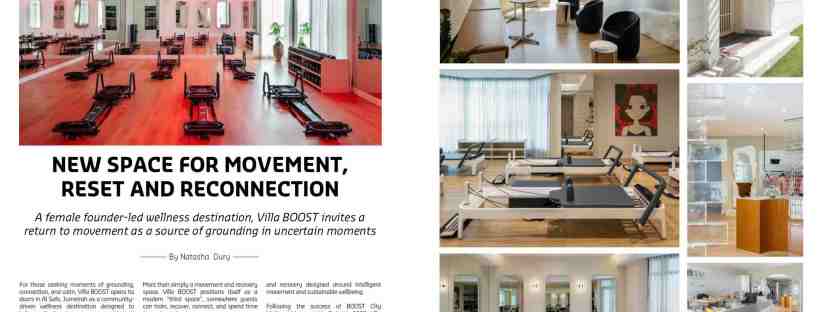
New Space for Movement, Reset and Reconnection

A female founder-led wellness destination, Villa BOOST invites a return to movement as a source of grounding in uncertain moments.

Natasha Dury

For those seeking moments of grounding, connection, and calm, Villa BOOST opens its doors in Al Safa, Jumeirah as a community-driven wellness destination designed to help people slow down, reconnect with their bodies, and return to mindful movement.

Founded by entrepreneur and wellness advocate Rania Zorkot alongside partner and brand ambassador Christelle Fourzali, Villa BOOST blends reformer and Lagree-inspired training with recovery-focused experiences and lifestyle-led wellness within an intimate villa setting designed to feel more like a home than a traditional studio.

More than simply a movement and recovery space, Villa BOOST positions itself as a modern “third space”, somewhere guests can train, recover, connect, and spend time throughout the day.

The concept builds on Rania’s long-standing philosophy around movement as both physical and mental grounding. More than a decade ago, she introduced Reformer Pilates to Abidjan through her first concept, FORM, cultivating a loyal community through results-driven training and a deeply personal approach to wellness.

That journey later evolved into the BOOST method, a balanced fusion of Pilates, Lagree, strength, and recovery designed around intelligent movement and sustainable wellbeing. Following the success of BOOST City Walk, which opened in Dubai in 2022, Villa BOOST expands the concept through a more immersive lifestyle experience shaped equally by community and mindful living.

The villa offers a curated mix of Reformer Pilates, Megaformer and Microformer sessions, infrared heated workouts, Cadillac Pilates, sculpt and conditioning classes, mobility training, assisted stretching, red light therapy, and Brazilian lymphatic massage in partnership with Lymph & Flow.

Beyond movement, guests can also experience TEASE, the villa’s wellness café serving functional smoothies and nutrient-rich drinks, alongside The Sweatshop, a retail concept featuring carefully selected international activewear and athleisure brands.

House of Samra Opens Its Doors to Emirati Jewellery Talent

A New Retail Initiative Bringing Local Design into Dubai’s Luxury Shopping Landscape

Natasha Dury

We live in an ecosystem that is celebrated for its luxury retail experiences and global fashion presence and House of Samra is turning the spotlight toward homegrown creativity with the launch of House of Samra: Emirati Talent Showcase, a new initiative created in collaboration with Mohammed Bin Rashid Establishment for Small and Medium Enterprises Development.

Designed to support emerging Emirati jewellery designers, the programme reflects a growing movement within the UAE’s retail landscape, one that increasingly values local craftsmanship, cultural identity, and entrepreneurial innovation alongside international luxury.

At the heart of the initiative is a simple yet powerful concept: giving Emirati designers direct access to premium retail environments and luxury consumers. Through the programme, selected jewellery designers will showcase their collections inside House of Samra boutiques located across some of Dubai’s most prestigious shopping destinations, including Dubai Mall, Mall of the Emirates, Dubai Hills Mall, and Dubai Festival City Mall.

The initiative arrives at a time when luxury retail is evolving beyond transactional shopping into something more experiential and community-driven. Consumers are increasingly seeking authenticity, storytelling, and individuality, qualities often found within independent and locally rooted brands. By integrating Emirati jewellery designers into its flagship retail spaces, House of Samra creates an environment where regional creativity can exist alongside established luxury retail experiences.

The collaboration also highlights the wider ambitions of Dubai’s entrepreneurial ecosystem. Supported by Dubai SME, part of the Dubai Department of Economy and Tourism, the initiative aligns with the emirate’s broader vision of nurturing Emirati businesses and positioning Dubai as a global hub for innovation, creativity, and luxury commerce under the Dubai Economic Agenda D33.

For House of Samra, the programme reinforces its identity not only as a fine jewellery maison, but as a platform invested in the future of regional design. Established in the UAE, the brand has built its reputation around refined craftsmanship and timeless elegance, and this latest initiative extends that philosophy into mentorship, visibility, and retail opportunity for the next generation of Emirati creatives.

Within Dubai’s highly competitive luxury retail market, the move feels both commercially intelligent and culturally significant. It recognises that the future of luxury retail lies not only in international names, but also in elevating local voices capable of bringing fresh perspectives and meaningful storytelling into the shopping experience.

Dubai Accelerates E-Commerce Growth Through Business-Friendly Regulation

Natasha Dury

Dubai continues to strengthen its position as a leading global business hub, underpinned by a regulatory framework designed to enable growth, innovation and operational agility. A key enabler of this environment is the emirate’s streamlined approach to licensing, which allows retail, trading and F&B businesses to expand into digital channels without the need for additional approvals, provided activities remain within their existing scope.

This flexibility reflects Dubai’s broader economic philosophy, reducing friction for businesses while creating clear, scalable pathways for expansion. As a result, companies across sectors are increasingly integrating e-commerce and delivery platforms into their operations, unlocking new revenue streams and reaching wider customer bases while maintaining full regulatory compliance.

Under the current framework, licensed businesses can seamlessly adopt digital sales channels, from launching proprietary online stores to leveraging established marketplaces and digital payment systems. This accessibility significantly lowers barriers to entry, particularly for SMEs and emerging entrepreneurs, enabling faster market participation in an increasingly digital economy.

The F&B sector has similarly benefited from this progressive approach. Licensed establishments are able to partner with approved delivery platforms, extending their reach beyond physical locations without compromising compliance standards. This has allowed operators to diversify income streams and enhance customer engagement in a highly competitive market.

Commenting recently on the evolving landscape, Ahmad Khalifa AlQaizi AlFalasi, CEO of Dubai Business Registration and Licensing Corporation (DBLC), emphasised the emirate’s commitment to fostering a supportive ecosystem for businesses of all sizes. He highlighted that Dubai’s regulatory framework is designed to minimise barriers while enabling companies to scale efficiently, leveraging digital channels to sustain growth and strengthen resilience.

Further reinforcing this ecosystem is the Dubai Traders programme, introduced under the Dubai Economic Agenda, D33. The initiative provides a structured pathway for businesses to enter and expand within the e-commerce space, offering preferential onboarding, competitive rates and dedicated support across key digital platforms. By facilitating smoother integration into online marketplaces, the programme accelerates digital adoption and enhances competitiveness at both local and regional levels.

Together, these measures position Dubai as a forward-looking economy where regulatory clarity and practical enablement converge. By empowering businesses to adapt quickly, embrace digital transformation and scale with confidence, the emirate continues to build a resilient and future-ready commercial landscape.

A Night of Ribs, Rhythm and Indulgence at FRANK Meat & Taps

Shereen Shabnam

There are restaurants you visit for a quick bite and then there are places like FRANK Meat & Taps, where the energy pulls you in before the first plate even lands on the table. Tucked away on Bluewaters Island just steps from Ain Dubai, this hip-hop-infused gastropub blends bold American comfort food with an atmosphere that feels instantly electric yet warmly welcoming.

The vibe is effortlessly cool with industrial-chic interiors, upbeat music, buzzing conversations and a crowd that reflects Dubai’s multicultural spirit. Despite the lively setting, the service remains impressively attentive. The staff are friendly without being intrusive, knowledgeable about the menu, and genuinely enthusiastic about guiding you through the experience.

We began with meat cubes that were tender, flavour-packed  and set the tone for what was to come. The corn dog delivered playful nostalgia with a crisp golden coating, popcorn and a juicy centre, while the smashed burger was everything you want from comfort food: juicy, perfectly caramelised edges, layered with just the right balance of pickles and sauce. We dined with a pescatarian who told us the prawn tempura and the salmon steak was done perfectly and a must try.

Then came the ribs and they truly are the heart of FRANK. Slow-cooked, generous, and beautifully glazed, they fall apart at the touch while still holding that satisfying bite. They are indulgent without feeling overly heavy, and it’s easy to see why they’re considered the signature order. Alongside them, the beef quesadilla offered a creamy, rich contrast, being hearty, well-seasoned and ideal for sharing.

Dessert deserves its own applause. The homemade Napoleon layered with cherry jam was delicate yet comforting, the pistachio Kunafa Fondant cleverly fused Middle Eastern texture with molten decadence, and the chocolate lava cheesecake was unapologetically indulgent. t

FRANK is not just about food; it is about mood. It is where big flavours meet big beats, where friends and family linger longer than planned, and where every dish feels generous, not just in portion, but in personality.

Inanna Reborn: A Desert Awakening of Myth, Memory and Modern Luxury

Natasha Dury

Under the vast, open skies of Mleiha National Park, where ancient landscapes hold stories older than memory itself, a new chapter in luxury quietly unfolded. At dusk, as the desert shifted from gold to amber, Sheikha Bodour bint Sultan Al Qasimi introduced Inanna Reborn, not merely as a fashion label, but as an immersive expression of storytelling, ritual and identity.

This was not a conventional launch. It was a moment of transformation. One where fashion, culture and symbolism converged in a setting that felt both timeless and deeply intentional. The desert became more than a backdrop; it became part of the narrative itself, reflecting the soul of a brand rooted in memory, mythology and feminine sovereignty.

The Birth of Mythic Luxury

At the heart of Inanna Reborn lies a compelling proposition: that luxury can be more than material. It can be memory, awakening and meaning. The brand introduces what it calls Mythic Luxury, a concept where couture becomes a vessel for personal transformation and ancestral remembrance. Founded by Sheikha Bodour bint Sultan Al Qasimi after years of research into Arabian queens and mythology, the brand is deeply informed by themes explored in her recent literary work.

A Launch Rooted in Ritual and Place

Set in Mleiha, a landscape known for its archaeological and cultural significance, the launch reflected the essence of the brand with remarkable clarity. Guests were immersed in a carefully choreographed experience that included a runway presentation of the debut collection, a multisensory Chamber of Inanna installation, and an intimate showcase of selected pieces in a guest space known as The Caravan. Each element was designed to reinforce the idea of adornment as ritual rather than ornament. The result was an atmosphere that felt cinematic yet intimate, where fashion was experienced as something emotional, symbolic and deeply personal.

Fashion as Resurrection

The debut collection draws on the legacies of powerful historical women including Zenobia, Sheba, Mavia, Samsi and Abi’el, translating their strength and mystique into garments that feel both contemporary and ceremonial. There is a softness to the silhouettes, but also undeniable command. Fabrics move with grace, while structure and detail evoke a sense of quiet authority. The garments do not shout for attention; instead, they hold presence in a way that feels elegant, grounded and deeply intentional. Rather than chasing trends, the collection seems to exist outside them. It speaks to women who view clothing not simply as style, but as self-expression, armour and extension of identity.

Jewellery with Meaning

Alongside the fashion collection, Inanna Reborn also unveiled its first jewellery line: Abi’el – The Desert Oath. Rooted in Emirati heritage, the collection reinterprets traditional adornment through a contemporary lens, using silver as its central material, a historic choice long associated with Bedouin women as both adornment and portable wealth. Coin motifs, fluid forms and tactile movement give each piece the feel of a talisman rather than an accessory. These are not static objects designed merely to decorate, but meaningful pieces intended to be worn with purpose, memory and presence.

A Commitment to Craft and Conscious Luxury

What elevates Inanna Reborn even further is its clear commitment to preserving artisanal heritage. The collection incorporates techniques such as Ikat weaving, Kantha and Phulkari embroidery, Shibori dyeing, hand block printing and Pashmina craftsmanship, all living traditions sustained through meaningful collaboration with artisans. The brand also embraces a deliberately slow and intentional production model, working with natural materials such as linen, cotton and wool, while minimising waste through thoughtful design and reintegration of offcuts. The launch of Inanna Reborn offers an experience rooted in reflection, craftsmanship and emotional resonance.