
Technology Trends
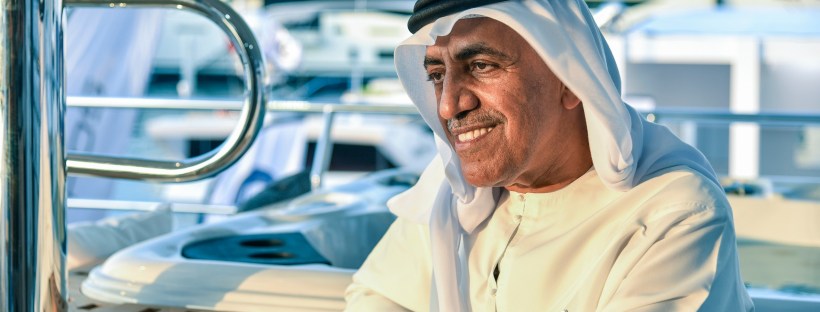
How Mohammed Hussein Alshaali built a world-class yacht brand with a culture of passion, purpose and people.
Words By Shereen Shabnam
There are people you interview because of their title, and there are people you genuinely look forward to meeting because, regardless of how successful they become, they never seem to change.
For more than two decades, I have had the privilege of sitting down with Mohammed Hussein Alshaali at the many Dubai International Boat Shows. During that time, I have watched Gulf Craft evolve from an ambitious Emirati yacht builder into one of the world’s most respected names in luxury yachting.
Every year the yachts become larger, the technology more advanced and the international audience more impressive. Yet one thing has remained remarkably consistent. Mohammed welcomes everyone with the same warm smile, the same quiet confidence and the same humility that first struck me all those years ago.
This year’s conversation felt particularly fitting. It came after walking through the spectacular new Majesty 145, a yacht that perfectly illustrates how far Gulf Craft has come. Every detail reflects decades of refinement, craftsmanship and innovation. Yet as impressive as the yacht is, spending time with the man behind it reminds me that Gulf Craft’s greatest achievement has never simply been the yachts themselves. It has been the philosophy that created them.
Few people have successfully navigated two careers as different as international diplomacy and luxury yacht building. Before dedicating himself fully to Gulf Craft, Mohammed spent more than three decades representing the UAE on the global stage, serving as Ambassador to the United States, Permanent Representative to the United Nations, Minister of State for Foreign Affairs and, remarkably, becoming the youngest President of the UN Security Council during his diplomatic career.
One might assume that diplomacy and yacht building have little in common. Mohammed sees it differently. He says, “In life, communication is important. In diplomacy, communication is everything. In business, it is exactly the same.”
It is a deceptively simple observation, but perhaps it explains why Gulf Craft has always been as much about relationships as it has been about engineering. The company’s success has never been built solely on beautiful yachts, but on the trust it has cultivated with owners, designers, suppliers and partners around the world.
Listening to Mohammed speak about Gulf Craft, it quickly becomes apparent that he rarely talks about himself. Instead, he talks about learning. “When we started, we were learning how to build. We were learning about the market. We were learning about everything. Those early years were not driven by vast financial resources or decades of experience. They were fuelled by something far more powerful. The biggest capital we had was enthusiasm and passion.”
More than forty years later, he believes that very little has changed. “Everybody comes here because of their passion. If you don’t love what you do, you simply won’t stay.”
It is a philosophy that resonates throughout Gulf Craft today. Walking through its facilities, there is a sense that every yacht represents thousands of hours of craftsmanship by people who genuinely care about what they are creating. It is an attitude that cannot be manufactured and certainly cannot be copied.
That passion is perhaps most evident in Gulf Craft’s unique approach to building. Rather than relying heavily on external suppliers, the company has invested in creating much of its production capability in-house. “We build everything ourselves,” Mohammed explains. “Steel, electronics, composite work and more.”
Today, Gulf Craft operates five specialised companies supporting different aspects of production, allowing it to control quality, delivery schedules and costs while ensuring owners ultimately benefit from that integration. The strategy was born not from convenience, but from necessity.
“When you start an industry like this in a country that had no such industry, every challenge becomes an opportunity.” Those challenges taught Gulf Craft to innovate, adapt and continuously improve. Looking back, Mohammed views those difficult early years not as obstacles but as the very foundation upon which the company was built.
That willingness to invest for the long term continues today. Alongside its expanding yacht portfolio, Gulf Craft has recently opened new service and manufacturing facility, capable of maintaining yachts of up to 80 metres, while also expanding its presence in the Maldives with a dedicated marina and service operation. Despite global economic uncertainty and geopolitical challenges affecting international deliveries, Mohammed remains characteristically optimistic.
Walking through the Majesty 145 before our conversation, it became clear that this optimism is well placed. Every space onboard reflects decades of accumulated experience, not only in engineering, but in understanding how owners want to live, entertain and relax on the water.
“So many experiences have come together in this yacht,” Mohammed says. “Our experience, our designers’ experience, our people’s experience and the market’s experience.”
Perhaps the strongest endorsement came before the yacht had even entered the water. Gulf Craft had already secured three sales based solely on the design drawings, a remarkable achievement in today’s highly competitive superyacht market.
While innovation and craftsmanship have undoubtedly propelled Gulf Craft onto the global stage, Mohammed returns repeatedly to one subject that matters more than anything else: people.
“Our team is the soul of the company.” It is a statement that feels entirely genuine.
He believes owners return not simply because they appreciate the yachts, but because they trust the people behind them. Beautiful designs attract attention, but lasting relationships build loyalty. “People come back because they have a relationship with the team.”
The biggest capital we have is enthusiasm and passion.
In an industry where luxury is often measured in materials, finishes and technology, Mohammed measures success differently. For him, culture has become Gulf Craft’s greatest competitive advantage.
That perspective may well explain why, after more than four decades, Gulf Craft continues to evolve while remaining unmistakably true to its roots. It has become one of the few yacht builders capable of competing confidently on the world stage while proudly retaining its Emirati identity.
Recognition has naturally followed. From building one of the world’s largest composite superyachts to receiving international accolades, including the prestigious Lifetime Achievement Award at the 2024 Boat Builder Awards, Gulf Craft’s journey mirrors the remarkable growth of the UAE itself.
When I ask Mohammed what legacy he hopes to leave behind, his answer is telling. “I want this company to always be considered one of the best yacht builders in the world.”
Noticeably absent is any mention of being the biggest. Instead, he speaks about reputation, excellence and earning the respect of customers, designers, suppliers and classification societies alike. It is an ambition rooted not in scale but in quality.
As our conversation comes to an end, I reflect on something I have observed over more than twenty years of meeting Mohammed at boat shows around the world. The yachts have grown larger. The company has expanded globally. The awards have accumulated. Yet the man himself has remained remarkably unchanged. He is still approachable. Still gracious. Still genuinely interested in people.
The Majesty 145 may represent the latest chapter in Gulf Craft’s remarkable journey, but perhaps the company’s greatest achievement is measured in the culture Mohammed Hussein Alshaali has quietly built over four decades. A culture where passion matters more than prestige, relationships matter more than transactions, and success is never claimed by one individual but shared with an entire team.

Celebrating life’s special moments at InterContinental Dubai Festival City
By Shereen Shabnam
Some hotels quietly become part of the memories you create there. My recent two-night stay at InterContinental Dubai Festival City was exactly that. It was for a birthday celebration for my husband the experience reminded me why some hotels continue to stand out, not through extravagance alone, but through genuine hospitality and thoughtful experiences.
Despite having visited the property countless times over the years for events and meetings, staying as a guest offered a completely different perspective. It allowed me to appreciate not only the hotel’s elegant surroundings but also the seamless way it blends luxury, convenience and warm service.
One of the first things that captures your attention is the setting. Overlooking Dubai Creek, the hotel enjoys one of the city’s most relaxing waterfront locations. During the day, the ever-changing views across the water create a welcome sense of calm, while evenings bring the spectacular IMAGINE light and laser show, transforming the creek into a vibrant canvas of colour and music. Watching the reflections dance across the water from the comfort of the hotel adds a memorable touch to the experience.
The rooms reflect the understated elegance that has long defined the InterContinental brand. Spacious, beautifully maintained and thoughtfully designed, they provide a comfortable retreat after a busy day. Floor-to-ceiling windows make the most of the waterfront setting, allowing natural light to fill the room while framing the city skyline beyond.
For me, however, memorable hotel stays are often defined by the people rather than the facilities, and this was especially true at Anise, where breakfast became one of the highlights of our stay.
The extensive buffet offers an impressive journey through international cuisines, with freshly prepared dishes, vibrant fruit selections, artisan pastries and made-to-order favourites catering to every palate. The genuine warmth of the team wss what I loved most. Every interaction felt personal, attentive and sincere, creating an atmosphere that encouraged guests to slow down, enjoy another cup of coffee and savour the morning rather than simply rushing through breakfast.
Dinner at Karam Al Bahr proved equally memorable. Known for its seafood cuisine, the restaurant delivers beautifully prepared dishes that celebrate the freshness of the ingredients without unnecessary complexity. From perfectly grilled seafood to authentic flavours inspired by the Mediterranean coast, the meal offered a fitting centrepiece for our celebration. We also had dinner the next day at Vista which had great food, great views and a relaxed, inviting atmosphere.
One of the hotel’s greatest advantages is its direct connection to Dubai Festival City Mall. Without stepping outdoors, we had immediate access to an excellent mix of international retail brands, cafés and entertainment. I am a big fan of Marks and Spensers so enjoyed some retail therapy, had a leisurely afternoon stroll through the mall and loved the convenience of having everything within easy reach.
It is this combination of luxury accommodation, outstanding dining, genuine hospitality and effortless convenience that makes InterContinental Dubai Festival City so appealing. I found it perfect for a romantic celebration and a family staycation as my daughter was with us for the stay. It was a great weekend escape without leaving the city.
As someone fortunate enough to experience many hotels around the world, I have learned that true luxury is rarely defined solely by beautiful rooms or impressive architecture. It is found in the warmth of the welcome, the attentiveness of the staff and the moments that leave you smiling long after you have checked out and the InterContinental Dubai Festival City delivered all of those moments during our stay.
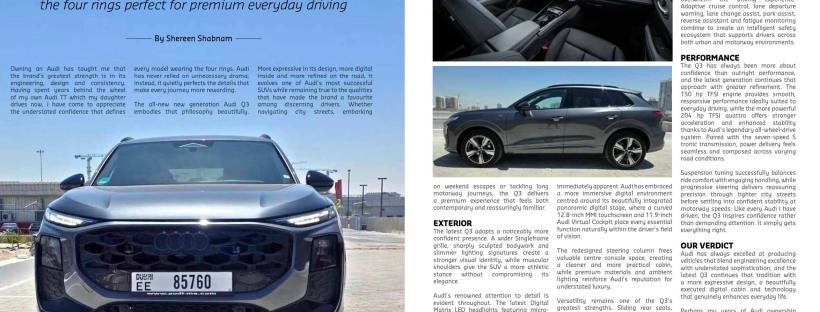
The all-new Audi Q3 builds on everything that has made the four rings perfect for premium everyday driving.
Shereen Shabnam
Owning an Audi has taught me that the brand’s greatest strength is in its engineering, design and consistency. Having spent years behind the wheel of my own Audi TT which my daughter drives now, I have come to appreciate the understated confidence that defines every model wearing the four rings. Audi has never relied on unnecessary drama; instead, it quietly perfects the details that make every journey more rewarding.
The all-new new generation Audi Q3 embodies that philosophy beautifully. More expressive in its design, more digital inside and more refined on the road, it evolves one of Audi’s most successful SUVs while remaining true to the qualities that have made the brand a favourite among discerning drivers. Whether navigating city streets, embarking on weekend escapes or tackling long motorway journeys, the Q3 delivers a premium experience that feels both contemporary and reassuringly familiar.
Exterior
The latest Q3 adopts a noticeably more confident presence. A wider Singleframe grille, sharply sculpted bodywork and slimmer lighting signatures create a stronger visual identity, while muscular shoulders give the SUV a more athletic stance without compromising its elegance.
Audi’s renowned attention to detail is evident throughout. The latest Digital Matrix LED headlights featuring micro-LED technology not only enhance visibility but also introduce intelligent lighting functions that improve driver awareness. At the rear, optional digital OLED lighting and illuminated Audi rings create a sophisticated signature after dark, ensuring the Q3 is instantly recognisable from every angle.
Interior
Step inside and the transformation is immediately apparent. Audi has embraced a more immersive digital environment centred around its beautifully integrated panoramic digital stage, where a curved 12.8-inch MMI touchscreen and 11.9-inch Audi Virtual Cockpit place every essential function naturally within the driver’s field of vision. The redesigned steering column frees valuable centre console space, creating a cleaner and more practical cabin, while premium materials and ambient lighting reinforce Audi’s reputation for understated luxury.
Versatility remains one of the Q3’s greatest strengths. Sliding rear seats, adjustable backrests and generous luggage capacity make the SUV equally suited to growing families, business professionals and weekend adventurers. Acoustic glazing for the front side windows, introduced for the first time in this segment, also contributes to a noticeably quieter cabin, particularly during longer highway journeys.
Technology
Technology continues to be one of Audi’s defining strengths, and the all-new Q3 demonstrates just how seamlessly innovation can enhance everyday driving. The intuitive infotainment system integrates effortlessly with the driver’s digital lifestyle, while voice controls and smartphone connectivity make accessing navigation, media and communication simple and distraction-free.
Audi’s latest driver assistance systems work discreetly in the background to enhance confidence rather than overwhelm the driving experience. Adaptive cruise control, lane departure warning, lane change assist, park assist, reverse assistant and fatigue monitoring combine to create an intelligent safety ecosystem that supports drivers across both urban and motorway environments.
Performance
The Q3 has always been more about confidence than outright performance, and the latest generation continues that approach with greater refinement. The 150 hp TFSI engine provides smooth, responsive performance ideally suited to everyday driving, while the more powerful 204 hp TFSI quattro offers stronger acceleration and enhanced stability thanks to Audi’s legendary all-wheel-drive system. Paired with the seven-speed S tronic transmission, power delivery feels seamless and composed across varying road conditions.
Suspension tuning successfully balances ride comfort with engaging handling, while progressive steering delivers reassuring precision through tighter city streets before settling into confident stability at motorway speeds. Like every Audi I have driven, the Q3 inspires confidence rather than demanding attention. It simply gets everything right.
Our Verdict
Audi has always excelled at producing vehicles that blend engineering excellence with understated sophistication, and the latest Q3 continues that tradition with a more expressive design, a beautifully executed digital cabin and technology that genuinely enhances everyday life.
Perhaps my years of Audi ownership make me appreciate these qualities more than most. Living with an Audi has shown me that the true appeal of the brand lies in the way every detail works together to create a car that feels as satisfying on day one as it does years later. The all-new Q3 carries that same philosophy into the premium SUV segment. Elegant, practical and quietly confident.
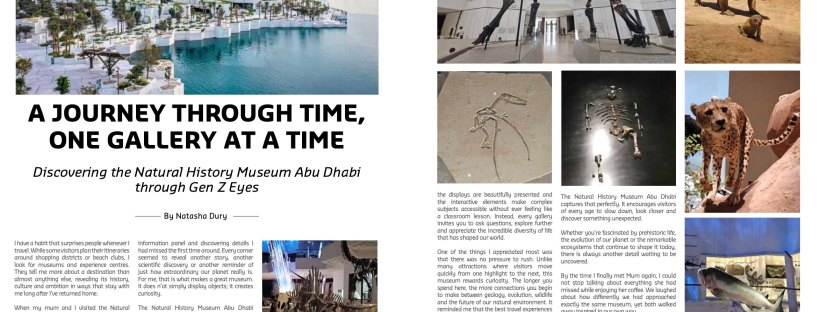
Discovering the Natural History Museum Abu Dhabi through Gen Z Eyes
By Natasha Dury
I have a habit that surprises people whenever I travel. While some visitors plan their itineraries around shopping districts or beach clubs, I look for museums and experience centres. They tell me more about a destination than almost anything else, revealing its history, culture and ambition in ways that stay with me long after I’ve returned home.
When my mum and I visited the Natural History Museum Abu Dhabi with our best friends, we both expected to enjoy it. What we didn’t expect was to experience it so differently. After about two hours of exploring, mum was ready to relax with a coffee, convinced she had seen the highlights. I was only just getting started and went along with my friends to see more.
Five hours later, I was still moving through the galleries, revisiting exhibits, reading every information panel and discovering details I had missed the first time around. Every corner seemed to reveal another story, another scientific discovery or another reminder of just how extraordinary our planet really is. For me, that is what makes a great museum. It does n’ot simply display objects; it creates curiosity.
The Natural History Museum Abu Dhabi has been designed as an immersive journey rather than a collection of exhibits. From the moment you step inside, you are encouraged to explore at your own pace. The spaces flow naturally from one discovery to the next, making it easy to lose track of time as millions of years of Earth’s history unfold around you.
As someone who genuinely enjoys learning, I loved that the museum never felt overwhelming. The storytelling is engaging, the displays are beautifully presented and the interactive elements make complex subjects accessible without ever feeling like a classroom lesson. Instead, every gallery invites you to ask questions, explore further and appreciate the incredible diversity of life that has shaped our world.
One of the things I appreciated most was that there was no pressure to rush. Unlike many attractions where visitors move quickly from one highlight to the next, this museum rewards curiosity. The longer you spend here, the more connections you begin to make between geology, evolution, wildlife and the future of our natural environment.
It reminded me that the best travel experiences aren’t always about seeing more—they’re about understanding more.
I think that’s something many people in my generation value. We don’t just want photographs of the places we visit; we want experiences that leave us with new perspectives. Museums have become destinations in their own right because they combine education, technology, storytelling and design in ways that feel engaging rather than traditional.
The Natural History Museum Abu Dhabi captures that perfectly. It encourages visitors of every age to slow down, look closer and discover something unexpected. Whether you’re fascinated by prehistoric life, the evolution of our planet or the remarkable ecosystems that continue to shape it today, there is always another detail waiting to be uncovered.
By the time I finally met Mum again, I could not stop talking about everything she had missed while enjoying her coffee. We laughed about how differently we had approached exactly the same museum, yet both walked away inspired in our own way.
Perhaps that is the museum’s greatest achievement. It doesn’t ask visitors to experience it in a particular way. Whether you spend two hours exploring the highlights or five hours immersing yourself in every gallery, it rewards your curiosity.
As for me, I already know I will be back. Because somehow, I still don’t think I have seen everything.
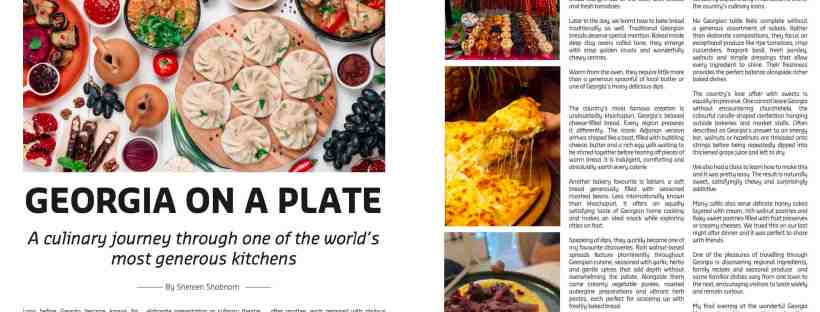
A culinary journey through one of the world’s most generous kitchens
By Shereen Shabnam
Long before Georgia became known for its dramatic mountain landscapes and charming historic towns, it had already perfected one of the world’s most comforting cuisines. Every meal feels like an invitation to linger, every table seems designed for sharing, and every recipe carries generations of tradition.
Having travelled through Tbilisi, Kakheti and Kutaisi in the past and recently, I quickly realised that Georgian food is not about elaborate presentation or culinary theatre. Instead, it celebrates fresh ingredients, family recipes and bold, honest flavours. Whether dining in elegant restaurants or traditional family homes, every meal reflected the country’s remarkable hospitality.
One of my most memorable lunches was at Kneina in Kutaisi, a beautiful old Georgian house run by a welcoming mother-and-son team. The setting was as memorable as the meal itself. Homemade dishes arrived one after another, each prepared with obvious pride and the kind of warmth that only family kitchens seem capable of producing.
Throughout my journey, I found myself constantly surprised by the freshness of every ingredient. Crisp vegetables, fragrant herbs, creamy cheeses and perfectly grilled seafood appeared on almost every table. One afternoon, a beautifully grilled salmon accompanied by seasonal vegetables reminded me that Georgian cuisine is far more diverse than many travellers expect. Another meal featured a delicate pear salad combining crisp fruit, fresh greens, soft cheese and toasted nuts, balancing sweetness with savoury flavours in a wonderfully refreshing way.
Then there were the pastries. Georgia’s bakeries are impossible to resist. The aroma of freshly baked bread drifts through almost every town, tempting visitors to stop “just for one” before inevitably leaving with several. We stopped by the road side and had fresh bread staright out of the oevn with cheese and fresh tomatoes.
Later in the day, we learnt how to bake bread traditionally as well. Traditional Georgian breads deserve special mention. Baked inside deep clay ovens called tone, they emerge with crisp golden crusts and wonderfully chewy centres. Warm from the oven, they require little more than a generous spoonful of local butter or one of Georgia’s many delicious dips.
The country’s most famous creation is undoubtedly khachapuri, Georgia’s beloved cheese-filled bread. Every region prepares it differently. The iconic Adjarian version arrives shaped like a boat, filled with bubbling cheese, butter and a rich egg yolk waiting to be stirred together before tearing off pieces of warm bread. It is indulgent, comforting and absolutely worth every calorie.
Another bakery favourite is lobiani, a soft bread generously filled with seasoned mashed beans. Less internationally known than khachapuri, it offers an equally satisfying taste of Georgian home cooking and makes an ideal snack while exploring cities on foot.
Speaking of dips, they quickly became one of my favourite discoveries. Rich walnut-based spreads feature prominently throughout Georgian cuisine, seasoned with garlic, herbs and gentle spices that add depth without overwhelming the palate. Alongside them came creamy vegetable purées, roasted aubergine preparations and vibrant herb pastes, each perfect for scooping up with freshly baked bread.
Vegetarians will find themselves exceptionally well catered for. Georgia celebrates vegetables rather than treating them as side dishes. Aubergines rolled around fragrant walnut fillings, colourful salads bursting with herbs, roasted peppers, tomatoes, cucumbers and seasonal greens appeared throughout my travels, each reflecting the country’s respect for fresh local produce.
One dish I particularly enjoyed was pkhali, an assortment of finely chopped vegetables mixed with walnuts, herbs and aromatic spices. Made using spinach, beetroot or other seasonal vegetables, these colourful appetisers are as beautiful as they are delicious.
Cheese lovers are equally spoiled. Sulguni, Georgia’s famous semi-soft cheese, appears in countless dishes, offering a mild, slightly salty flavour that pairs beautifully with breads, salads and baked dishes. Its versatility explains why it has become one of the country’s culinary icons.
No Georgian table feels complete without a generous assortment of salads. Rather than elaborate compositions, they focus on exceptional produce like ripe tomatoes, crisp cucumbers, fragrant basil, fresh parsley, walnuts and simple dressings that allow every ingredient to shine. Their freshness provides the perfect balance alongside richer baked dishes.
The country’s love affair with sweets is equally impressive. One cannot leave Georgia without encountering churchkhela, the colourful candle-shaped confection hanging outside bakeries and market stalls. Often described as Georgia’s answer to an energy bar, walnuts or hazelnuts are threaded onto strings before being repeatedly dipped into thickened grape juice and left to dry. We also had a class to learn how to make this and it was pretty easy. The result is naturally sweet, satisfyingly chewy and surprisingly addictive.
Many cafés also serve delicate honey cakes layered with cream, rich walnut pastries and flaky sweet pastries filled with fruit preserves or creamy cheeses. We trued this on our last night after dinner and it was perfect to share with friends.
One of the pleasures of travelling through Georgia is discovering regional ingredients, family recipes and seasonal produce and some familiar dishes vary from one town to the next, encouraging visitors to taste widely and remain curious.
My final evening at the wonderful Georgia House brought everything together. Accompanied by live traditional music, dinner unfolded slowly, with one beautifully prepared dish following another in an atmosphere filled with laughter, conversation and unmistakable Georgian warmth. It was the perfect reminder that here, food is never simply nourishment. It is culture, celebration and hospitality woven together around a shared table.
For More Information on Travelling in Georgia Visit – https://georgia.travel

Shereen Shabnam
Returning to Georgia is a little like meeting an old friend. The familiar warmth is still there, but every conversation reveals something new. On my first visit, the dramatic journey to Kazbegi, with its soaring mountain landscapes and the iconic Gergeti Trinity Church framed by snow-capped peaks, left an unforgettable impression. This time, however, I deliberately stepped beyond the country’s best-known highlights to discover new regions, hidden experiences and a slower, more authentic side of one of the Caucasus’ most captivating destinations.
There is something wonderfully effortless about travelling through Georgia. Distances are manageable, the scenery changes dramatically within a few hours, and every stop introduces another chapter in the country’s rich history.
My journey began in Tbilisi, a city I never tire of returning to. Even after previous visits, the Georgian capital always feels fresh. The old town, with its colourful timber balconies, cobbled streets and eclectic architecture, blends centuries of history with an unmistakably youthful energy. Every corner seems to reveal another hidden courtyard, artisan gallery or café filled with locals lingering over coffee.
Dinner on my arrival at Oilibuli Restaurant was the perfect start to Georgian hospitality. Like every meal throughout the journey, it reinforced why Georgian cuisine deserves far more global recognition. From traditional family recipes to contemporary interpretations, every meal became an experience rather than simply another stop on the itinerary.
Leaving Tbilisi behind, we headed east into Kakheti, Georgia’s celebrated wine region. Rolling vineyards stretched towards the Caucasus Mountains while sleepy villages appeared almost untouched by time. Our destination was Sighnaghi, affectionately known as the City of Love.
Small enough to explore on foot, Sighnaghi possesses a romantic charm that few European towns can rival. Its beautifully restored pastel houses, ancient defensive walls and sweeping valley views make it easy to understand why visitors linger here far longer than planned. Walking along the old fortifications, I found myself pausing repeatedly to absorb the endless landscape unfolding below.
Nearby, the remarkable Kvareli tunnel offered one of the most unusual grape curation experiences I have encountered. Originally constructed as a military tunnel during the Soviet era, it has since been transformed into an immense underground drinks cellar where thousands of bottles mature naturally beneath the earth.
The evening concluded at Lopota Lake Resort & Spa, nestled in the peaceful Lopota Valley. Surrounded by vineyards, forests and mountain ridges, the expansive resort feels less like a hotel and more like its own destination. As daylight faded across the lake, it became one of those rare places where silence itself becomes part of the luxury.
The following morning, curiosity led us to the Caucasus’ first outlet village for retail therapy before another afternoon immersed in Georgian hospitality followed by one of the journey’s greatest surprises, Dashbashi Canyon. While Georgia’s mountain scenery often dominates travel brochures, this spectacular volcanic gorge offers an entirely different perspective on the country’s natural diversity. Lush greenery cascades down dramatic cliffs towards waterfalls hidden below, while the now-famous glass sky bridge provides an unforgettable viewpoint suspended high above the canyon floor.
After a night in Tblisi, our adventure then shifted west towards Kutaisi, one of Georgia’s oldest continuously inhabited cities. Along the way, Prometheus Cave revealed a hidden underground world sculpted over millions of years. Towering stalactites, shimmering stalagmites and softly illuminated chambers create an almost surreal landscape that feels closer to fantasy than geology. Walking through the vast caverns is a reminder that some of nature’s greatest masterpieces remain hidden beneath our feet.
Kutaisi itself quickly became one of my favourite discoveries. We experienced Gemo Fest, the Georgian National Tourism Administration’s travelling gastronomic festival celebrating regional food traditions and local producers. Although I will save the country’s remarkable cuisine for another story, the festival offered a fascinating glimpse into how proudly Georgians preserve their culinary heritage.
Our boutique hotel, immediately charmed me with its intimate atmosphere, but it was an unexpected resident parked outside that truly caught my attention in form of a beautifully preserved powder-blue 1963 Volga. As someone who has spent decades writing about automobiles, stumbling across this elegant piece of Soviet motoring history was a delightful surprise. It felt entirely at home against Kutaisi’s timeless backdrop.
Returning to Tbilisi, I embraced one of the city’s oldest traditions at Gulo’s Thermal Spa in the historic Abanotubani district. Georgia’s famous sulfur baths have welcomed travellers for centuries, and soaking in the naturally heated mineral waters provided the perfect opportunity to slow down after several days of exploring. The experience felt authentic, restorative and deeply connected to the city’s identity.
The same day we had lunch at Kneina, a beautifully restored traditional Georgian home where lunch is prepared by an inspiring mother-and-son team. Rather than simply serving guests, they welcome visitors into their family story.
My final full day was spent wandering through the underground market, a treasure trove of antiques, vintage cameras, memorabilia, artwork and handcrafted souvenirs. Every stall seemed to tell another story about Georgia’s complex past, and browsing became an unexpected history lesson as much as a shopping experience.
Later, I wandered once again through Old Tbilisi, where ancient churches stand comfortably alongside synagogues, mosques and colourful wooden balconies overlooking winding streets. It remains one of Europe’s most visually distinctive historic quarters, constantly inviting visitors to slow down and simply observe everyday life unfolding around them.
My final evening ended at the wonderful Georgia House, where traditional music filled the dining room long into the night. Surrounded by locals and visitors alike, the live performances captured something difficult to describe but impossible to forget. It was the perfect farewell to a country where hospitality simply comes naturally and I hope to return for a road trip experience next, hopefully in a vintage car to add to the experience.
For More Information on Travelling in Georgia Visit – https://georgia.travel
Shereen Shabnam
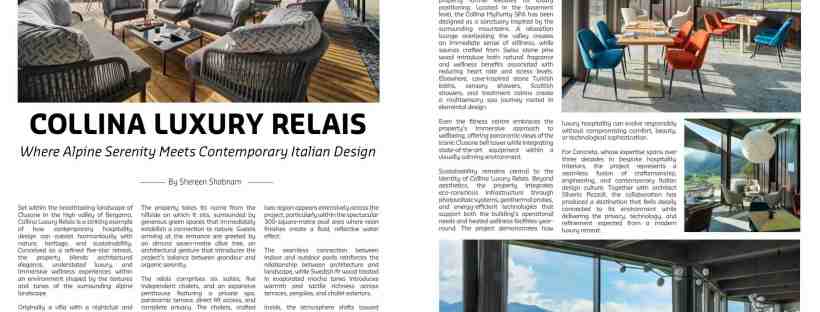
Set within the breathtaking landscape of Clusone in the high valley of Bergamo, Collina Luxury Relais is a striking example of how contemporary hospitality design can coexist harmoniously with nature, heritage, and sustainability. Conceived as a refined five-star retreat, the property blends architectural elegance, understated luxury, and immersive wellness experiences within an environment shaped by the textures and tones of the surrounding alpine landscape.
Originally a villa with a nightclub and outdoor swimming pool, the site has been completely reimagined through a low-impact redevelopment project led by architect Silverio Pezzoli of TecnoArreda Interior Design, with Concreta overseeing the execution of the interiors and common spaces. The result is not merely a hotel, but a carefully orchestrated sensory experience where materials, light, and craftsmanship work together to create a sense of calm sophistication.
The property takes its name from the hillside on which it sits, surrounded by generous green spaces that immediately establish a connection to nature. Guests arriving at the entrance are greeted by an almost seven-metre olive tree, an architectural gesture that introduces the project’s balance between grandeur and organic serenity.
The relais comprises six suites, five independent chalets, and an expansive penthouse featuring a private spa, panoramic terrace, direct lift access, and complete privacy. The chalets, crafted entirely from wood with corrugated aluminium roofs, mirror the earthy tones of the alpine environment while maintaining a contemporary architectural language.
What defines the interiors most profoundly is the material palette. Throughout the property, Concreta has created a dialogue between natural textures and precision craftsmanship. Locally sourced Gré stone from the Lake Iseo region appears extensively across the project, particularly within the spectacular 300-square-metre pool area where resin finishes create a fluid, reflective water effect. The seamless connection between indoor and outdoor pools reinforces the relationship between architecture and landscape, while Swedish fir wood treated in evaporated mocha tones introduces warmth and tactile richness across terraces, pergolas, and chalet exteriors.
Inside, the atmosphere shifts toward refined contemporary elegance. The Beides Restaurant forms the social heart of the property, where grey-stained timber, metal, and glass intersect in a dramatic yet restrained composition. Large glazed surfaces flood the interiors with natural light, while Canaletto walnut, moka-stained fir, aged oak flooring, and Fenix finishes introduce depth and softness to the space. The continuity between interior and exterior materials is particularly striking, with gré cobblestone surfaces extending the visual narrative throughout the property.
The private lounge, featuring a Canaletto walnut floor and visible wine cellar, reflects the project’s broader philosophy of understated exclusivity. Rather than relying on decorative excess, the design focuses on proportion, atmosphere, and the emotional quality of materials.
The wellness component of the property further elevates its luxury positioning. Located in the basement level, the Collina MyPurity SPA has been designed as a sanctuary inspired by the surrounding mountains. A relaxation lounge overlooking the valley creates an immediate sense of stillness, while saunas crafted from Swiss stone pine wood introduce both natural fragrance and wellness benefits associated with reducing heart rate and stress levels. Elsewhere, cave-inspired stone Turkish baths, sensory showers, Scottish showers, and treatment cabins create a multisensory spa journey rooted in elemental design.
Even the fitness centre embraces the property’s immersive approach to wellbeing, offering panoramic views of the iconic Clusone bell tower while integrating state-of-the-art equipment within a visually calming environment.
Sustainability remains central to the identity of Collina Luxury Relais. Beyond aesthetics, the property integrates eco-conscious infrastructure through photovoltaic systems, geothermal probes, and energy-efficient technologies that support both the building’s operational needs and heated wellness facilities year-round. The project demonstrates how luxury hospitality can evolve responsibly without compromising comfort, beauty, or technological sophistication.
For Concreta, whose expertise spans over three decades in bespoke hospitality interiors, the project represents a seamless fusion of craftsmanship, engineering, and contemporary Italian design culture. Together with architect Silverio Pezzoli, the collaboration has produced a destination that feels deeply connected to its environment while delivering the privacy, technology, and refinement expected from a modern luxury retreat.
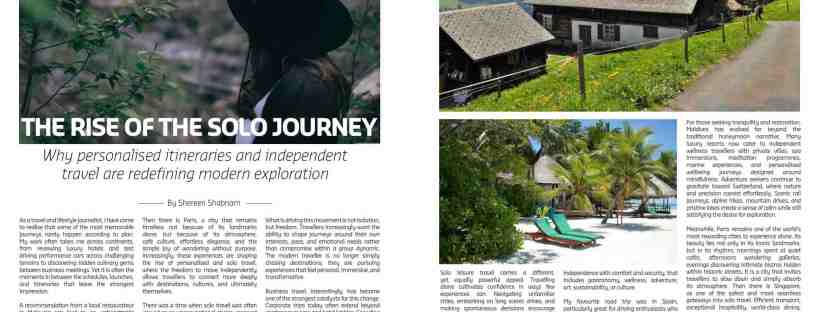
Why personalised itineraries and independent travel are redefining modern exploration
Shereen Shabnam
As a travel and lifestyle journalist, I have come to realise that some of the most memorable journeys rarely happen according to plan. My work often takes me across continents, from reviewing luxury hotels and test driving performance cars across challenging terrains to discovering hidden culinary gems between business meetings. Yet it is often the moments in between the schedules, launches, and itineraries that leave the strongest impression.
A recommendation from a local restaurateur in Malaysia can lead to an unforgettable street food experience in Penang, while a spontaneous detour through the winding coastal roads of Spain can transform a simple road trip into something cinematic. In Switzerland, driving through alpine passes and remote mountain villages offers a rare connection to nature and adventure, while the serenity of the Maldives provides the perfect counterbalance, a place where wellness, stillness, and reflection become part of the journey itself.
Then there is Paris, a city that remains timeless not because of its landmarks alone, but because of its atmosphere, café culture, effortless elegance, and the simple joy of wandering without purpose. Increasingly, these experiences are shaping the rise of personalised and solo travel, where the freedom to move independently allows travellers to connect more deeply with destinations, cultures, and ultimately themselves.
There was a time when solo travel was often viewed as an unconventional choice, reserved for gap-year students, or those simply unable to find company for a trip. Today, it has evolved into one of the most significant shifts in modern tourism. Across luxury travel, wellness escapes, and even corporate journeys, personalised itineraries and independent exploration are becoming deeply desirable experiences for travellers seeking something more meaningful than traditional sightseeing.
What is driving this movement is not isolation, but freedom. Travellers increasingly want the ability to shape journeys around their own interests, pace, and emotional needs rather than compromise within a group dynamic. The modern traveller is no longer simply chasing destinations; they are pursuing experiences that feel personal, immersive, and transformative.
Business travel, interestingly, has become one of the strongest catalysts for this change. Corporate trips today often extend beyond conference rooms and hotel lobbies. Spending time with local clients, colleagues, and industry professionals introduces travellers to a more authentic side of a destination. A recommendation from a local often becomes more memorable than anything in a guidebook. These interactions create a richer cultural connection and encourage travellers to explore independently during downtime, transforming work trips into deeply personal experiences.
Solo leisure travel carries a different, yet equally powerful appeal. Travelling alone cultivates confidence in ways few experiences can. Navigating unfamiliar cities, embarking on long scenic drives, and making spontaneous decisions encourage self-reliance and adaptability. Many travellers describe returning from solo journeys feeling more capable, focused, and emotionally recharged. In a world increasingly dominated by digital noise and rigid schedules, solo travel offers something increasingly rare: uninterrupted personal space.
The travel industry has recognised this shift. Luxury operators, boutique agencies, and wellness brands are now curating highly personalised solo itineraries that combine independence with comfort and security, that includes gastronomy, wellness, adventure, art, sustainability, or culture.
My favourite road trip was in Spain, particularly great for driving enthusiasts who view driving as part of the experience. From the dramatic mountain routes of Andalusia to the coastal highways stretching along the Mediterranean, Spain offers the perfect balance of scenery, culture, and spontaneity. Malaysia continues to attract independent travellers for its extraordinary culinary diversity and accessibility. I lived there for 9 years and love the refined dining in Kuala Lumpur to hawker stalls in Penang.
For those seeking tranquility and restoration, Maldives has evolved far beyond the traditional honeymoon narrative. Many luxury resorts now cater to independent wellness travellers with private villas, spa immersions, meditation programmes, marine experiences, and personalised wellbeing journeys designed around mindfulness. Adventure seekers continue to gravitate toward Switzerland, where nature and precision coexist effortlessly. Scenic rail journeys, alpine hikes, mountain drives, and pristine lakes create a sense of calm while still satisfying the desire for exploration.
Meanwhile, Paris remains one of the world’s most rewarding cities to experience alone. Its beauty lies not only in its iconic landmarks, but in its rhythm, mornings spent at quiet cafés, afternoons wandering galleries, evenings discovering intimate bistros hidden within historic streets. It is a city that invites travellers to slow down and simply absorb its atmosphere. Then there is Singapore, as one of the safest and most seamless gateways into solo travel. Efficient transport, exceptional hospitality, world-class dining, and a cosmopolitan energy allow travellers to move confidently while still experiencing cultural depth and diversity.
Ultimately, the rise of personalised solo travel reflects a broader evolution in how people define luxury and fulfilment. Modern travellers are placing greater value on authenticity, emotional wellbeing, flexibility, and meaningful experiences over rigid itineraries or crowded group tours and solo travel has become a powerful expression of curiosity and confidence.

Natasha Dury
For decades, Piaget has embodied a glamorous world where high jewellery, artistic freedom, and celebration exist in perfect harmony. Drawing inspiration from the legendary spirit of the Piaget Society, an era defined by elegance, creativity, and jet-set sophistication, the Maison’s latest Piaget Cocktail collection captures that same sense of joyful extravagance in a contemporary and highly wearable form.
The new collection introduces nine vibrant rings and two ear cuffs that blend colourful gemstones with sculptural design and playful sophistication. Designed as an ode to celebration, the pieces channel the energy of cocktail culture through daring colour combinations, fluid lines, and precious stones arranged like luminous compositions of flavour and light.
Piaget’s connection to glamour dates back to the 1970s and 1980s, when Yves Piaget gathered artists, icons, and cultural figures from around the world into what became known as the Piaget Society.
From Capri and Saint-Tropez to Palm Beach and Monaco, the Maison became synonymous with a lifestyle built around creativity, elegance, and fearless self-expression. Legendary names including Elizabeth Taylor, Jacqueline Kennedy Onassis, Andy Warhol, Ursula Andress, and Roger Moore were all part of this vibrant universe.
That festive spirit continues within the Piaget Cocktail collection, originally introduced in 2010 and now reimagined with fresh energy and contemporary flair. Bright tourmalines, aquamarines, citrines, emeralds, amethysts, turquoise, and diamonds are paired in unexpected combinations that evoke the colours and freshness of exotic cocktails. Lemon-yellow sapphires, mint-green tourmalines, icy purple amethysts, and soft pink quartz create compositions that feel playful yet unmistakably luxurious.
The rings are sculpted with fluid curves inspired by the shape of a cocktail straw, while carefully cut stones introduce texture, movement, and lightness. Some pieces feature delicate figurative details, including sculpted leaves and crystal-like accents that echo ice cubes shimmering inside a glass.
Despite their bold colour palette, the designs remain refined and versatile. The pieces can be worn individually for understated elegance or layered together to create a more expressive statement. The result is jewellery that feels modern, spirited, and deeply connected to Piaget’s heritage of creativity and craftsmanship.
With Piaget Cocktail, the Maison once again transforms high jewellery into an experience, vibrant, celebratory, and full of personality. It is a collection that perfectly captures the Riviera-inspired glamour, artistic freedom, and joyful sophistication that continue to define the world of Piaget.

