
Chinchilla – The Hilltop Village of Kindness and History
Natasha Dury
There are places that quietly stay with you long after you leave. Chinchilla de Monte-Aragón, a historic hilltop village in the province of Albacete is just that kind of place. We often explore small towns when we visit our home in Spain but this one touched our heart. Perched high above the plains of Castilla–La Mancha, this charming medieval town feels untouched by the hurried pace of modern tourism, offering instead something increasingly rare in travel today – authenticity.
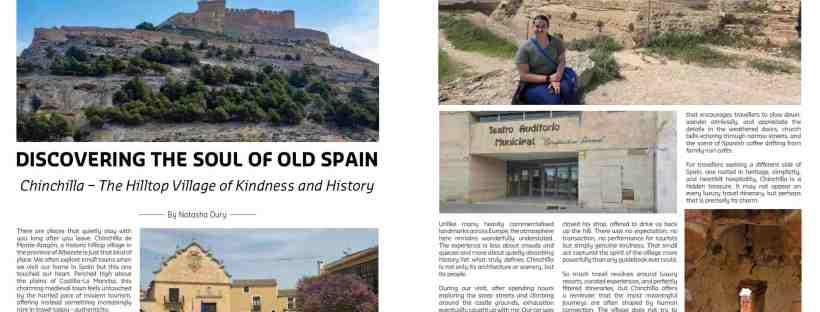
Arriving in Chinchilla feels like stepping into another era. Narrow stone streets wind gently through the village, opening onto hidden squares, rustic homes, and panoramic viewpoints that stretch endlessly across the Spanish landscape. Above it all rises the magnificent Castle of Chinchilla, its imposing stone walls watching over the town like a guardian from centuries past.
The castle itself is breathtaking. Built between the 15th and 16th centuries on the remains of earlier Moorish fortifications, it carries the layered history of Spain within its walls. Standing near the fortress, with the wind moving across the hilltops and golden light washing over the old stone, there is a stillness that feels deeply cinematic.
Unlike many heavily commercialised landmarks across Europe, the atmosphere here remains wonderfully understated. The experience is less about crowds and queues and more about quietly absorbing history.Yet what truly defines Chinchilla is not only its architecture or scenery, but its people.
During our visit, after spending hours exploring the steep streets and climbing around the castle grounds, exhaustion eventually caught up with me. Our car was parked further uphill, taxis were nowhere to be found, and the climb back felt far more daunting under the afternoon sun. In many destinations, this would simply become one of those inconvenient travel moments quickly forgotten. In Chinchilla, it became something unforgettable.
The local Mercado shopkeeper, noticing our situation, did something extraordinary in its simplicity. Without hesitation, he closed his shop, offered to drive us back up the hill. There was no expectation, no transaction, no performance for tourists but simply genuine kindness. That small act captured the spirit of the village more powerfully than any guidebook ever could.
So much travel revolves around luxury resorts, curated experiences, and perfectly filtered itineraries, but Chinchilla offers a reminder that the most meaningful journeys are often shaped by human connection. The village does not try to impress loudly. Instead, it reveals itself slowly through warm conversations, old-world hospitality, and moments that feel deeply personal.
The beauty of Chinchilla also lies in its rhythm. Life moves differently here. Locals gather casually in cafés, conversations linger in quiet squares, and evenings arrive with golden sunsets spilling across ancient rooftops. It is the kind of place that encourages travellers to slow down, wander aimlessly, and appreciate the details in the weathered doors, church bells echoing through narrow streets, and the scent of Spanish coffee drifting from family-run cafés.
For travellers seeking a different side of Spain, one rooted in heritage, simplicity, and heartfelt hospitality, Chinchilla is a hidden treasure. It may not appear on every luxury travel itinerary, but perhaps that is precisely its charm.

