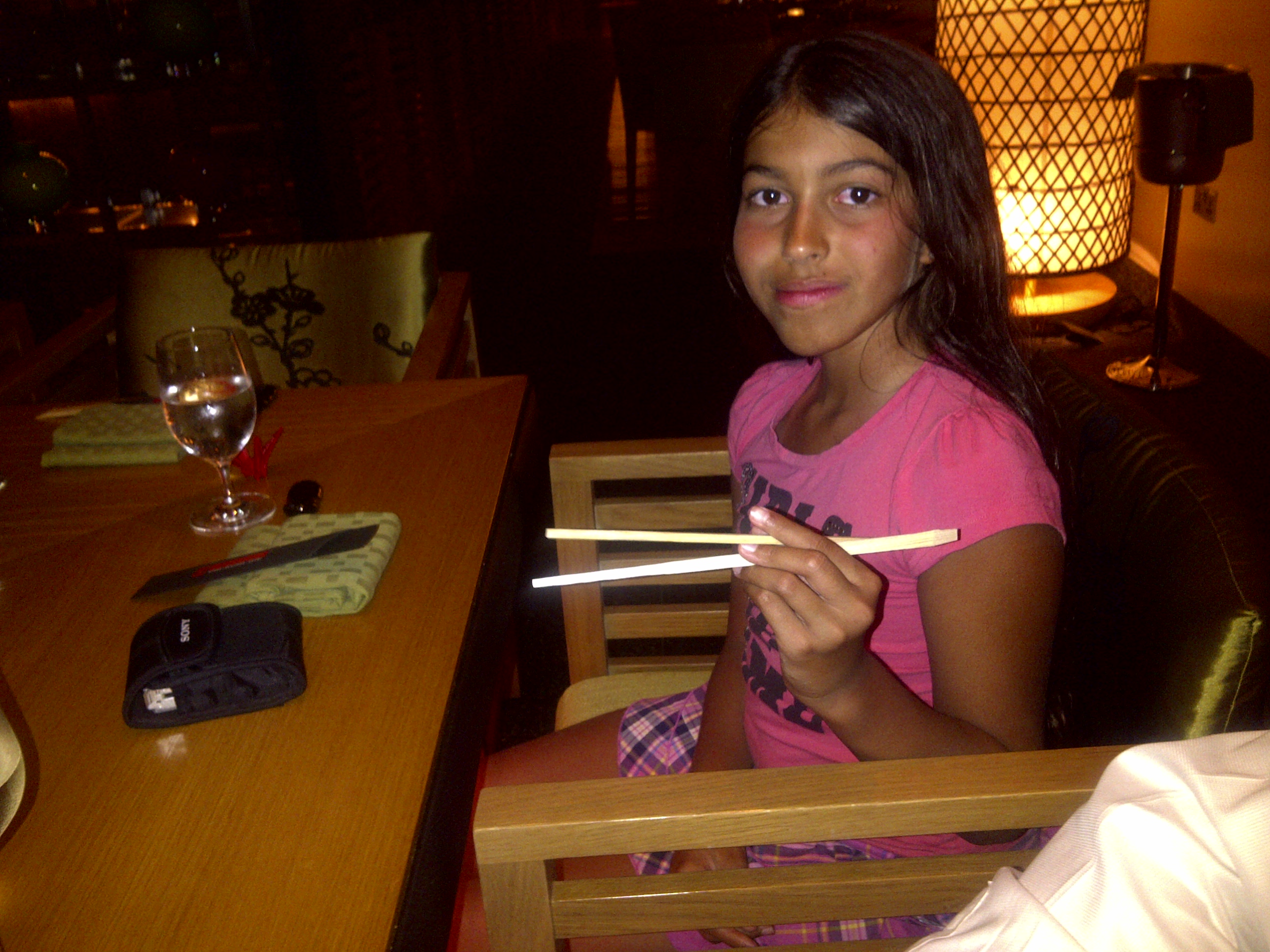
Its time for Dim Sum

Little Diva NJD is ready for dim sum in Seoul Korea

Taking mandarin lessons is tough….the language is tough as it is but for some reason, most syllabus use food a lot in the lessons – I guess because everyone knows Chinese food so our dear teachers think it’s the easiest way to teach us the language.

Tonight my lesson was on Shaomai (shāo mài) which  is a traditional Chinese dumpling served in dianxin/dim sum. The first time I had this was on a roadside stall in Malaysia on my way from KL to Penang. My companion spoke mainly Cantonese and was a huge fan of dim sum. All I knew was that I loved the little bamboo steamers it came in and enjoyed each delicate piece with a dollop of spicy chilli sauce.

In my lesson today, I learnt that I should be able to recognise a Shaomai as it has a fluffy and flowery shape on the top. Although shaomai originates from steamed stuffed bun (I’ve seen a lot of these a lot on the streets of Malaysia, Hong Kong, Macau and Singapore), these two similar kinds of food have two main differences. First, the outer covering of shaomai is made of a thin sheet of lye water dough; Secondly, shaomai differ from steamed buns in that their outer covering is not sealed but instead has a pomegranate shape….i prefer the shaomai any day.

Once well steamed in the pot, shaomai are prized for the thin skin and abundant fillings. Shaomai is in the shape of a cup, not only delicious but also beautiful. There are two regional varieties of shaomai: a Cantonese version and a version from the Jiangnan region…frankly I couldn’t tell the difference but I certainly love a good shaomai in my Friday brunch.

In KL, I loved the dim sum varieties at the Pan Pacific Sunday brunch, In Singapore its best to try it at Paradise Point and in Dubai, Shangri-La does it best! I didn’t have much time in Korea and Macau to try good recommended Dim Sum but the best has to be in Hong Kong – I wanted to go to Maxim’s on the way to Fiji but the stopover was too short so I tried random restaurants and they were all awesome for dim sum.

Once again, I have diverted to food… I blame my Mandarin instructor. Each lesson this week was related to food and brought back heaps of memories from Asia.

Hidden health secrets from Kiwifruit

How gorgeous and tempting is this Kiwi Artwork

One of the beauties of coming from an exotic island tropical paradise is that you grow up eating wholesome organic fruits in abundance….and what we don’t have in sunny Fiji Islands, we get from our neighbours Australia & New Zealand. Without doubt, one of the most healthiest fruits from NZ is kiwifruit and the best ones to get is from ZESPRI which is now on the supermarket shelves of the UAE….delightful!

Since I am always on the lookout for the next best thing with health benefits, ZESPRI’s  “superfruit” status caught my eye. Citing the high levels of Vitamins C and E, low glycemic index (GI) and high fibre content of kiwifruit, New Zealand growers stress that it is particularly well suited to the UAE due to the help it provides in the management of diabetes, which is so prevalent here.

Supporting ZESPRI’s campaign is Hala Barghout, a leading nutritionist and licensed clinical dietician in Dubai. She stresses that everyone knows that citrus fruit contains vitamin C, but a kiwifruit actually contains twice as much vitamin C as an orange of the same size – and three times as much as a lemon. “Vitamin C helps strengthen the body’s defences and promotes healthy bones, teeth and blood vessels. Kiwifruit is high in fibre and is also a good source of the antioxidant Vitamin E. It provides twice the level of Vitamin E as an apple and is five times more nutritious.”

I met Warren Young and Ben Hughes from ZESPRI International who were explaining the difference between traditional green kiwifruit now on sale in the UAE and the newer gold variety which will be here later – it provides faster Vitamin C absorption in the body than an artificial vitamin supplement. I am the only one at home who eats Kiwifruit so I was delighted to hear what Hala and Ben had to say and may use this to convince NJD to start eating kiwifruit.

The kiwifruit actually originated in China and was known initially as the Chinese gooseberry when seeds were first transported to New Zealand. However, New Zealand growers became the world’s largest source for the fruit, which became known globally as the kiwifruit after New Zealand’s national symbol…..in fact in Fiji, when we say ‘are you a Kiwi?’, we mean are you a New Zealander. Since 20% of my family members are now Kiwi’s, perhaps its about time to hang out with them in Kiwi Land and try ZESPRI straight off the fields.

Exciting new science centre to be launched in Bahrain

Children interacting at the new state-of-the-art Bahrain Science Centre

Bahrain’s Ministry of Human Rights and Social Development has appointed MTE Studios to run operations of the Bahrain Science Centre which is slated to open soon to public. Experts in Science Centre and Museums operations and management, the company has been awarded a two year contract for Commissioning and Operating the new state-of-the-art Bahrain Science Center (BSC). According to the Minister of Human Rights and Social Development, Fatima Al Beloushi, the science centre will fall under the Directorate of Family and Childhood Development in her Ministry, and will contribute to formal and non-formal science education and awareness programmes in Bahrain. Khalid Ishaq, Assistant Undersecretary of Community Development of Bahrain’s Ministry of Human Rights and Social Development said, “Importance of science centres to the community and education is undebatable. Our aim is to strengthen the science and technology culture of Bahrain by engaging young people, and their families, in activities that excite their interest in science, technology and engineering.” The Ministry has awarded a two-year contract to MTE Studios to develop the science centre. MTE Studios is a consultancy company that specializes in the conceptualization, design, development and operation of science centres, museums, visitor centres and other edutainment destinations. One of their most recent projects was the development of the Museum of Science and Technology in Islam at the King Abdullah University of Science and Technology in Saudi Arabia. Commenting on the appointment, Ishaq said, “We are excited to open the centre soon and collaborate with MTE Studios, whom we have identified as an experienced and valuable partner for our new Science Centre. We are confident that their extensive experience in operating Science Centre’s will help us achieve our goal in the accomplishment of social cohesion and attract the young generation towards science education and research. We look forward to the launch and success of the new centre.” “We are delighted to be awarded this contract as we believe that a science centre will contribute strongly to the Ministry’s social development programmes”, says the CEO of MTE Studios, Ludo Verheyen. “It has been shown worldwide that science centres are one of the most effective ways of bringing science and technology into the mainstream of society and strengthening a country’s science culture”, added Verheyen. Over 2 500 interactive science centres have been established in more than 90 countries worldwide, and they receive over 310 million visitors per year. Globally, science centres and interactive museums have taken the lead in hands-on, inquiry-based learning, and have achieved a high trust rate for the accuracy of the information that they convey. The Bahrain Science Centre will be an active participant in this worldwide community of science centres. “Science centres play many important roles in society”, says Professor Mike Bruton, Director of Imagineering at MTE Studios and the Consultant Director of the new Science Centre. “These roles include promoting awareness of science and technology among the youth, families and adults, supporting the school curriculum in science, mathematics and technology, and creating a forum for public debate on topical science and technology issues.” School Groups will be formally invited to the Bahrain Science Centre from middle of April onwards. The target audience of the Bahrain Science Centre will be children as well as families and adults, and one of its most important roles will be to promote cross-generational learning between children and their parents and grandparents. The science centre will also endeavour to promote social engagement across different cultures as well as an ethos of lifelong learning.