Piaget Cocktail: Couture Creativity and Joyful Highlife

Natasha Dury

For decades, Piaget has embodied a glamorous world where high jewellery, artistic freedom, and celebration exist in perfect harmony. Drawing inspiration from the legendary spirit of the Piaget Society, an era defined by elegance, creativity, and jet-set sophistication, the Maison’s latest Piaget Cocktail collection captures that same sense of joyful extravagance in a contemporary and highly wearable form.

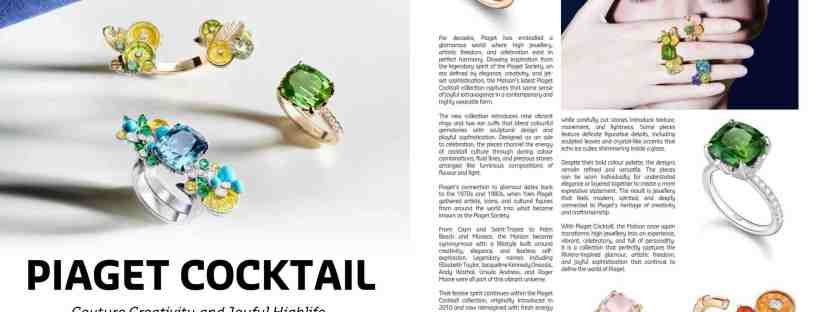
The new collection introduces nine vibrant rings and two ear cuffs that blend colourful gemstones with sculptural design and playful sophistication. Designed as an ode to celebration, the pieces channel the energy of cocktail culture through daring colour combinations, fluid lines, and precious stones arranged like luminous compositions of flavour and light.

Piaget’s connection to glamour dates back to the 1970s and 1980s, when Yves Piaget gathered artists, icons, and cultural figures from around the world into what became known as the Piaget Society.

From Capri and Saint-Tropez to Palm Beach and Monaco, the Maison became synonymous with a lifestyle built around creativity, elegance, and fearless self-expression. Legendary names including Elizabeth Taylor, Jacqueline Kennedy Onassis, Andy Warhol, Ursula Andress, and Roger Moore were all part of this vibrant universe.

That festive spirit continues within the Piaget Cocktail collection, originally introduced in 2010 and now reimagined with fresh energy and contemporary flair. Bright tourmalines, aquamarines, citrines, emeralds, amethysts, turquoise, and diamonds are paired in unexpected combinations that evoke the colours and freshness of exotic cocktails. Lemon-yellow sapphires, mint-green tourmalines, icy purple amethysts, and soft pink quartz create compositions that feel playful yet unmistakably luxurious.

The rings are sculpted with fluid curves inspired by the shape of a cocktail straw, while carefully cut stones introduce texture, movement, and lightness. Some pieces feature delicate figurative details, including sculpted leaves and crystal-like accents that echo ice cubes shimmering inside a glass.

Despite their bold colour palette, the designs remain refined and versatile. The pieces can be worn individually for understated elegance or layered together to create a more expressive statement. The result is jewellery that feels modern, spirited, and deeply connected to Piaget’s heritage of creativity and craftsmanship.

With Piaget Cocktail, the Maison once again transforms high jewellery into an experience, vibrant, celebratory, and full of personality. It is a collection that perfectly captures the Riviera-inspired glamour, artistic freedom, and joyful sophistication that continue to define the world of Piaget.

Parmigiani Fleurier Captures the Spirit of Alpine Elegance

The TONDA PF Sport Chronograph Silver Verzasca Blends Precision with Refined Luxury

Shereen Shabnam

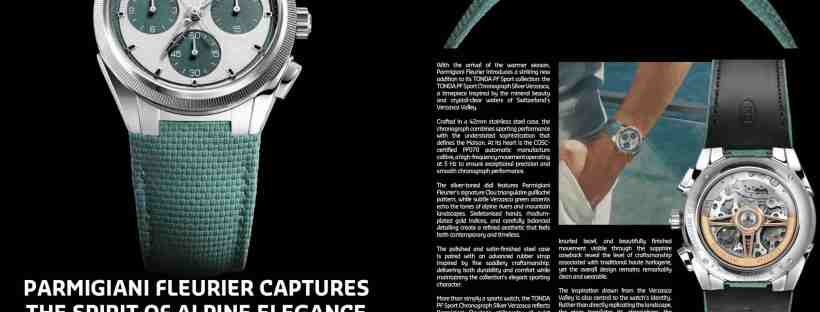
With the arrival of the warmer season, Parmigiani Fleurier introduces a striking new addition to its TONDA PF Sport collection: the TONDA PF Sport Chronograph Silver Verzasca, a timepiece inspired by the mineral beauty and crystal-clear waters of Switzerland’s Verzasca Valley.

Crafted in a 42mm stainless steel case, the chronograph combines sporting performance with the understated sophistication that defines the Maison. At its heart is the COSC-certified PF070 automatic manufacture calibre, a high-frequency movement operating at 5 Hz to ensure exceptional precision and smooth chronograph performance.

The silver-toned dial features Parmigiani Fleurier’s signature Clou triangulaire guilloché pattern, while subtle Verzasca green accents echo the tones of alpine rivers and mountain landscapes. Skeletonised hands, rhodium-plated gold indices, and carefully balanced detailing create a refined aesthetic that feels both contemporary and timeless.

The polished and satin-finished steel case is paired with an advanced rubber strap inspired by fine saddlery craftsmanship, delivering both durability and comfort while maintaining the collection’s elegant sporting character.

More than simply a sports watch, the TONDA PF Sport Chronograph Silver Verzasca reflects Parmigiani Fleurier’s philosophy of quiet luxury, where performance, craftsmanship, and design exist in complete harmony. Equally suited to a mountain escape or an elegant dinner setting, the watch captures a lifestyle defined not by excess, but by precision, balance, and effortless refinement.

What makes the Silver Verzasca particularly compelling is its ability to merge technical intensity with visual restraint. The chronograph’s integrated architecture, knurled bezel, and beautifully finished movement visible through the sapphire caseback reveal the level of craftsmanship associated with traditional haute horlogerie, yet the overall design remains remarkably clean and wearable.

The inspiration drawn from the Verzasca Valley is also central to the watch’s identity. Rather than directly replicating the landscape, the piece translates its atmosphere, the clarity of alpine light, the movement of water over polished stone, and the calm elegance of the Swiss outdoors into colour, texture, and proportion.

For collectors and enthusiasts who appreciate subtle sophistication over overt statement-making, the TONDA PF Sport Chronograph Silver Verzasca offers a modern interpretation of luxury sports watchmaking: refined, highly engineered, and quietly confident.

Art Dubai at 20 as it Helps Shape a Cultural Capital

Natasha Dury

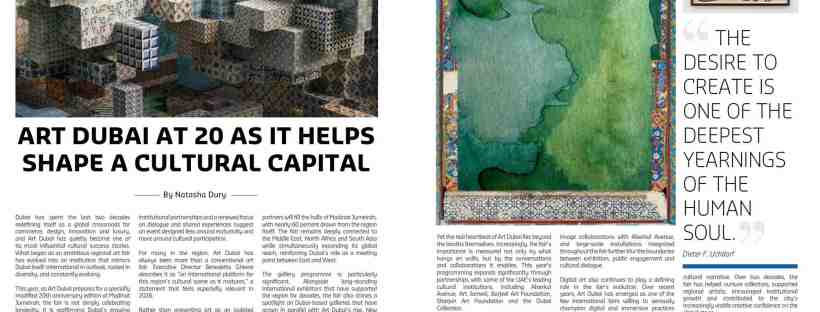
Dubai has spent the last two decades redefining itself as a global crossroads for commerce, design, innovation and luxury, and Art Dubai has quietly become one of its most influential cultural success stories. What began as an ambitious regional art fair has evolved into an institution that mirrors Dubai itself: international in outlook, rooted in diversity, and constantly evolving. This year, as Art Dubai prepares for a specially modified 20th anniversary edition at Madinat Jumeirah, the fair is not simply celebrating longevity. It is reaffirming Dubai’s growing confidence as one of the world’s most dynamic cultural capitals.

The special edition arrives during a moment of global uncertainty for the art market, yet its tone is notably optimistic. Presented in partnership with A.R.M. Holding, with Dubai Culture & Arts Authority serving as strategic partner, the fair places collaboration, accessibility and resilience at the centre of its vision. Free public entry, expanded institutional partnerships and a renewed focus on dialogue and shared experiences suggest an event designed less around exclusivity and more around cultural participation.

For many in the region, Art Dubai has always been more than a conventional art fair. Executive Director Benedetta Ghione describes it as “an international platform for this region’s cultural scene as it matures,” a statement that feels especially relevant in 2026. Rather than presenting art as an isolated luxury commodity, Art Dubai continues to position itself as part of a wider creative ecosystem, bringing together artists, galleries, collectors, institutions and audiences in ways few fairs globally have managed to sustain.

This year’s special edition reflects that ambition through a carefully curated programme spanning contemporary, modern and digital art practices. Around 75 presentations from galleries, institutions and partners will fill the halls of Madinat Jumeirah, with nearly 60 percent drawn from the region itself. The fair remains deeply connected to the Middle East, North Africa and South Asia while simultaneously expanding its global reach, reinforcing Dubai’s role as a meeting point between East and West.

The gallery programme is particularly significant. Alongside long-standing international exhibitors that have supported the region for decades, the fair also shines a spotlight on Dubai-based galleries that have grown in parallel with Art Dubai’s rise. New exhibitors join established names, creating a blend of emerging voices and internationally recognised institutions that reflects the city’s increasingly sophisticated cultural identity. In a notable response to current market pressures, the fair has also introduced an innovative risk-sharing model where gallery booth costs are linked to sales success, a move that underscores Art Dubai’s reputation for experimentation and adaptability.

Yet the real heartbeat of Art Dubai lies beyond the booths themselves. Increasingly, the fair’s importance is measured not only by what hangs on walls, but by the conversations and collaborations it enables. This year’s programming expands significantly through partnerships with some of the UAE’s leading cultural institutions, including Alserkal Avenue, Art Jameel, Barjeel Art Foundation, Sharjah Art Foundation and the Dubai Collection.

Among the highlights is “Made Forward,” a major presentation from Dubai Collection, the city’s first institutional collection of modern and contemporary art. Elsewhere, the 20th edition of the Global Art Forum, commissioned by Shumon Basar under the title “Before and After Everything,” promises the kind of cross-disciplinary discussions that have become synonymous with Art Dubai’s identity. Performance-led programming curated with Sharjah Art Foundation, moving-image collaborations with Alserkal Avenue, and large-scale installations integrated throughout the fair further blur the boundaries between exhibition, public engagement and cultural dialogue.

Digital art also continues to play a defining role in the fair’s evolution. Over recent years, Art Dubai has emerged as one of the few international fairs willing to seriously champion digital and immersive practices beyond trend-driven novelty. Its continued emphasis on digital culture reflects Dubai’s own future-facing mindset, positioning the city at the forefront of conversations surrounding technology, creativity and cultural production.

What makes this year especially compelling, however, is the sense of reflection underpinning the anniversary edition. There is a recognition that Art Dubai’s journey has become inseparable from Dubai’s broader cultural narrative. Over two decades, the fair has helped nurture collectors, supported regional artists, encouraged institutional growth and contributed to the city’s increasingly visible creative confidence on the global stage.

In many ways, the fair’s evolution mirrors Dubai’s own transformation. Both began as ambitious propositions often underestimated by outsiders. Both have grown through boldness, adaptability and a willingness to challenge conventional models. And both now occupy a position where global attention is no longer about potential, but influence.

The desire to create is one of the deepest yearnings of the human soul.” 

– Dieter F. Uchdorf-

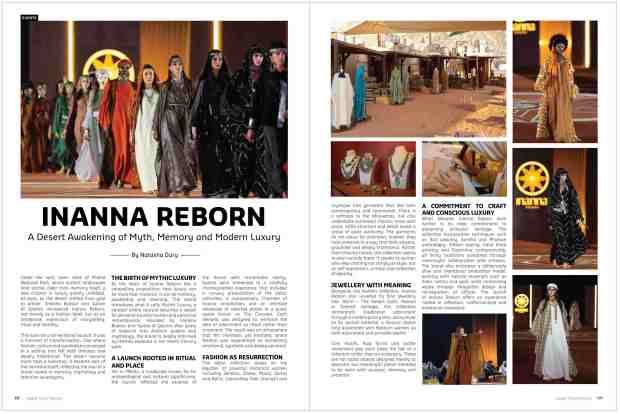
Inanna Reborn: A Desert Awakening of Myth, Memory and Modern Luxury

Natasha Dury

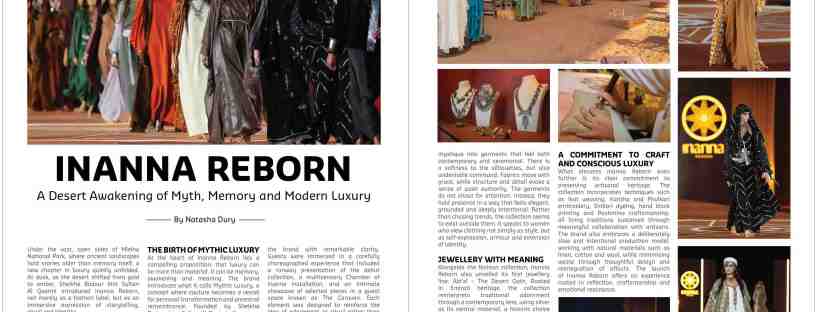
Under the vast, open skies of Mleiha National Park, where ancient landscapes hold stories older than memory itself, a new chapter in luxury quietly unfolded. At dusk, as the desert shifted from gold to amber, Sheikha Bodour bint Sultan Al Qasimi introduced Inanna Reborn, not merely as a fashion label, but as an immersive expression of storytelling, ritual and identity.

This was not a conventional launch. It was a moment of transformation. One where fashion, culture and symbolism converged in a setting that felt both timeless and deeply intentional. The desert became more than a backdrop; it became part of the narrative itself, reflecting the soul of a brand rooted in memory, mythology and feminine sovereignty.

The Birth of Mythic Luxury

At the heart of Inanna Reborn lies a compelling proposition: that luxury can be more than material. It can be memory, awakening and meaning. The brand introduces what it calls Mythic Luxury, a concept where couture becomes a vessel for personal transformation and ancestral remembrance. Founded by Sheikha Bodour bint Sultan Al Qasimi after years of research into Arabian queens and mythology, the brand is deeply informed by themes explored in her recent literary work.

A Launch Rooted in Ritual and Place

Set in Mleiha, a landscape known for its archaeological and cultural significance, the launch reflected the essence of the brand with remarkable clarity. Guests were immersed in a carefully choreographed experience that included a runway presentation of the debut collection, a multisensory Chamber of Inanna installation, and an intimate showcase of selected pieces in a guest space known as The Caravan. Each element was designed to reinforce the idea of adornment as ritual rather than ornament. The result was an atmosphere that felt cinematic yet intimate, where fashion was experienced as something emotional, symbolic and deeply personal.

Fashion as Resurrection

The debut collection draws on the legacies of powerful historical women including Zenobia, Sheba, Mavia, Samsi and Abi’el, translating their strength and mystique into garments that feel both contemporary and ceremonial. There is a softness to the silhouettes, but also undeniable command. Fabrics move with grace, while structure and detail evoke a sense of quiet authority. The garments do not shout for attention; instead, they hold presence in a way that feels elegant, grounded and deeply intentional. Rather than chasing trends, the collection seems to exist outside them. It speaks to women who view clothing not simply as style, but as self-expression, armour and extension of identity.

Jewellery with Meaning

Alongside the fashion collection, Inanna Reborn also unveiled its first jewellery line: Abi’el – The Desert Oath. Rooted in Emirati heritage, the collection reinterprets traditional adornment through a contemporary lens, using silver as its central material, a historic choice long associated with Bedouin women as both adornment and portable wealth. Coin motifs, fluid forms and tactile movement give each piece the feel of a talisman rather than an accessory. These are not static objects designed merely to decorate, but meaningful pieces intended to be worn with purpose, memory and presence.

A Commitment to Craft and Conscious Luxury

What elevates Inanna Reborn even further is its clear commitment to preserving artisanal heritage. The collection incorporates techniques such as Ikat weaving, Kantha and Phulkari embroidery, Shibori dyeing, hand block printing and Pashmina craftsmanship, all living traditions sustained through meaningful collaboration with artisans. The brand also embraces a deliberately slow and intentional production model, working with natural materials such as linen, cotton and wool, while minimising waste through thoughtful design and reintegration of offcuts. The launch of Inanna Reborn offers an experience rooted in reflection, craftsmanship and emotional resonance.

Shaping the Future of Climate-Responsive Living

The Future of Desert Living to Take Centre Stage at the 2nd Desert Architecture MENA Forum

Dubai, UAE: Positioning desert architecture at the forefront of climate responsive design, the 2nd Desert Architecture MENA Forum returns on 30–31 March 2026 at the Habtoor Grand Resort, following the success of its inaugural edition last year. Under the theme “Integrating Heritage with Innovation: The Future of Desert Living”, the Forum will bring together global architects, policymakers, developers, sustainability leaders, and technology innovators.

As the region’s only platform dedicated to desert architecture, the Forum addresses one of the most pressing challenges facing the Middle East and arid regions worldwide: how to design cities, buildings, and communities that are resilient, climate-smart, and culturally rooted in desert environments.

The 2026 edition will expand its scope with deeper technical discussions, real-world case studies, and actionable strategies focused on climate-resilient urbanism, low-carbon materials, passive cooling systems, regenerative landscapes, and self-sufficient infrastructure. More than an event, the Forum serves as a marketplace of ideas and partnerships, providing direct access to project owners, regulators, architects, consultants, contractors, and technology providers shaping the next generation of desert cities.

Mark Powell Kyffin, Director of Architecture, Project Management and Engineering, with the Department of Culture and Tourism in Abu Dhabi highlighted the importance of such platforms in shaping future cities, stating: “Desert architecture is not a constraint. It is an opportunity. Rooted in heritage, culture, and innovation, the region is uniquely positioned to lead the world in climate-responsive design. Forums such as this are essential in fostering dialogue, knowledge exchange, and collaboration that translate vision into meaningful, lasting impact.”

Commenting on the Forum’s return, Leila Masinaei, Managing Partner at Great Minds Events, said: “The Desert Architecture MENA Forum was created to move beyond theory and deliver practical, scalable solutions for building in desert climates. The second edition reflects the urgency of the moment, where climate realities demand collaboration, innovation, and a renewed respect for traditional desert wisdom combined with cutting-edge design and technology.”

The Forum aligns closely with the UAE’s broader sustainability, urban development, and cultural preservation agendas. It also reinforces the region’s growing role as a global leader in climate-responsive architecture.

Across two days, the Forum will host 35+ international speakers from leading global and regional firms including Foster + Partners, BIG – Bjarke Ingels Group, Snohetta, Killa Design, Arup, AECOM, SOM, HKS, and DLR Group, alongside senior representatives from government authorities, municipalities, and academic institutions.

Key objectives of the Forum include strengthening cross-sector collaboration, showcasing smart materials and emerging technologies, blending traditional desert knowledge with contemporary design solutions, and positioning the MENA region as a global hub for climate-responsive architecture.

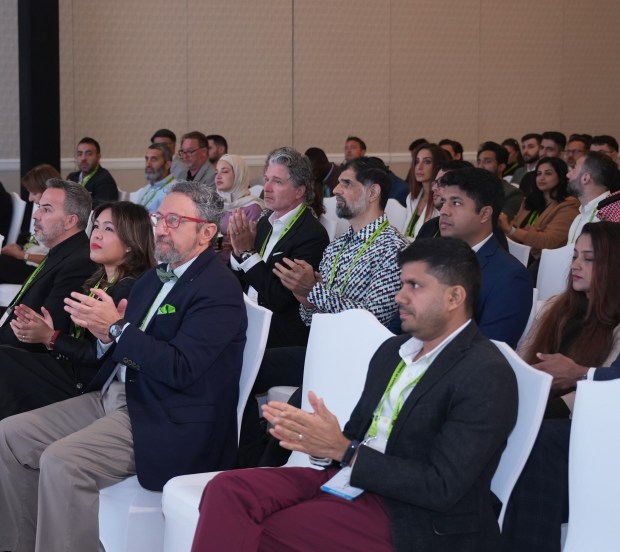
The event will welcome 300+ delegates from across the region and beyond, including government authorities, project owners, developers, architectural firms, consultancies, EPCs, and senior decision-makers spanning architecture, design, sustainability, engineering, R&D, and construction.

As part of the Forum, the Desert Architecture Recognition Awards 2026 will take place on 31 March, celebrating visionaries redefining excellence in arid-climate design. The Awards will recognise achievements across sustainable materials, façade innovation, regenerative landscapes, digital design, architectural lighting, and emerging talent, concluding with an exclusive reception dinner and networking evening.

With over 20 sessions, and case studies, and participation from over 15 countries, the 2nd Desert Architecture MENA Forum promises to be a defining platform for advancing sustainable, culturally grounded, and future-ready design across desert regions.

For more information, visit https://desertarchitectureforum.com/

THE WORLD PARK FOR PEACE LAUNCHES IN THE UAE AMID GLOBAL CALL FOR UNITY AND HOPE

Initiative supported byShaikh Ali Abdalla Rashid Nasir Almulla and International Opera Singer Inva Mula.

In a world increasingly fractured by conflict and uncertainty, the launch of the World Park for Peace in Dubai offers a timely and powerful symbol of hope, unity, and sustainability. Set within the historic Al Fahidi area, the park is an immersive exhibition that speaks a universal language – the language of peace through the eyes and imagination of children. The park opening was attended by well known local Emirati artist, Shaikh Ali Abdalla Rashid Nasir Almulla and International Opera Singer, Inva Mula.

The World Park for Peace invites visitors on a moving journey through creatively curated spaces that reflect the core elements of the universe. Each room has been transformed to evoke emotion and inspiration, showcasing the profound connection between humanity, nature, and our shared future. At the heart of this experience is a global collection of more than 200,000 drawings till today from over 152 countries, a visual testament to the universal yearning for peace.

This monumental initiative stems from a decade-long movement led by the Association Colors for Peace. Over the past ten years, children aged 4 to 12 from every continent have contributed their visions of peace, resulting in one of the world’s most extensive children’s art archives dedicated to harmony and understanding.

Founder Aurela Cuku, whose vision brought the World Park for Peace to life, expressed the deeper mission behind the project. “In a time when the world is seeking answers, we are choosing to listen to the quiet voices of children. These are voices that imagine a world without war, without fear, and without division,” said Cuku. “The World Park for Peace is not just an exhibition; it is a call to action. It is a tangible space where nations connect without borders, where art becomes diplomacy, and where children lead the way toward a peaceful tomorrow.”

The transformation of the House of Peace honors Dubai’s heritage while creating a global dialogue rooted in innocence, creativity, and sustainable values. As the UAE continues to champion cultural tolerance and coexistence, this landmark project is set to become a cornerstone of international cultural diplomacy and a beacon of inspiration for generations to come.

The World Park for Peace is now partly open to the public, offering a unique and timely opportunity to witness the extraordinary power of art, imagination, and unity — through the eyes of a child.