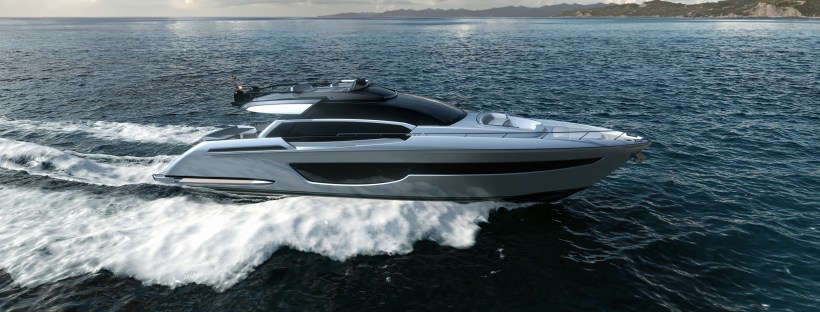
The new flagship of the storied Sarnico shipyard entered the water on Lake Iseo
Sporty, elegant and instantly exhilarating, Riva 68’ Diable touched the water for the first time on Lake Iseo. An irresistible design, magnetic beauty and amazing performance are the distinctive features of this incredibly alluring new masterpiece, forged in the storied Sarnico shipyard and scheduled to make its debut in September at the Cannes Yachting Festival 2021.
With Riva 68’ Diable, a new star is born in the under 70-foot open yacht market, where Riva is the undisputed leader because of its ability to innovate with elite boats that anticipate trends and satisfy the tastes of highly evolved owners.
The brainchild of Mauro Micheli, founder with Sergio Beretta of Officina Italiana Design, working in partnership with the Product Strategy Committee led by Mr. Piero Ferrari and the Group Engineering Department, this incredible yacht revolutionises the open concept, incorporating exciting technological and functional design innovations that elevate liveability and comfort on board to their maximum level. All embellished by the traditional style features and premium detailing that have been distinctive features of Riva’s iconic status from the outset.
“Riva 68’ Diable is the irresistible temptation to which every Riva owner and fan can’t wait to succumb. It looks like a design from the future, but is also a fantastic journey through Riva’s hallmark style and sophisticated detailing,” said Ferretti Group CEO Alberto Galassi. “An unrivalled mix of innovation and masterful hand craftsmanship, it offers outstanding performance and unparalleled comfort. I understand the enthusiasm generated around this incredible boat and it gives me immense pleasure.”
One of the stand-out new features and strengths of this yacht is the innovative built-in hard top, with a clean, linear design that hides the technical and technological elements from view. This ingenious and versatile solution protects and shelters the central areas of the yacht, including the dining area and the helm station on the main deck. The result is total coverage and maximum comfort, without sacrificing the enjoyment and sportiness of an open yacht with a top speed of 40 knots.
Another interesting functional design feature is the sunroof that can be opened in two directions (forwards and reverse) for maximum liveability and comfort on the move.
The layout of the lower deck features three cabins for six guests, arranged around an open space containing a
galley and a dinette for versatility and convenience. The master cabin is amidships, with the twin cabin with single beds to port and the VIP forward.
To discover all the secrets and outstanding design solutions that will seduce owners around the world, Riva 68’ Diable will make its official debut in a world premiere at the Cannes Yachting Festival, in September 2021, after which it will move on to the Genoa Boat Show.
The iconic American 1921 watch faithfully recreated as if in 1921
To mark the 100th anniversary of the American 1921 watch, Vacheron Constantin has delved into its archives and its horological expertise to offer a faithful reproduction of the timepiece emblematic of an era. Stemming from an impressive technical and human epic saga pushing the limits of fine craftsmanship excellence, the creation of the American 1921 Pièce unique watch mobilised the remarkable expertises of the Maison’s Restoration workshop and the Heritage department for an entire year. This approach might be a first in the watch industry, reflecting Vacheron Constantin’s commitment to the conservation, transmission and continuous enrichment of its heritage and of traditional skills.
Only 24 pieces of the reference dated 1921 were originally manufactured. Today only one of them is part of Vacheron Constantin’s private collection, making it an extremely rare and sought-after timepiece for collectors and watch connoisseurs. Some watches tell stories, inviting us to travel back in time, to retrace origins and immerse oneself in bygone eras. Faithfully recreated as if in 1921, the American 1921 Pièce unique watch presented this year is a case in point, offering a journey into the creativity of the Roaring Twenties and reviving the beauty of artisanal skills as practiced a century ago. More than a jubilee watch, it is the fruit of a fascinating odyssey into the heart of the artisanal know-how cultivated by Vacheron Constantin for over 265 years.
Heritage and Restoration departments’ commitment to perpetuate the art of high watchmaking
When the idea of faithfully recreating an American 1921 model from the Vacheron Constantin private collection first took shape, the project looked set to be both exciting and ambitious.
A bridge between the past and future of the Maison, the Vacheron Constantin Heritage department has a place of its own within the Manufacture. Spanning an exceptional timeline that began in 1755, and overseeing a unique collection, it is anything but a dusty museum. The research and expertise of the teams working there on a daily basis are an inexhaustible source of inspiration for the creation of new collections and a masterful reference for the Restoration workshop. The department preserves 800 machine tools, workbenches and sets of watchmaking tools, along with substantial documentary and iconographic archives. No less than 420 linear metres are taken up by an infinite wealth of production and accounting registers comprising foreign sales, correspondence between associates, suppliers and clients, various documents and photographs. All contribute to shedding both historical and artistic light on Vacheron Constantin’s activity through the years and centuries. They represent a sum of written instruments serving to ensure the traceability of a creation since its origins, given that all the models produced are systematically referenced in the production registers. This unprecedent heritage helped retrace the history of the creation of the American 1921 and provided a solid basis for the Restoration workshop teams. The latter thus took up the authentic challenge of reviving some forgotten skills and combining today’s techniques with yesterday’s know-how.
Few Manufactures are able to restore all the watches that have come out of their workshops for centuries. That is why Vacheron Constantin makes it a point of honor to pass on this watchmaking know-how and to ensure that the great history of each of its timepieces continues. The skill and style of the Restoration artisans thus consists in showing respect for ethical considerations in their work. To achieve this, they can draw upon a substantial stock of components, adjust component blanks or entirely remake them – the latter being the most delicate task of all and calling for particularly complex size calculations. Experts in the art of maintaining Vacheron Constantin’s oldest timepieces without altering their nature, the Restoration workshop’s seasoned watchmakers are thus accustomed to combining a historian’s perspective with scientific analysis, but until now they had never undertaken to reproduce an antique watch in its entirety. This unprecedented work of reconstitution, respectful of ethics because it is faithful and precise down to the smallest detail, called upon the multiple competencies of these artisans, who pursued an empirical approach throughout this year-long project.
Several months of research in the Manufacture’s archives, weeks of reflection and observation, numerous experiments, as well as unsuccessful attempts and successful trials were necessary to produce such a work. The American 1921 Pièce unique will be in the spotlight throughout 2021 through prolonged exposure in Vacheron Constantin boutiques around the world.
In order to reproduce the hand-crafted operations performed back in the day, artisans had to work with some historical tools from Vacheron Constantin’s Heritage. A late 19th century facing lathe enabled them to faithfully recreate the elements composing the case; a rounding-up (topping) tool from the latter half of the 19th century served to modify the profile of wheel teeth and to adjust their diameter. Watchmakers used an 18th century upright drilling accessory to drill through the movement’s mainplate. To drive the jewels into their settings, they resorted to an early 20th century staking tool.
These vintage machines were complemented by tools specially made for this project, such as custom-made milling-cutters and riveting tools in line with those of the early 20th century, enabling the artisans to work in a manner attuned to that period and closely reproducing the operations and development techniques of the time. The result of this remarkable stylistic exercise is an exceptional collector’s item symbolising Vacheron Constantin’s unwavering commitment to the transmission, enhancement and continuous enrichment of its production skills.
Rebirth of a vintage movement
While the watchmakers in Vacheron Constantin’s Restoration workshop fully master the art of bringing back to life the most exceptional timepieces produced by the Manufacture in the course of its long history, never before had they been called upon to rebuild a vintage calibre from scratch.
They began by disassembling and examining every single component of the original 11-ligne Calibre Nouveau powering the original model. Apart from the bridges and mainplate which had to be recreated, the Restoration workshop’s stocks proved to be a goldmine for the artisans who thereby had access to all the necessary blank parts. This involved extremely laborious research, since a vintage case could contain an infinite number of components, all different in terms of size and shape. In order to identify them one by one, the first stage consisted in taking the measurements and dimensions of each of the 115 components of the original movement. This meticulous work of observation and comparison subsequently led watchmakers to make plans and mock-ups of the calibre, a particularly delicate task requiring extremely complex sizing calculations.
At this stage, the archive documents safeguarded by the Heritage department proved extremely valuable, notably in recreating the bridges and the mainplate according to the specificities of this vintage movement. How could each component be adjusted and calibrated prior to assembly? How should the vintage machines be regulated? How could the jewels be set on the movement, whereas they are now generally driven in? How could the exact colour of the gilding on the wheels be achieved? At what distance and at which height should they be placed in order to be faithful to the original calibre? These were all issues that the watchmakers had to resolve by assembling the components one by one, as any potential error could jeopardise the entire project.
Setting the jewels on the movement was also a real tour de force. Since the 1940s, it has been customary to drive in the jewels, and while the watchmakers in Vacheron Constantin’s Restoration workshop are accustomed to replacing damaged jewels on very old timepieces, until now they had never had the opportunity to make the settings themselves. Successfully hollowing out the metal to the exact depth required to fit the stones to the nearest hundredth required multiple trials. Not to mention the patient research work required to develop the system for reproducing the unique ribbed pattern which, alongside various manual engravings, adorns the movement in the same way as was done at the time.
A dial and case distinguished by sophisticated craftsmanship
Accurately reproducing the exterior of the American 1921 also represented a real feat of manual workmanship. Here again, Vacheron Constantin’s watchmakers had to provide answers to numerous technical questions by observing the 1921 timepiece in minute detail, while comparing it with archive documents, and then individually crafting each element of the case and dial.
Some period components were available in the stocks of the Restoration workshop, such as rough blanks of the crown and hands. Others had to be entirely recreated, starting with the 31.5 mm case, according to the dimensions of the original American 1921. It was crafted by a Restoration workshop goldsmith from the specific gold alloy used for the historical model (18K 3N yellow gold), identified with the help of a spectrometer in order to reproduce its exact colour. Only a laser engraving applied to the case back, for customs purposes, distinguishes the American 1921 Pièce unique watch from its ancestor.
The creation of the dial also called for highly specialised expertise on the part of the artisan responsible for restoring the grain and unique beauty of the original dial. Crafted in Grand Feu enamel, an ancestral technique considered to be one of the most delicate in the field of watchmaking ornamentation, it required numerous firings in the kiln at a temperature of over 800°C. It features vintage numerals and logo, along with slender open-tipped hands that have been hand-blued by the Restoration workshop using the production techniques of the time.
And since no detail is left to chance, the exercise in style has continued right the way through to the end of the strap, whose pin buckle in 18K 3N yellow gold (the same alloy as the original model) was also produced in the Vacheron Constantin workshop.
A tribute to the art of wearing a watch in 1921
Because it retains all the original properties of the original American 1921, this unique, identically recreated timepiece reflects a historian’s approach.
It subtly mirrors the social and cultural context of the 1920s, the effervescence and the wind of freedom blowing across the United States and Europe at the dawn of the Roaring Twenties. Its distinctive design illustrates the stylistic creativity of Vacheron Constantin which revelled in expressing its “classic with a twist” style through multiple case shapes.
It also tells the story of the early days when the wristwatch began to become more widespread. At that time, men’s wristwatches were only just beginning to take precedence over pocket watches, until then regarded as more robust and accurate. Despite the considerable progress made by watch manufacturers in terms of movements’ resistance, reliability and miniaturisation, water-resistance requirements as we understand them today were not yet a reality. Choosing to wear time on the wrist thus meant exposing the watch to more risks in terms of shocks and external aggressions such as dust, humidity or water. In order to avoid any possible damage, watch owners took numerous precautions, notably including placing their wristwatch on the edge of the washbasin when they washed their hands. The watch was regarded as a life companion that was taken care of and had to be wound every day by hand.
Sum-up
Enriched by a heritage based on the transmission of watchmaking expertise and stylistic research through generations of master artisans, Vacheron Constantin continues to celebrate the 100th anniversary of the American 1921 by recreating this emblematic model from scratch. From the 11-ligne Calibre Nouveau to the gold case along with the decorations and exterior components, the American 1921 Pièce unique watch reproduces the original properties of its ancestor created a century ago. This highly complex and unprecedented process involved the most experienced watchmakers in the Restoration workshop and the Vacheron Constantin Heritage team, who spent a year reviving old tools and forgotten know-how in the course of a passionately exciting human and technical adventure. The result is an exceptional one-of-a-kind timepiece, a symbol of the Maison’s attachment to its heritage and to the continuous enrichment of traditional know-how.
The best-loved Riva sport-fly of recent years proposes new aesthetic solutions combined with unprecedented design and functional features for an increasingly sporty, elegant and high-performance yacht.
Improving a masterpiece with an incredible and long-lasting record of success is a challenge that only Riva can accept and win, thanks to an aesthetic and technological development effort that achieves a perfect balance of past, present and future.
Riva 76’ Perseo Super is the exciting natural evolution of the 76’ Perseo, which in recent years has become one of the sport-fly yachts best loved by owners around the world. The first unit has already been sold and will sail with its owner during Summer 2021.
The result of collaboration between the Product Strategy Committee led by Mr. Piero Ferrari, designer Mauro Micheli – the founder of Officina Italiana Design with Sergio Beretta – and the Ferretti Group Engineering Department, she has a length overall of 23.25 metres (76 feet) and a maximum beam of 5.75 metres (18 feet).
Riva 76’ Perseo has a sleek profile with over 40 square metres of glazed surfaces in the hull and superstructure. The exterior styling reprises and enhances the sporty look of the 76’ Perseo, with the introduction of new style elements.
Worthy of note is the mahogany and polished stainless steel detailing, a technical and design feature that forms part of the Sarnico-based shipyard’s legacy and pays tribute here to the Riva tradition. One of the main functional design features on this fantastic boat is the glass roof with an opening forward section positioned over the lounge, letting light and fresh air into the space below.
EXTERNAL AREAS The stern area is designed to offer comfort for guests and to be practical for the crew. Almost the entire swim platform can be lowered into the water, becoming an underwater surface to relax on and an aid to leaving the water safely.
When the garage door is open and the swim platform lowered, launching and hauling up the tender (up to 3.25 metres) are quick and easy operations. On request, a second water toy can be installed on the swim platform and two seabobs in the garage on either side of the tender.
The cockpit offers an area for socialising, with a sofa in the aft section and a dining table seating eight. On request, the entire area can be converted into a big sun pad with a mechanism that lowers the table so that it can be covered with cushions. The entire area is enhanced with solutions that increase the level of comfort on this yacht, like the option of fitting a drawer refrigerator under the sofa.
On the left, under the stairs leading to the sun deck, is the entrance to the crew cabin on the lower deck. On request, a bar corner is available, with stools featuring mahogany and polished stainless steel detailing and a Corian counter top, complete with fridge, icemaker and sink.
The spacious sun deck is integrated into the yacht’s aerodynamic lines, offering somewhere to relax in total privacy, plus a helm station to pilot the yacht from a privileged vantage point. The deck has a big central sun pad covering about 4 square metres, with a forward-facing sofa at its edge. The second centrally positioned helm station is forward and surrounded on both port and starboard sides by other sofas. The helm station has one 16-inch touchscreen in the standard version and two in the optional version.
Here too, various solutions are available to increase your comfort, including an optional drawer refrigerator under the sofa next to the helm station.
The bow area, on the other hand, is fitted out as a big lounge with a front-facing sofa that can be sheltered by a hood. A big sun pad at the tip of the bow rounds out the fittings in this private relaxation area.
All mooring gear is hidden from view, in a solution designed not to detract from the yacht’s beautiful lines, without compromising on the practicality of technical manoeuvres and enhancing the ergonomics.
A third lateral manoeuvring station is also available on request.
MAIN DECK The lounge is a big open space with a living area inside the glass entrance door, furnished with a sofa and a coffee table on the starboard side. The decor is rounded out by low furniture, an armchair and a pouffe. Further forward is the dining area seating eight, featuring an L-shaped sofa and an oak table with chairs by Arper. Forward on the starboard side and fitted with two Riva pilot seats is the helm station, equipped with integrated control, monitoring and navigation systems, plus three 16-inch touchscreens. A solution with three 19-inch touchscreens and a convenient and functional manoeuvring joystick is also available.
The dominant wood for the standard version is a sand-coloured oak, matched with light and dark lacquer and polished stainless steel detailing. Rosewood is available on request as the featured wood.
LOWER DECK
The lower deck has a lounge furnished with a big L-shaped sofa. Opposite it, on the starboard side, is a fully appointed galley with a door, complete with appliances, a work top, a hob and a sink arranged along the hull sides and in the stern area.
76’ Perseo Super has a standard layout with three cabins, each with its own private bathroom. There is also the option of a fourth cabin, with two single beds and its own bathroom.
The master cabin is in the centre of the boat, while the guest cabin furnished with single beds and a separate bathroom is on the starboard side, and the VIP cabin is in the bow, with a twin wardrobe and an en-suite bathroom with separate shower.
The decor in the cabins reprises not only the dominant wood on the main deck, but also the chiaroscuro contrasts and the same precious materials.
As always, there was a special focus on acoustic insulation in the cabins. All the forward and aft walls in the master suite have additional insulation to guarantee maximum comfort with regard to both other areas and the galley.
The crew cabin, entered from the cockpit and communicating directly with the engine room, extends horizontally to include a bathroom and a night area with two bunk beds.
PROPULSION AND TECHNOLOGY The new Riva 76’ Perseo Super delivers excellent performance in line with all the other great success stories in the sport range. Fitted with two MAN V12 V-engines rated 1,550 MHP each, her top speed is 32 knots and her cruising speed 28 knots. The owner can also opt for a more powerful propulsion system featuring two MAN V12 engines rated 1,800 MHP each, in which case the top speed rises to 37 knots and the cruising speed to 32 knots.
Riva 76’ Perseo Super is fitted with automatic Humphree dynamic trim interceptors, guaranteeing maximum simplicity of use and optimised fuel consumption.
The optional AVENTICS manoeuvring joystick features docking mode functionality for easy handling in confined waters, such as when mooring alongside, with lateral movement obtained by the combined action of the main propellers and the proportional bow thruster.
Performance means comfort too and, on request, a Seakeeper NG18 stabilizer can be installed to minimise rolling at anchor.
By: Jacob Chacko, Regional Director – Middle East, Saudi & South Africa at Aruba, a Hewlett Packard Enterprise company
As educational organisations across the Middle East adjust to new hybrid learning environments, there is a need to take a hard look at their IT network capabilities in anticipation of a return to a busy campus in the months to come.
Such capabilities have been tested to their absolute limits since COVID-19 forced students of all ages into a home learning environment. But after the scramble to patch together short-term emergency remote instruction, how can education organizations maintain the increased pace of their digital transformation and ensure the enhanced digital capabilities become locked in for the longer-term? Particularly when digital transformation is growing ever more important for student satisfaction and for institutions needing to stay competitive.
Whether under pressure from the global pandemic or not, as schools and universities embrace digital instruction and learning, continuous collaboration, and develop more smart spaces, IT decision makers (ITDMs) in education are being tasked with providing increasingly complex network solutions to our respected centres of learning. As they plan for a new term, they must ensure they have robust capabilities in place to respond to three main challenges: managing expanding campus footprints and devices; supporting more sophisticated and frequently hybrid teaching methods and safeguarding users and data against cybercrime.
COVID-19 forced educational organizations into remote learning practically overnight – and whilst this has been a herculean challenge, it has also shown its viability. Once the coronavirus is largely under control, some schools and universities may want to keep elements of this virtual situation, even as more students return to campuses. But there is also a need to build in a degree of flexibility to go hybrid between the two – no one knows what the future holds.
Meanwhile, student device and organizational IoT usage is on the rise – with students bringing more devices with them and campuses adopting IoT technologies to improve facility management, lower operational costs and enhance student experiences.
Whatever post-COVID scenario we find ourselves in, campus networks will have to deal with an increased volume of connected devices and an ever expanding and contracting footprint. For education planners the challenge becomes how to provide anytime, anywhere access for students, staff, and guests alike, and deliver a consistent experience whenever and wherever a user logs in.
To tackle these challenges education ITDMs need to start with complete network visibility – leveraging a single unified infrastructure across administrative offices, departmental buildings, lecture halls, classrooms, research facilities and outdoor spaces in order to deploy, manage, analyse, diagnose and remediate network operations centrally.
Not only does this move to a unified network approach make it easier to manage a scaling network but it will also help education centres boost student experiences and operational efficiency.
Network challenge 2: Supporting sophisticated teaching and learning modalities
As schools, colleges, and universities embrace digital learning, education ITDMs must deal with issuing more devices to students, as well as building out smart spaces to support not only greater interactivity and collaboration, but also campus safety initiatives.
Against this backdrop, advanced technologies like Machine Learning (ML) and Artificial Intelligence (AI) are becoming more commonplace and the use of learning analytics has also dramatically expanded, particularly in higher education. In fact, Aruba research from 2020 showed that 42% of ITDMs in education had production apps running with AI even before the pandemic.
As the network is tasked with supporting increasingly sophisticated technologies, cloud-based apps, and teaching methods, the competition for connectivity is growing, and so too is the resulting administration and troubleshooting required of those trying to manage it all.
Luckily, as well as contributing to the issue, AI offers the solution here in the form of Artificial intelligence for IT operations (AIOps), which automates many of the day-to-day tasks network managers have to run.
One of the many benefits AIOps offers ITDMs is the ability to prioritise apps and essential administrative and academic services and ensure they perform at their peak potential, without impacting educators’ or students’ thirst for new learning experiences.
The technology can also use advanced analytics to anticipate and offer solutions for network problems and ensure zero downtime for all academic, administrative, or building applications – essential for students working on pressing deadlines.
Network challenge 3: Safeguarding against cybercrime
Whenever the discussion around introducing new technologies in education arises, so does the thorny issue of cyber threats. Cybercrime has been increasing over the past years, with educational institutions often viewed as a soft target for stealing personal data or shutting down campuses entirely with ransomware.
Already made vulnerable by the increase in student devices and the trend towards an open, collaborative culture, security challenges are growing within the education sector as forward-thinking universities and departments embrace industrial IoT, which is leaving them susceptible to data breaches and cyber-disruptions. In fact, our research showed that 59% of education ITDMs felt connecting IoT devices to networks increases the attach surface and makes them more vulnerable.
But how do you lock down campuses without diminishing the user experience? Adopting a zero-trust approach to edge-to-cloud security is part of the answer here – assuming that neither the end point nor the network is secure unless the proper authentication and authorization is applied. But network visibility and device identification are also key – ensuring a single-pane-of-glass view and giving IT teams the ability to grant differentiated levels of data access according to device or user group. Thinking about the openness of university campuses, this includes automatically segmenting visitors from internal administrator and educator traffic.
Act today for seamless learning tomorrow
As they look ahead to the new term, educational organizations need a powerful, automated, and manageable network infrastructure that can enable always-on, secure, and everywhere connectivity for users and devices. This is essential if we are to continue providing safe, seamless education that inspires future leaders. And while such institutions are always under financial pressure, choosing the right network solution can enable them to do far more with less and retain a competitive edge.
Schneider Electric’s EcoStruxure™ Platform Combined with AVEVA’s Digital Transformation Solutions Proven to Drive Industrial Sustainability Initiatives
Schneider Electric, the leader in the digital transformation of energy management and automation, and AVEVA, a global leader in industrial software, driving digital transformation and sustainability, announced today that their combined technology offerings are supporting the sustainability initiatives of mining companies in four key pillars: energy efficiency, yield improvement, low greenhouse emission technology adoption, and new green processes.
Global decarbonization is heavily reliant on the sustainable production of minerals and commodities. A thriving and healthy mining and metals sector is crucial for the global economy and to support the innovation of new technologies and materials needed for climate change reduction, environment protection, and the circular economy.
Schneider Electric and AVEVA are providing the tools required by organizations to make informed decisions that will empower people across the mining, minerals, and metals value chains to be more strategic in their choices based on sound advice with sustainability in mind. They are assisting operators and managers in these choices leaving these organizations well positioned to tackle some of the challenges associated with adopting sustainable practices, potentially resulting in reduced operating costs and thus providing the rare ability of appeasing all stakeholders.
According to an IDC Technology Spotlight, sponsored by AVEVA and Schneider Electric, Transitioning to Sustainable Mining, Minerals and Metals Practices, the top three market pressures driving the sustainability agendas of mining and metals organizations are:
Need to improve brand equity
Reduce the risk of an adverse event
Ensure compliance with current and future regulations
“Technology has a critical role to play in supporting mining companies,” said Ben Kirkwood, Senior Research Manager, IDC Energy Insights – WW Mining. “Efforts to hit sustainability targets and gain greater visibility and control over operations will enable corporate insight and action relating to energy, water usage, and management of the operational environment. IDC’s global analysis of the revenue growth and profitability of industrial companies shows that those with a committed and ongoing sustainability-based strategy combined with a long-term, funded, digital transformation agenda considerably outperform their competitors.”
Digitalization underpins Mining and Metals Sustainability
The IDC Technology Spotlight also reinforces the fact that as the industry continues to experience backlash from its perceived stagnant position on sustainability, platforms with added analytics are enabling improved operational efficiencies while enhancing the visibility of the changes being made.
“Digitally integrated operations can address the key areas of an organization’s sustainability agenda by combining power and process intelligence and controls,” said David Willick, VP North America, Mining, Minerals and Metals Segment, Schneider Electric. “Digitalization is a critical evolution for the resources industry, and Schneider Electric and AVEVA are uniquely qualified to help. We are experts at marshalling the power of connected systems and human insight to bring operational performance to its highest level. Together, we have won the trust of the world’s leading companies with thousands of implementations onsite and in the cloud. Today our joint customers can benefit from our shared customer-centric innovation culture, unmatched R&D capabilities, and extensive sector-specific expertise.”
“Although the benefits of digital transformation are crystal clear, the mining industry has thus far been limited by legacy infrastructure, data inadequacies, and piecemeal optimization programs,” said Martin Provencher, Industry Principal, Mining, Metals and Materials, AVEVA. “Increasingly virulent cyberattacks and a growing mandate for decarbonized minerals have further emphasized the importance of having high data availability and embracing a secure, cloud-first approach to visualize and contextualize enterprise-wide processes across global operations. The combination of Schneider Electric’s energy management solutions, automation systems and services, and AVEVA’s Digital Mining Transformation solutions enable our customers to transform conventional mining operations into intelligent, resilient and sustainable undertakings.”
Corporate Knights recently named Schneider Electric the world’s most sustainable company. According to the IDC Technology Spotlight, Schneider Electric’s EcoStruxure platform combined with AVEVA’s Digital Mining and Metals Transformation solutions can provide the operational and organizational insight required to make sustainable operations and improved decisions through the collection and analysis of data. The partner companies aim to decarbonize the mining, minerals and metals value chains through the provision of an industrial IoT platform with technology and software elements supporting the capability for energy management and automation.
By: Lars Koelendorf, EMEA Vice President, Solutions & Enablement at Aruba, a Hewlett Packard Enterprise company
An unprecedented ability to connect, collaborate and work from anywhere. Enterprise-level connectivity and equipment at home. New work spaces, automated systems and cognizant buildings at the office. The hybrid workplace, with all its incredible features and possibilities, is undoubtedly something to look forward to.
But mixed with this excitement must also be apprehension. This new model cannot function without fast, reliable wireless connectivity and a unified, automated and secure network. And for most organizations, this will mean investing in their IT infrastructure.
Given the current economic circumstances and ongoing unpredictability of what comes next, it’s understandable that organizations may feel that they will struggle to finance these investments, or that they are simply not in a position to consider any upgrades beyond what’s immediately necessary for the return to the office.
The good news, however, is that with a few smart, strategic moves, I firmly believe it is possible for organizations to leverage their current budgets and resources to create a network that delivers both short- and long-term value. Here’s what you need to think about to put these moves into motion.
Make data your top priority
The enterprise data that is available today has tremendous potential to deliver significant cost savings – but it must first be turned into actionable insights. That’s why organizations need to prioritize network investments that will improve their ability to analyze the data at their disposal.
This means investing in Edge technologies. Not only are organizations dealing with unprecedented amounts of data, that data is increasingly being generated outside of the traditional data centres. Instead, it is being created by user devices and IoT sensors at the Edge of the network – the place people, devices, and things connect to the digital world.
Processing data at the Edge is the only way to reduce latency, minimize transmission costs and unleash its full potential for optimization and innovation. The ability to unlock and leverage their data in real-time will enable organizations to take actions that deliver long-lasting benefits, such as improved operational efficiency and costs, opportunities for greater profitability, and new revenue streams.
Explore flexible consumption models and as-a-Service options
At a time when resources and budgets are tight and yet change is more pervasive than ever, organizations need to choose solutions that offer simple pay-as-you-go subscriptions, and financial and consumption flexibility across hardware, software, and management operations.
These solutions, which turn infrastructure expenses from CapEx investments into OpEx costs, represent benefits for both cost-efficiency and business agility. They ensure that payments can be aligned to budgets, revenue and cash flow – making them suitable for whatever the financial situation is at any given moment. They also provide the freedom to test, adapt, build and possibly rebuild without the fear of exhausting already strained budgets, as you’ll only ever pay for what you’re currently using.
Essentially, they are the foundations of a bespoke, flexible, and scalable network that can adapt rapidly to changing needs and circumstances.
Leverage the Circular Economy
Adopting more environmentally friendly practices and leveraging existing equipment and systems has the double benefit of helping organizations maximize their budgets while also meeting their sustainability goals – something that we know is becoming more and more important across all industries.
Through the Circular Economy, which aims to extend the utility and value of resources and eliminate waste, organizations can optimize and repurpose IT assets like network equipment, PCs, laptops, servers and storage devices.
Or they can convert them into capital that funds innovation and transformation initiatives. By remarketing and reselling any unneeded equipment, organizations can return significant amounts of money to their IT budgets.
They should also avoid buying new hardware unless absolutely necessary. When it comes to expanding infrastructure and making new investments, adapting pre-owned equipment or choosing functionally equivalent used hardware can have dramatic cost savings.
Additionally, organizations can increase the likelihood of further savings down the road by strategically choosing technology that is designed for energy efficiency, and easy recycling and removal of heavy metals for reuse.
Similarly, organizations can also rent new equipment instead of buying it outright. With vendors like Aruba offering a technology refresh as part of the monthly contract, this ensures organizations stay on the latest technology for the same price. And when upgrades happen, the vendor takes the existing equipment and uses it elsewhere – maintaining the circular economy.
Embracing the future
The reality is that a network that can support the hybrid workplace and business agility is becoming an increasingly urgent need.
We have now seen that a hybrid workplace model is the answer to the changes in how we communicate, live and work – changes that have only been accelerated by COVID-19. The mission-critical role of IT within this model means that organizations cannot afford the consequences of a poor performing network.
Organizations must invest in their IT infrastructure or risk limiting productivity, creating security threats, frustrating employees and clients, and losing their competitive advantage. At scale and over time, these issues pose a severe threat to business continuity.
I hope that the strategies above will enable you to make these investments in a way that suits your organization’s budget and resources. I also hope that they will help you see beyond the challenges and stay enthusiastic about hybrid workplaces. We are entering a brand new era of work and I, for one, cannot wait to see what it will bring.
The rise of awareness and demand for non-volatile cryptocurrencies, digital assets, reliable blockchain and decentralized finance applications (aka De-Fi Apps) in the UAE and across the world, has proportionally ignited concerns about risk, compliance, the environment and safety. Imagine a team on a mission to create a solution that makes it safe to create and transfer digital assets, takes advantage of all what makes blockchain useful, provides alternative secure access to liquidity via De-Fi applications whilst guaranteeing total transparency and addressing virtually all the fundamental challenges that blockchain technologies have manifested until now. Pioneering DIFC based company, ZENIQ, is just that.
The partnership with Sheikh Saeed Bin Hasher Al Maktoum, ZENIQ is committed to supporting the UAE Government towards achieving a digital economy and accelerating the UAE’s role in the 4th Industrial Revolution. ZENIQ is founded by a unique team of blockchain, fintech, sports, environmental and legal experts on a mission to enhance everyday living with blockchain technology.
In particular, the partnership seeks to capitalize on ZENIQ’s highly advanced blockchain research & development to launch within a few weeks in the DIFC a cutting-edge platform for the tokenization of physical assets. The user-friendly solution will allow its users access to liquidity in the Dubai International Financial Center (DIFC), and potentially globally, whilst being compliant with best international and local regulatory standards relating to know-your-customer (KYC) and anti-money-laundering (AML) and other laws, without the hassle of the conventional financial and banking services. ZENIQ is working with the best-in-class partners to launch a sustainable, secure, and hassle-free tokenization solution from the United Arab Emirates.
ZENIQ’s tokenization platform is intended to make the UAE a pioneering global market and a go-to destination for 100% secure and user-friendly digital asset management for users and innovators alike.
Sheikh Saeed Bin Hasher Al Maktoumcomments on the significant partnership, “We are in line with the vision of HH Sheikh Mohammed Bin Rashid Al Maktoum, Vice President & Prime Minister of the UAE and Ruler of Dubai, to transform Dubai into a city that is fully-powered through the blockchain”.
ZENIQ CEO, Mag. Erwin Dokter, comments on the company’s potential for success, “ZENIQ isn’t just unleashing the true potential of blockchain technology, it will also provide a new wave of digital innovation and economic opportunities. We have developed an advanced infrastructure and regulatory system for the development and adoption of digital assets and tokenization”.
Ransomware attacks have bitten a gaping hole in the pockets of businesses who are having to pay extortionate ransoms in response to highly targeted attacks by sophisticated criminal organisations. The problem has only worsened with the onset of mass remote working. The extension of the office’s boundaries into online and remote locations has exposed severe vulnerabilities, and criminals are all too willing to take advantage.
Right now, a new ransomware attack will occur every 11 seconds. To put this in context, in the five minutes it takes you to read this article, 27 businesses will have been attacked by ransomware. The best piece of advice on ransomware is not to give in and pay. But despite the majority of businesses will pay the ransom that this attack demands. Many feel under extreme pressure to limit the damage of downtime caused by ransomware, and the quickest resolution is to pay up.
It’s not a surprise that so many have chosen to pay when they’re already grappling with the challenges and pressures of operating throughout the risky business terrain that COVID-19 has created. However, this is simply encouraging cyber-attackers to continue exploiting this lucrative illegal market, as is evident from the 600% uplift in attacks since COVID-19 first emerged.
On a positive note, businesses and governments have recognised that this can’t continue. Ransomware is now on the agenda of every boardroom, and even made the cut for discussion at the G7, as well as numerous other diplomatic talks between global leaders. Now is the time to think about modern data protection and its future. And now is the time to bite ransomware back.
This is organised crime
It’s easy to forget that there’s a criminal behind the ransomware that makes itself at home within your business system. While it may once have been deemed something loitering on the web and only harmful if clicked on, many are starting to recognise the severe, complex, and targeted nature that ransomware really has. This is organised crime, and it works innovatively to infiltrate your business and your supply chain. It quite honestly poses a genuine threat to entire industries and communities.
So how can we start clamping down on the perpetrators behind this? The downside to such a connected and digital world means an attacker can operate in completely different areas of the world, making it difficult to prosecute using the same legal system your business is subject to. The reality is that a clamp down of this scale is going to require international co-operation and government action beyond anything we’ve seen in the cybersecurity sphere. And of course, this is going to take time, which, as you know, is something businesses don’t have when facing constant threats.
Therefore, while we wait for these political interventions to happen, businesses must be fully prepared for the ongoing onslaught of ransomware attacks, especially now they’re operating in remote locations. Previous cybersecurity measures won’t be enough, we have to adapt to the enemy by deploying modern data protection measures.
Think like a hacker
In the same was that a detective has to think like a criminal to solve a crime, the only way businesses will successfully protect themselves sufficiently from cyberattacks is to think like the hackers. They’re relentless, hyper-aware, and stringent. Employers and employees must act the same to stop vulnerabilities from opening up.
Good digital hygiene must become second nature, as opposed to something practiced for a week following annual cyber security training, and forgotten about until the next one. Failure to patch software should create the same attention as failing to lock up the office overnight. Not having a disaster recovery plan is akin to skipping contents insurance. We can’t simply think about security in the physical space because the enemies are operating in the digital one.
Another important aspect is thinking about the hacker’s success rate. In many cases they’ll spend all day attacking systems. They dedicate their time to evolve and innovate their attacks to overcome the security barriers that are holding them back. We need to anticipate they will eventually be able to do this, even if the best cybersecurity defences are in place. As we can see from the number of businesses paying ransoms, an attack can cause enough damage to push businesses into paying out rather than taking alternative routes.
It’s up to every organisation across every industry to invest in modern data protection practices to minimise the impact of ransomware attacks. Viewing attacks as an inevitability is the first step towards creating a more cyber-secure culture, with employees who are more educated and aware of ransomware. At the same time, businesses need to have the right safeguards in place to minimise disruption, including anti-virus software and firewalls, plus continuous backup and recovery to offer adequate insurance against the crippling effects of ransomware.
If the worst happens, and your systems are compromised, the business won’t collapse, and the attacker won’t get everything they want. The cybersecurity landscape may feel rocky right now, but there are steps we can and should take to better protect ourselves from the damages. It’s time to bite the ransomware hackers back.
Aafaq Islamic Finance, the leading institution in the financial sector that provides financial products and services compliant with Islamic Sharia law, has signed a cooperation agreement with Al Jazira Aviation Club in of Ras Al Khaimah to provide the best unparalleled financing solutions for club members wishing to purchase light aircraft of various types.
The cooperation agreement was signed by Captain Adel Yousef Al Zaabi, responsible manager of Al Jazira Aviation Club and Mr. Rashid Mahboob Al Qubaisi, CEO of Aafaq Islamic Finance, who praised this step that encourages hundreds of young people, citizens and residents to practice the hobby of flying light aircraft over UAE landscapes.
The agreement effectively builds and strengthens relations between the two parties and provides club members activities that promote sports in the country and provide social and development services to the public who deal with the club while Aafaq provides financing programs and facilities to club members wishing to finance the purchase of their own light aircraft.
Rashid Mahboob Al Qubaisi, CEO of Aafaq Islamic Finance said: “We are honored to be in Ras Al Khaimah to extend our appreciation and gratitude to His Highness Sheikh Saud bin Saqr Al Qasimi, Member of the Supreme Council of the Union, Ruler of Ras Al Khaimah, for all the generous care that he entrusts and Crown Prince, Sheikh Muhammad bin Saud bin Saqr Al Qasimi, for looking after the welfare of all.
He added, “After signing a memorandum of understanding recently with the “Saud Bin Saqr Foundation for Youth Enterprise Development”, we at Aafaq Islamic Finance are pleased to announce our cooperation with the Al-Jazira Aviation Club, to support the youth and their ambition to purchase a light aircraft at competitive financing rates. Following the approach of our wise leadership, we encourage our young people to engage in hobbies.”
Captain Adel Youssef Al Zaabi said: “We extend our sincere thanks to His Highness Sheikh Saud bin Saqr Al Qasimi, Supreme Council Member and Ruler of Ras Al Khaimah, for his continuous interest in everything that enhances the emirate’s position as a vibrant tourist destination and we also thank the Club’s President, Sheikh Omar bin Saqr Al Qasimi for achievements under his guidance. We look forward to offering Aafaq Islamic Finance financing services to club members that include banking and related services and conclude this cooperation agreement with ‘Islamic Horizons’.
Al Jazira Aviation Club, located in Ras Al Khaimah is accredited by the General Civil Aviation Authority in the UAE and currently has 470 members. It plays a key role in promoting and encouraging young people to join the field of light aviation, and provides everyone with the opportunity to witness the stunning landscapes in the emirate, distributed among beautiful high mountain ranges, beaches, creeks, desert sandy hills and natural life.
From day 1, Sunreef Yachts positioned itself as leader in luxury catamaran design and manufacturing, having introduced some of the most remarkable designs in the multihull industry including the world’s first flybridge catamaran. Presented in 2003 by company Founder and President Francis Lapp, Sunreef Yachts’ first luxury craft originated with a layout concept before taking final shape.
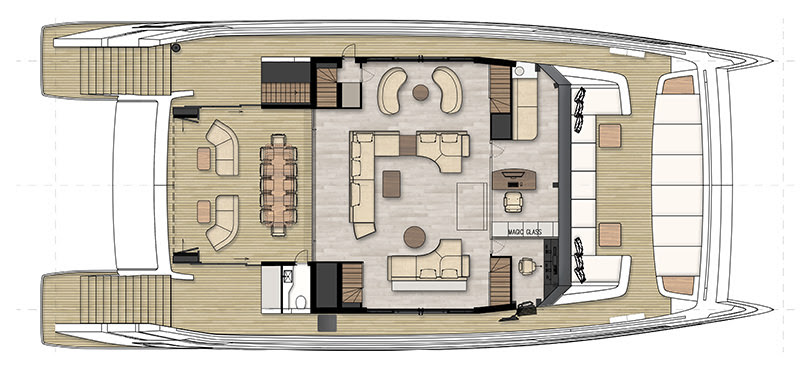
Today, Sunreef Yachts shares an exclusive first look at the layouts of a new luxury catamaran range of 60-90 feet that has been in the works for the last three years. With extreme living space, the range’s architecture takes a fresh look at catamaran design.
The concept unlocks a new potential for onboard comfort thanks to a design using the volume of both the hulls and bridge deck to achieve immense living space. Thanks to this, guest accommodation profits from new, generous amounts of fully-customizable living space. Standout features also include an imposing beach club.
With an innovative main deck design, the saloon of the yacht boasts full-height glazing and opens wide onto the sides and the lounging area of the aft cockpit. All spaces offer full freedom in terms of customization. The stern lounge uses the entire beam but can also be enclosed with sliding doors for more privacy in the marinas.
The sundeck can welcome an impressive master suite with panoramic views along with a large alfresco relaxation and fitness area.