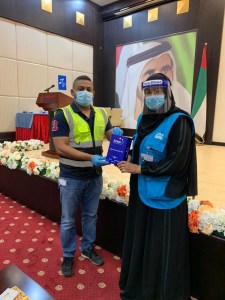
First Responders and stakeholders provided with Anker Protection Kits to combat COVID-19

Anker Innovations, a global leader in mobile charging and consumer electronics has shipped over 1.8 million FDA-certified masks and other medical equipment to countries around the world, including Anker Protection Kits to the UAE.

Each Anker Protection Kit contains masks, sanitizing Liquid and Sanitizing wipes, items vital to maintaining and protecting the health of essential workers.

The UAE team at Anker Innovations is providing Anker Protection Kits to distribution partners, promoters, IR Reseller & Dealers, Dubai Ambulance, Watani Al Emarat Community Services, the Noon Delivery Team etc.

Faraz Mehdi, Regional Sales Head at Anker Innovations MEA said, “We are proud of our team at Anker Innovations for sourcing essential safety gear to address challenges faced by the first responders, online delivery teams, promoters and partners during this grave time of the COVID-19 pandemic.”

“We want to lead by example and support our partners and stakeholders with the Anker Innovations ecosystem as well as the first responders in the UAE with protective gear to keep them safe. We will continue our efforts to assist with PPE needs that are essential to combat COVID-19 and hope that it makes a difference,” continued Faraz.

The COVID-19 pandemic has motivated the Anker Innovations team to continue the fight against the coronavirus by supporting local entities with Anker Protective Kits.

Nutanix Simplifies Advanced Business Continuity with Automation

New Capabilities in Hyperconverged Infrastructure Platform Simplify Disaster Recovery to Protect Business Critical Applications

Nutanix (NASDAQ: NTNX), a leader in enterprise cloud computing, today announced several new capabilities in its hyperconverged infrastructure (HCI) software and AHV hypervisor to protect business-critical applications and maintain continuous business operations in the face of a possible disaster. New capabilities include advanced automation for recovering applications and data, support for seamless multi-site disaster recovery (DR), synchronous replication for workloads running on AHV, and a near zero data loss with “near sync” replication for recovery point objective (RPO) times of approximately 20 seconds.

At a time when business continuity is more important than ever, ensuring businesses have strong recovery policies and procedures is no longer a “nice to have.” However, customers looking to implement strong DR plans for critical applications, such as those supporting emergency services, had little choice but to deploy complex, often disparate technologies that demand specialized, on-going administration. The new capabilities in Nutanix HCI and AHV help enable customers to confidently deliver mission-critical applications with significantly less complexity and lower management overhead.

“Maintaining continuous business operations is a high priority for all types of companies and organizations,” said Greg Smith, VP of Product Marketing at Nutanix. “However, most businesses rely on custom, handcrafted DR implementations to guard against system-wide IT failures. Nutanix now natively delivers automated, easy-to-deploy disaster recovery solutions built to deliver applications that must always be available.”

New capabilities to simplify and automate DR efforts include:

  • Multi-Site Disaster Recovery: Nutanix now supports multi-site DR designs, helping enable enterprises to quickly recover from the simultaneous failure of two or more data centers, while keeping applications and data available to users. Particularly valuable in regulated industries like financial services, healthcare, and emergency services where organizations need to deliver uninterrupted service, Nutanix DR leverages advanced automation technology to eliminate the complexity of DR installation and on-going orchestration. Application teams can quickly recover from unplanned outages or data corruption and set configurations to adhere to many stringent compliance requirements.
  • Unmatched Near Sync Disaster Recovery: Nutanix now supports near sync replication with an RPO of only about 20 seconds, a 3x improvement from its already industry-leading technology. Nutanix is the only leading HCI vendor to offer a 20-second RPO.
  • Synchronous Data Replication for Nutanix AHV: Synchronous replication, or the nearly instantaneous replication of data between multiple locations, is now natively supported on the Nutanix AHV hypervisor. AHV can be used by customers to deliver a highly available service for their most important workloads, such as virtual desktop infrastructure, databases, and general server virtualization.
  • DR Orchestration with Runbooks: The latest release gives customers more flexibility and control over the end-to-end recovery process, with more granular control to focus DR resources toward targeted applications.

“Our business users expect a zero recovery point objective, which guarantees no data loss when a failover occurs following a datacenter outage,” said Delfim Da Costa, System and Infrastructure Manager at Infomil, an IT spin-off of a large European retailer and a Nutanix customer since 2015. “We are delighted to now use Nutanix’s AHV virtualization and to maintain the highest possible SLA for our production workloads.”

These new DR capabilities are included in the Nutanix HCI software and are generally available. More information on Nutanix business continuity and disaster recovery solutions are available here.

Anker Innovations Distributes Anker Protection Kits to Dubai Ambulance staff

Anker Innovations, a global leader in mobile charging and consumer electronics has shipped over 1.8 million FDA-certified masks to countries around the world, including the UAE. Anker Innovations GCCA (Dubai Office) complemented these masks with Sanitizing Liquid and Wipes in Anker Protection Kits.

One of the first recipients in the UAE of the Anker Protection Kits is the team at Dubai Ambulance, thanks to the initiative and coordination efforts of Mr. Habilash Hamza, Retail Sales Director of Alam Al Tawasol Electronics LLC, who are the distribution partner of Anker Innovations GCCA in the UAE. Mr. Habilash Works as a volunteer for Dubai Ambulance. Dubai Ambulance received 200 kits as additional support to first responders.

Faraz Mehdi, Regional Sales Head at Anker Innovations GCCA said, “Our team at Anker Innovations recognize the challenges faced by first responders attending to patients affected by the pandemic. We wanted to get involved and help by donating essential safety kit that help keep the first responders in UAE safe and will continue our efforts to assist entities that need our support.”

Khalifa Hassan Al Darrai, Executive Director at Dubai Ambulance said, “We appreciate the generosity and support of companies like Anker Innovations GCCA and Alam Al Tawasol Electronics LLC in this fight to keep our First Responders safe. The donated kits will be distributed as crucial gear to ensure the protection of our frontline team.”

The COVID-19 pandemic has motivated the Anker Innovations team to fight against the coronavirus by supporting more local essential workers with the Anker Protective Kits they need.

How You Can Avoid Digital Transformation Stagnation by Flexing Your Finances

By: Morten Illum, EMEA Vice President at Aruba, a Hewlett Packard Enterprise company

Introduction

As businesses everywhere struggled to get a true sense of COVID-19 during the first month of lockdown, data analytics company Global Data predicted that “The impact of COVID-19 on the IT services sector will be deep, immediate, and long-lasting.”

One month on and thoughts are indeed beginning to turn from the immediate business continuity challenge of keeping companies running remotely, to the far more insidious financial fallout of the pandemic – as the long-term economic impact leaves businesses facing significant cashflow and liquidity challenges.

According to IDC, worldwide IT spending is now projected to decline by 2.7% in 2020 as a result of the pandemic. Meanwhile a recent CFO survey from Gartner found that 70% of CFOs are making changes to their long-term investment plans.

Digital transformation

And yet against this backdrop, the continued digital transformation of businesses will be more vital than ever – not just to help them get through lockdown but also to set themselves up for a successful rebound.

In fact, many industry commentators are telling businesses to accelerate their projects if they want to give themselves a fighting chance. To bring in Gartner again, Sandy Shen, Senior Director Analyst, has said of COVID-19: “Businesses that can shift technology capacity and investments to digital platforms will mitigate the impact of the outbreak and keep their companies running smoothly now, and over the long term.”

So whether you’ve gone through the hard work of getting a digital transformation project up and running only to find it put on ice, or find yourself facing an uphill battle to get new projects moving in response to the pandemic, how can you unlock them from limbo?

Flexible financing

Even in today’s uncertain business climate, there are options available for companies seeking to continue their tech investments despite a squeeze on funds.  

Indeed, this is something vendors like Aruba, a Hewlett Packard Enterprise company, have been giving serious thought to in recent weeks – evaluating our finance portfolios to find a way to support both customers and partners.

In general, there are two main avenues to explore when it comes to flexible financing:

  • Defer or reduce expenses – vendors may let you delay payments for a set period of time (typically a number of months) or start your payments on a reduced rate and offset the balance at an agreed date in the future (i.e. one year from now)  
  • Generate cash from assets – vendors will offer to buy back your existing IT assets or other infrastructure and lease it to you as a service

Determining which option suits your business will largely depend on your current IT real estate and preferred future consumption model. What is the scope of your existing tech infrastructure? Do you want to continue to own it or are you happy to pay to use it instead? Are you comfortable outsourcing its management or would you like to keep it in-house?

Your sector may also be a deciding factor, as certain sectors will be more risk adverse when it comes to moving their IT solutions off-premise and handing over their management. Good examples of this include financial services and healthcare, both of whom have serious data protection issues to navigate when it comes to changes to their IT infrastructures.

What to do next

There is no doubt that COVID-19 has been a wake-up call for companies in terms of how ready they are for a truly digital age – with many finding that their current infrastructures and systems are simply not able to cope with the demands this brings.

In the coming months it will be important not to lose sight of the fact that the digital age will not end when lockdown does. The need to transform existed before the pandemic and it will continue long after – particularly as consumer behaviours and habits become permanently changed by the experience of living remotely.

In light of this, you cannot afford to let your digital transformation journey stagnate. So, continue to pressure your C-Suite on its digital transformation promises, assess what consumption models your business will be comfortable with coming out of the crisis, and challenge your vendor on their financial portfolio. If they are anything like Aruba, they’ll want to help.

eufy Security helps keep an eye on home, office and elderly relatives as we work remotely

Families & Front Liners Stay In Touch With Loved Ones During Covid-19

As we practice social distancing and follow guidelines to flatten the curve and reduce the spread of Coronavirus, a reliable home security system like eufy Security can help us keep an eye on what is happening outdoors, at home, at the office, watch elderly relatives living remotely while essential front liners can keep an eye of their family while at work.

COVID-19 has caused significant “Anxiety” for families, making it difficult to keep an eye on children around the clock or monitor elderly parents who live remotely. Eufy Security Smart Wireless Cameras and Video doorbells hence have become essential at this current moment using “Motion activity alerts” that shows who is entering or leaving your home or any room, who is at your door step and users can define the designated zone to get alerts on unusual activity.

While some parents are allowed to work from home during isolation, essential workers do not have that privilege and need to monitor home schooling or child sitting at a distance. For these parents, knowing what is going on at home while they are away is vital. Are the kids staying in the house and attending their classes and is their lunch or dinner arriving on time are questions that can cause anxiety.

The motion detection alerts in Eufy security cameras, which can be wirelessly installed near the front door and are triggered by movement can answer the above questions. Users receive a smartphone alert when a motion is detected & recorded and the video is viewable at the same time.  

The real time response feature on the camera allows you to speak directly to anyone who approaches your front door via two-way audio as well as keep the kids disciplined during study time. It is a great way to be plugged into your kids’ activity while working on the front lines and ensure intruders stay away.

Eufy Video Doorbell has proven to be another great accessory during isolation. If you use online food and groceries delivery services like Talabat, Uber Eats, Amazon, noon, you may know that they practice “no-contact delivery” by placing your food or grocery in a way that minimizes in-person contact. Eufy Video Doorbell alerts you when your food or grocery has arrived and you can see and speak to the delivery team using the Eufy Security app.

If you are worried about unfamiliar faces or strangers in the neighbourhood, you can check suspicious activity from your smartphone. Eufy doorbell (2k Resolution) is equipped with a two-way audio system to scare off intruders and allows you to save footage with no monthly charges.

If you are in quarantine or at the hospital, you can also stay in touch with people at home and office and feel as though you are in the same room.

Eufy Security Doorbell is more important now than ever during these challenging times as COVID-19 keeps us away from our office, our elderly relatives and in some instances, away from family if our jobs require us to be out in the field helping to battle the Coronavirus. It has made isolation from our loved ones more bearable and relieves anxiety with the real time interaction.

Fortinet Disrupts the Network Firewall Marketplace with Unprecedented Scale and Performance

Fueled by the Fortinet NP7 Processor, the FortiGate 4200F Delivers an Average of 10x the Performance of Competitors; Enables Ultra-fast Network Firewalling, Accelerated Internal Segmentation, and Massively Scalable Teleworker Solutions

Fortinet® (NASDAQ: FTNT), a global leader in broad, integrated and automated cybersecurity solutions, today announced another milestone in its ability to deliver the industry’s highest performance. Powered by NP7, the seventh generation of Fortinet’s custom-built network processor, FortiGate 4200F is specifically engineered to deliver the scalability and performance required for the networks of today and tomorrow.


John Maddison, EVP of products and CMO at Fortinet

“In recent weeks, the lack of performance and scalability of integrated firewall and VPN solutions has challenged organizations when scaling their secure remote access initiatives. Organizations deploying traditional firewalls cannot scale across multiple applications and have been forced to upgrade or even install completely separate appliances. With 10 times the performance at the same price, the FortiGate 4200F powered by our 7th generation Network Processor (NP7) sets a new paradigm in network security performance. Our ability to deliver the highest performing firewalls on the market means customers can either scale far beyond their expectations at the same price point of competitors or spend less to get the performance they need. Either way, our customers win.”


Organizations need to be able to expand and adapt their network security to changing business conditions at a moment’s notice. Whether an organization is retooling their network to suddenly support a remote workforce, or embracing digital innovation, performance and scalability are key. Unfortunately, most security solutions are simply unable to provide speed and scale at a price that most companies can afford. That’s because security vendors simply have not invested in the technology required to cost-effectively meet the demands of today’s digital workplace. This has forced organizations to purchase security solutions with minimal performance and scalability headroom. As a result, when a critical event occurs, or the market requires digital innovation, firewalls become a bottleneck rather than an enabler.


To deliver security that keeps pace with the scale and performance demands of the new realities of today’s data centers, Fortinet is introducing the FortiGate 4200F, the newest addition to its portfolio of high-end network firewalls. As an integral part of the Fortinet Security Fabric, FortiGate 4200F has been specifically engineered to enable an innovative, security-driven networking approach that seamlessly integrates networking with security. The hardware acceleration of FortiGate 4200F via Fortinet’s seventh generation network processor, NP7, delivers Security Compute Ratings* 5 to 15 times better than comparable competitor solutions. Below is a comparison of the top firewalls on the market against FortiGate 4200F:


  • Security Compute Rating is the benchmark (performance multiplier) that compares Fortinet’s purpose-built ASIC-based FortiGate NGFW performance vs the industry average of competing products across various categories that fall within a close price band that utilize generic CPUs for networking and security capabilities.

1 Enabled with an optional Feature License

2 SRX5400E-B1-AC, non-power mode

With these performance numbers, FortiGate 4200F enables ultra-fast network firewalling, accelerated internal segmentation, and massively scalable teleworker solutions to secure the data center edge and core across a variety of use cases.

FortiGate 4200F: Delivering Business Outcomes 

FortiGate 4200F, powered by Fortinet’s 7th generation processor (NP7), radically increases the speed, scale, and performance for large enterprise data centers. The 4200F delivers the highest performance and scale to securely drive digital innovation and meet the huge capacity and performance demands of critical business operations across a wide variety of verticals and large enterprises including financial services, healthcare, education, advanced research, and high-velocity e-commerce. The following are a few examples of FortiGate 4200F use cases: 

• Financial services organizations building massively scalable remote access: In this ever-changing world, customers across industries are increasingly enabling a remote workforce to come online expeditiously – speed translates to productivity. The FortiGate 4200F offers the industry’s highest Security Compute Rating of 10x for IPsec encrypted performance and allows organizations to implement business continuity while sustaining ongoing operations.  

• Large manufacturing and energy companies managing internal security risks: Reducing the attack surface, especially in today’s dynamic environment, is essential for protecting critical applications and infrastructure. Providing trusted application access and achieving compliance requires enterprises to segment at scale. With a Security Compute Rating of 5x for SSL inspection (including TLS 1.3), FortiGate 4200F delivers the industry’s best price/performance. 

• High-velocity e-retail and e-commerce providers handling event-based connection bursts: Managing previously unseen levels of capacity and support for up to tens of millions of user connections per second is mandatory for virtual business. With a Security Compute Rating of 15x for connections per second, the FortiGate 4200F provides high performance security to handle escalating business needs without compromising user experience. With a further Security Compute Rating of 8x, FortiGate 4200F delivers essential firewall security for a wide variety of online businesses. 

• Advanced pharmaceutical research, oil and gas, and government organizations that require support for elephant flows: Today’s data centers struggle to securely transfer huge datasets (e.g. 1 TB files) for activities such as AI/ML simulations used within cutting-edge research. The FortiGate 4200F allows the rapid transfer of large datasets by supporting multiple 100Gbps elephant flows.

• Cloud providers and large enterprises that must segment massively scalable virtual networks: Typical security products that use software-based Virtual Extension LAN (VXLAN) solutions have low performance and high latency, which increases time to service. FortiGate 4200F offers hardware accelerated VXLAN to enable secure, and super-fast communication without impacting performance.

Riverbed Research Reveals Cloud and Network Readiness of UAE Enterprises as Organizations Adopt Work from Home Model

 Report highlights that secure access for remote and branch workers and high costs are the main connectivity challenges that regional organizations currently face

Riverbed® announced today the results of its ‘Middle East Network Transformation Survey’, which assessed the state of cloud and network technology advancement for enterprises in the UAE and Saudi Arabia. The Report, which was commissioned by Riverbed and conducted by IDC earlier this year, provides excellent insights into just how prepared enterprises have been to roll out their remote work strategies.

With government measures to control the spread of the COVID-19 virus still in effect in both countries, organizations have had to prioritize the IT investments that enable their employees to work from home. Cloud-based Software-as-a-Service (SaaS) offerings such as Microsoft 365, Salesforce, and Zoom are all seeing a significant spike in adoption rates, given their ability to be rapidly deployed at scale. It is no surprise then that three quarters (75%) of respondents agree that cloud is ‘important’ to their organization’s network strategy. Riverbed’s survey reveals that 29% of organizations in the UAE and Saudi Arabia have already completed migration of workloads to the cloud. This process is currently ongoing for a further 31% while an additional 20% of organizations will execute such migrations within the next two years.

The transition of employees to remote working arrangements has also meant that organizations must now ensure seamless and secure access to applications and data across the Internet and home networks. With business-critical services now being delivered to employees working from home via the cloud, it is no surprise that 77% of respondents stated that it is ‘very important’ for them to optimize connections to SaaS applications such as Microsoft 365 to ensure consistently good performance at all times.

Highlighting that 71% of organizations believe cloud is crucial for their digital transformation, Mena Migally, Senior Director, MENA, at Riverbed said, “Current events are hugely impacting all of us on a global scale and organizations are under immense pressure to maintain business continuity while safeguarding the health and safety of their employees. For many, this has translated to the rapid roll-out of work-from-home policies whereby cloud has been instrumental. However, slow SaaS applications can reduce workforce productivity and significantly impact organizations’ ability to execute in highly demanding times.”

When queried on the key connectivity challenges they face, respondents identified secure access for remote and branch workers and high costs as their top two concerns. With large segments of the workforce now requiring access to corporate data and applications from personal devices and home networks, and the challenging economic environment, the impact of issues is likely to be aggravated.

Organizations in the UAE and Saudi Arabia are therefore investing in upgrading their networks and currently over half (52%) are undergoing network transformation. Riverbed’s commission survey reveals the top three factors driving these transformation initiatives to be the need for greater security and compliance (54%), improved application performance (50%) and improved network monitoring and optimization (44%). In conducting these network upgrades, these businesses hope to improve operational efficiency (62%) and business productivity (52%).

“Given that our technology has the ability to greatly aid the success of these initiatives, we are keen to play our part in supporting regional customers,” said Migally. “Riverbed empowers IT teams with purpose-built solutions that facilitate fast, agile, secure delivery of SaaS applications to any user, anywhere, ensuring even the most remote and mobile employees stay productive as well as monitoring their organization’s network performance.”

Manish Ranjan, Program Manager for Software and Cloud, IDC Middle East, Turkey and Africa, adds, “IDC is seeing increasing appetite for cloud adoption these days and Work From Home is expected to be a new normal across various organizations in the Middle East region. As organizations increasingly deploy and use mobility and productivity solutions on cloud (including IaaS/SaaS, multi-cloud, and hybrid cloud solutions), greater bandwidth with lower latencies will be needed to access these applications. Business leaders need to focus on optimizing their network infrastructure, make it agile to improve application performance and network security. Organizations that optimize their network performance and provide stable network infrastructure to its users will be able to improve operational efficiency and enhance business productivity.”

Riverbed Network and Application Performance Platform

The Riverbed Network and Application Performance Platform enables organizations to maximize the visibility and performance of any network for any application. Riverbed’s Platform includes a powerful combination of four key solutions to ensure our customers reach the full potential of their technology investments. These include:

• WAN Optimization: Maximize network efficiency and expand network capacity with market-leading WAN optimization technology.

• Network Performance Monitoring: A unified performance monitoring solution that provides deep and broad visibility and analytics.

• Application Acceleration: Ensure the fastest, most reliable delivery of SaaS, cloud and on-premises applications to any user, regardless of location, including for remote and work from home employees.

• Software-Defined WAN: Modernize your network with a software-defined architecture that delivers cloud-ready agility and cost savings.

Nutanix Demonstrates Commitment to Channel in Middle East and Turkey by Successfully Hosting Virtual Partner Xchange 2020

Nutanix (NASDAQ: NTNX), today announced that it has successfully hosted a ‘Virtual Partner Xchange 2020’ conference in mid-April. The webinar with the theme ‘Scale up with Nutanix’ exclusively catered to Nutanix partners across the Middle East and Turkey and was attended by over 330 channel executives from across the region. The two hour programme included partner awards being announced at the end.

Bassam Al Masri, Director of Channel, METI at Nutanix said, “As a result of the COVID-19 virus impact on businesses, we have had to come up with a novel way of connecting with our partners and reinvent our annual partner summit as a virtual event. By sharing our company’s vision and roadmap and providing insights into the latest innovations in our products and partner program, we believe we have set our channel partners up for success this year and beyond. We take this opportunity to congratulate all the partners that won awards, and thank them for their continued commitment to driving growth for our company.”

During the virtual event, executives from Nutanix delivered a number of sessions enlightening partners about how they could benefit from the technical and business advantages of the cloud offered by Nutanix, such as infrastructure-independent and automated app mobility, scalability, flexibility and elasticity. Insights were also provided on how partners can maximise their organisations’ profitability with the ‘enhanced’ Nutanix Channel Charter.

GBM, a Nutanix strategic Master Partner, presented a video case study involving a prestigious government agency that implemented a Nutanix Virtual Desktop Infrastructure (VDI) solution for 2000+ users. This was based on Nutanix’s latest offer called FastTrack for VDI that supports companies anywhere in the world to quickly deploy a VDI solution and onboard thousands of remote employees in record time.

In order to keep the session fun and interactive, Nutanix organized a quiz with participants having a chance to be one of the three winners of exciting prizes. There was also a raffle draw.

The programme concluded with the partner awards. Below is the list of partners that were recognized for their excellence:

Innovation Partner of the Year – Fujisoft

Partner of the Year – PRO TECHnology

Partner Project of the Year – GBM

Top Nutanix Sales Professional of the Year – Berkan Kılıç (KoçSistem)

Top Nutanix Sales Engineer of the Year – Farhan Parkar (GBM)

Top Nutanix Champion of the Year – Khalid Mashayekh (Versos)

TOP MET Distributor of the Year – Redington

OEM Partner of the Year – Solutions by STC

Best Marketing Campaign Award – Rana Mustafa (GulfNet Solutions Company limited)

Top Nutanix Sales Professional of the Year – Serdar Ünsal (KoçSistem)

“We have ambitious plans. We will be introducing new initiatives that will enhance our partners’ capabilities and drive business for them. Despite the less than ideal market conditions, we are confident that we shall close out this year on a positive note,” concluded Bassam.


NetApp Acquires Leading Virtual Desktop Infrastructure Player, CloudJumper


Company improves and accelerates public cloud virtual desktops for work from home, branch offices and enterprise deployments.

 NetApp® (NASDAQ: NTAP), the leader in cloud data services, today announced that it acquired CloudJumper, a leading cloud software company in the virtual desktop infrastructure (VDI) and remote desktop services (RDS) markets. As a result of the acquisition, the new NetApp Virtual Desktop Services (VDS) will solve the most challenging problems of virtual desktop services and application management, allowing customers to deploy, manage, monitor and optimize those environments as a total solution from a single company on the public cloud of their choice.

“The ability to provide a consistent virtual desktop experience at scale while keeping data available and secure without sacrificing performance has always been important and is especially critical in today’s unprecedented environment,” said Anthony Lye, senior vice president and general manager of NetApp’s Cloud Data Services business unit. “NetApp and CloudJumper provide a simplified management platform for delivering virtual desktop infrastructure, storage and data management across Microsoft Azure, AWS and Google Cloud with best in class virtual desktop management combined with best in class storage and data services.” 

CloudJumper gives customers a simple and secure path to the future by managing current environments – often on-premises or using older technologies such as Remote Desktop Services (RDS) – in addition to the environment the market is moving to – cloud hosted desktops using Windows Virtual Desktops (WVD). NetApp VDS provides CloudJumper’s customers highly resilient data storage with enterprise-class features including performance, high availability, global file caching, backup, compliance and essential capabilities to help move business operations to the cloud.

NetApp VDS will be available immediately on NetApp Cloud Central and integrated with Azure NetApp Files and Cloud Volumes. In addition, NetApp will add significant resources to the existing CloudJumper channel partner program enhancing the capabilities of MSP, VAR, SI and ISV partners to solve customer challenges and grow their businesses.


Security in a Multi-cloud Environment

By: Paul Nicholson, Director of Product Marketing, A10 Networks

As companies leverage a multi-cloud strategy to improve IT operations and provide better services to their customers, they can’t afford to overlook the implications for security. This is especially true with the emergence of a new paradigm to run multiple disparate compute environments for application delivery. In fact, while issues like creeping complexity, non-existent cross-platform visibility, and multiple vendor standards all compete for IT focus in a multi-cloud environment, enterprise leaders cite security as the top challenge of all.

This trend was illustrated in a global survey of IT and business executives conducted by A10 Networks in partnership with the Business Performance Innovation (BPI) Network. In the survey, respondents reported that ensuring strong security across clouds, networks, applications and data will be critical for realising the advantages of multi-cloud IT. This is clearly a work in progress; to date, only 11 percent believe they have been highly successful in seeing the full value of their multi-cloud strategy, while a majority (51 percent) rate themselves as only somewhat successful or unsuccessful so far.

A quick web search will uncover many cases of vulnerabilities and real-life incidents. In one blog post by VMware, it is noted that it’s the job of IT and security teams, not just cloud providers, to take care of many aspects of security. To stop sophisticated bots, frequent data exfiltration of personally identifiable information (PII), application attacks, and other threats, it’s essential to implement a security strategy across all your clouds, private or public that is as stringent as the one used for your on-premises solutions, if not more so.

Deterministic or Accidental Multi-cloud Complexity – It All Needs to be Secured

It’s easy to understand why the proliferation of multi-cloud environments has tended to outpace the evolution of multi-cloud security. While the move to multi-cloud is often part of a clearly defined and intentional strategy, this isn’t always the case. For many organisations, the shift happens on a more ad hoc basis. For example, it may happen when a company with a single-vendor cloud strategy acquires or merges with another organisation using a different cloud platform. Business units and development teams may source their own cloud resources, with or without IT’s blessing as shadow IT. New requirements for specific services, data sovereignty (such as GDPR), or integration lead IT to add new vendors to the environment. As a result, most companies end up in a more complex multi-cloud setup than they had envisaged.

Intentional or not, the evolution to multi-cloud environments typically focuses on the business and IT factors driving it. As with many technologies in IT operations, organisations first provision the services they need to address various requirements, and only then turn their attention to how best to control, govern, and manage the resulting environment. This often proves more difficult than anticipated, as shown in the results of the survey. Nearly two-thirds of respondents (63 percent) said that ensuring security across all clouds, networks, applications and data was the top challenge of multi-cloud IT, which is good news, as it is top-of-mind, even if the solutions are not ubiquitous today. Management skills and expertise (37 percent) and centralised visibility and management (33 percent) were also cited—both key concerns for effective multi-cloud security.

Essential Security Capabilities and Practices

As IT, security teams, and business leaders have worked to close the security gap in their multi-cloud environment, a clear sense of the most relevant technologies to leverage is needed. In the BPI report a majority named centralised visibility and analytics into security and performance (56 percent), automated tools to speed response times and reduce costs (54 percent), and centralised management from a single point of control (50 percent) as the top capabilities for improving multi-cloud security, reliability, and performance. With the volume of digital business data and transactions constantly rising, 38 percent of respondents also pointed to the need for more scalable, higher-performing security solutions. This will only be exacerbated over time, especially with the rise of IoT and the emerging 5G connectivity.

Looking at the most important considerations in protecting the security and reliability of multi-cloud environments, 62 percent of survey respondents agreed on the importance of centralised authentication or pre-authentication to help maintain effective control over the users, admins, and systems allowed to access various resources across multiple clouds. One respondent, Raja Mohan, senior strategic architect for cloud and platform services at Franklin Templeton, explained the reasoning behind this emphasis: “How do we deliver highly secure applications in a way in which it doesn’t matter where they reside? How do we provide seamless, secure services? That’s the goal.”

An answer to this question is seen in the high ranking of centralised security policies as a critical practice for multi-cloud IT (46 percent). Among defensive technologies, many respondents called out specific high value defences such as robust web application firewalls (WAFs) (40 percent) and DDoS protection (33 percent).

IT Operations Need to Partner with the Security Teams for Cross-Cloud Security

Organisations have been doing their best with the security tools available to them, but they’re far from satisfied with the results. “At this juncture, we’re taking advantage of security solutions from our public cloud providers augmented with our existing toolset, but we are continuing to evolve in that space,” said Mohan.

Indeed, IT organisations are continually reassessing their solutions and vendors and identifying areas where change is needed. Only nine percent of survey respondent are extremely satisfied with their current security solutions for multi-cloud environments—while 38 percent see a need for significant improvements. Only 18 percent believe they do not need to re-evaluate their suppliers. Figures like these are a wake-up call for everyone in the multi-cloud security space.

This evidence shows the need to adopt a Polynimbus secure application services approach to give the power back to IT and security teams so they can provide a secure and consistent secure application services environment across their clouds. Powered by application delivery controller (ADC) solutions, Polynimbus mindsets and practices will be the most effective way to ensure that multi-cloud compliance, security policies, functionality, and expectations are met, while easing the burden of over worked and stressed IT and security teams. Ultimately, this approach will make vigilance easier to enact and responsibility easier to fulfil.

You can learn more about the security challenges that come with multi-cloud IT and how they’re being addressed in the complete report, “Mapping the Multi-Cloud Enterprise: Next Steps in Optimising Business & IT Agility, Efficiency & Security.”