FLY NOW, PAY IF OK is Now Available in the UAE

Innovative flight compensation company, Colibra, is now live for users in the United Arab Emirates to use. For the first time the ‘Fly Now, Pay if Okay’ service allows passengers with a valid UAE residency to book flights that they only pay for if their flight arrives on time. They now have the privilege to be the first in the world to use the pilot version of the product and test this disruptive travel technology.

The Colibra app guarantees UAE residents that if the flight is cancelled or delayed for more than three hours, passengers do not have to pay for their plane tickets at all. This service is entirely free for users of the app, allowing them to book tickets within 30 days before departure (and arrival) and then pay the regular ticket fare if their flight arrives on time or within three hours of its scheduled departure. 

The Colibra app is now available to download on the Apple Store for IOS users, as well as on the Google Play Store for Android users.

How the app works:

1. The passenger chooses a flight – it must depart and arrive within 30 days from the booking date

2. Adds his/her personal data – Colibra doesn’t charge at the time of booking

3. Colibra charges the passenger upon arrival if everything goes smoothly and the service is delivered (ticket’s price is at no extra cost). In all other cases, the user travels for FREE.

Sniper Advanced Targeting Pod Successfully Integrates with Kuwait F-18 Super Hornet

Lockheed Martin (NYSE: LMT), in conjunction with the U.S. Navy, completed its first flight test integrating Sniper® Advanced Targeting Pod (ATP) with the F/A-18E/F Super Hornet for the Kuwait Air Force. Sniper ATP will be located on the Weapon Station 5, an area on the aircraft where pods or weapons attach, and is expected to be fielded with the aircraft in late 2023. This integration gives existing and future Super Hornet fleets the ability to add Sniper ATP’s precision targeting and surveillance capabilities, which are critical to pilot survivability.

“Integrating Sniper ATP onto Weapon Station 5, commonly known as the ‘cheek station,’ brings state-of-the-art tracking algorithms, two-way-data-link, and many other capabilities to the Kuwait F/A-18E/F crews that will positively impact the overall success of their missions,” said Kenen Nelson, director of Fixed Wing Sensor Programs at Lockheed Martin’s Missiles and Fire Control. “This also means that all F/A-18E/F customers will have the option of a reliable, easily maintainable and modern targeting pod.”

To verify the mechanics of the system, flight testing with a non-operational Sniper ATP was conducted at Naval Air Station Patuxent River in Maryland in March. Subsequently, flight-testing with an operational Sniper ATP was conducted at Naval Air Weapons Station China Lake in California in March. Both first flight tests were successful.

“The Sniper ATP provides an additional tool in the already robust Kuwait F/A-18 Super Hornet package,” said Jessica Idleman, Boeing program manager Kuwait F/A-18 program. “The Super Hornet provides the warfighter with enhanced situational awareness and Sniper ATP is an important part of our technology insertion plan and future growth of the platform.”

Currently, Sniper ATP flies on both the Kuwait F/A-18C/D and Canadian CF-18 Hornets. As the Kuwait Air Force transitions to the F/A-18E/F Super Hornet, they will benefit by receiving the new capabilities that the latest Sniper ATP configuration provides to the Super Hornet fleet. There are currently more than 27 countries and 15 different types of aircraft operating with the platform-agnostic Sniper ATP.

The modular design, field-proven reliability (Sniper ATP exceeds 500 hours Mean Time Between Maintenance Events [MTBME]) and a world-class depot partnership with Robins Air Force Base makes Sniper the lowest Life Cycle Costs targeting pod on the market. 

For additional information, visit our website: http://www.lockheedmartin.com.

dnata and Blue Aqua join forces to boost food security in Singapore

dnata, a leading global air services provider, has signed a Memorandum of Understanding (MoU) with Blue Aqua Food Tech (Blue Aqua) to boost food security in Singapore. The partnership will see Blue Aqua upcycle organic waste from dnata’s catering and ground handling operations into alternative insect protein for aquafeeds.

Blue Aqua’s innovative bioconversion solution processes underutilized nutrients from the leftovers that can be transformed into quality insect proteins for aquacultural use. The bioconversion is a virtuous circle that makes the insect protein a sustainable and efficient alternative to traditional fishmeal.

Compared to traditional protein, insect protein is a sustainable solution with low land, water, and carbon footprint, offering a very high yield. The partnership will supply Singapore’s farmers with sustainable access to domestically produced animal feed, which is traditionally imported.

The MoU is the starting point to a deeper partnership between Blue Aqua and dnata, which will look into the development and implementation of a ‘Zero Waste’ master plan. The air services provider will also add Blue Aqua to its list of suppliers to purchase locally farmed seafood for its catering operations.

Dirk Goovaerts, dnata’s Regional CEO for Asia Pacific, said: “We are delighted to partner with Blue Aqua to further decrease food waste and support the local food production supply chain. This initiative will help us minimise our environmental footprint whilst delivering the highest value for our customers and the communities around us.”

Dr Farshad Shishehchian, CEO & Founder of Blue Aqua International Group, said: “Blue Aqua has been a strong advocate for sustainable and practical farming since its inception, this partnership with dnata is a perfect fit. We are excited to grow our efforts in food technology to develop a circular economy in aquaculture globally through our network, starting with Singapore.”

The global population is expected to reach 9.9 billion by 2050, and food production has to increase by 70% to fulfil this demand. This is further implicated by food security concerns worldwide and the rapid degradation of valuable farmland. Waste management is a global issue that governments and companies are racing to solve. Singapore imports more than 90% of its food, yet, its food waste amounts to 744,000 tonnes annually. Today, less than 20% of Singapore’s food waste is recycled.

Blue Aqua’s Waste-to-Protein Program aspires to significantly reduce food waste across Singapore’s food supply chain through aquaculture. This is in line with Singapore’s vision of being a ‘Zero Waste Nation’, which means the recycling rate has to be increased to 70%. Singapore has also set a “30 by 30” goal, aiming to have the nation produce 30% of its food domestically by 2030. With this mandate, aquaculture will play an important role in the future of Singapore’s food security. However, local farms still rely heavily on imported feed and raw materials, which the program is aiming to mitigate.

Ras Al Khaimah International Airport Welcomes Rossiya Airlines

Ras Al Khaimah International Airport (RAK Airport) has opened up a new service to Russia through a partnership with Rossiya Airlines, with the inaugural flight from the carrier arriving from the Russian city of Yekaterinburg – Russia’s fourth-largest city and the second-largest in Siberia – today (2nd April). The airport’s commencement of operations with the airline directly connects the UAE’s northernmost emirate to nine destinations in the world’s largest country.

Touching down at 08:35  at RAK Airport – currently the UAE’s fastest growing aviation hub – Rossiya Airlines flight FV 5633 marked the start of a service that offers passengers weekly flights to and from major cities (in Russia, including its capital, Moscow and its second largest city and cultural centre, St. Petersburg. Other cities being serviced include Kazan, Samara, Yekaterinburg, Nizhny Novgorod, Perm, Ufa and Rostov-on-Dov. 

“Ras Al Khaimah International Airport forms a major plank in Ras Al Khaimah’s growth plans by increasing its numbers of destinations and schedules through forging partnerships with new carriers and extending services with existing ones. Its new partnership with Rossiya Airlines represents a significant step forward in the airport’s phased expansion strategy, opening up as it does nine direct flights into and out of Russia,” said H.E. Engr. Salem Bin Sultan Al-Qasimi, Chairman of Department of Civil Aviation and Ras Al Khaimah International Airport, and Board member of General Civil Aviation Authority and Ras Al Khaimah Executive Council.

“This new service will be instrumental in bringing in a greater number of Russian visitors to experience the unique attractions of Ras Al Khaimah, with an increase in guests – an important part of the emirate’s diversification strategy. Russia is one of the UAE’s top source countries for tourism, where business between the two countries is also important for bi-lateral growth and development. The new direct connections between Ras Al Khaimah and nine industrial and cultural conurbations in Russia will help meet current tourist and business requirements in both the countries, as well as fuel up the new demand for capacity building,” His Excellency added.

“With the start of Rossiya Airlines’ commercial operations from Ras Al Khaimah International Airport, we are connecting Ras Al Khaimah to nine cities in Russia. This expands our reach to new destinations, offering our customers a broader selection to choose from when planning their travel through RAK Airport. The new routes development comes as an added attraction for travellers, since its completion of two years of opening visa-free travel policy between Russia and the UAE in February 2019,” said Sanjay Khanna, Chief Executive Officer of Ras Al Khaimah International Airport.

“With the coronavirus situation tightly being controlled in the UAE with stringent measures, active vaccination drive, and the easing of travel lockdown, we are expecting strong demand for this new service,” he added. “RAK Airport continues to play a vital role in building trust in both business travel and tourism at this critical time. The steady and solid growth decisions being taken in the pandemic era are  both extending operations and building passenger confidence. Our recent expansion phase has seen us increase flights throughout India and Kazakhstan – this new service to Russia further strengthens our position as one of the most significant UAE airports, flying passengers to numerous destinations globally and connecting people to the world’s most notable places,” he added.

On  6th April, Rossiya Airlines’ first flight from Moscow to Ras Al Khaimah touches down at 7:05 at RAK Airport. On the same date, a flight from Ufa – the capital and largest city of the Republic of Bashkortostan – lands at 9:30, followed by flight Perm, a population centre that is located on the banks of the Kama River near the Ural Mountains, which lands at 19:20.

Rossiya Airlines’ flight to RAK Airport from Kazan, the capital and largest city of the Republic of Tatarstan in Russia, lands on 8th April at 12:05, followed on the same date by the first in the new schedule from St. Petersburg – known as the ‘Cultural Capital of Russia’ – which arrives at 10:30. Also on 8th April a flight from Samara, Russia’s eighth-largest city, lands at 14:05 at RAK Airport followed by a flight from the port city of Rostov-on-Don, which arrives at 21:10.

Finally, as the last component in Rossiya Airlines new schedule to Ras Al Khaimah, 10th April sees a weekly flight arriving at RAK Airport at 12:45 from Nizhny Novgorod, the sixth-largest city in Russia and second-most populous on the Volga – the longest river in Europe.

Two Global 7500 aircraft delivered and 10 Challenger 350 jets ordered

VistaJet today announces additions to its state-of-the-art infrastructure with the delivery of the first two of its Global 7500 aircraft, ready for commercial availability, and the order of 10 new Challenger 350 planes, from long-standing partner Bombardier.

VistaJet is the first company to provide a fleet of Global 7500 aircraft, unlocking the world with the largest and longest-range business jet. The 7500 is a gamechanger, and with VistaJet’s unparalleled network and technological capabilities, it will join the best ecosystem to operate at its peak — opening an extended world of non-stop air mobility for Members, in the very best comfort and space. Up to 12 Global 7500 aircraft are planned to join the VistaJet fleet over the next two years.

The Challenger 350 order, the majority of which are expected to be delivered through 2022, is on the back of growing and urgent demand from corporates and executives who are interested in the super-mid segment — VistaJet has seen a surge of nearly 50% in corporate interest globally since July 2020. The award-winning Challenger 350 aircraft is an integral offering in VistaJet’s super-midsize range, which is driving the higher demand with new and existing customers. It is consistently one of the best-selling businesses jets among charter operators and corporate flight departments across the globe and offers several unique benefits.

The Challenger 350 and Global 7500 new additions will bring VistaJet’s global fleet to over 90 aircraft providing access to 187 countries, with regional flying in North America, Europe, the Middle East, Africa and Asia, including domestic flights within India.

The pandemic is clearly demonstrating that customers are increasingly requiring guaranteed global access 24/7. VistaJet’s leading flexibility and adaptability across its business model and service offerings are playing a critical part in its success and resilience, and this latest order of Challenger 350s clearly reiterates its confidence in the future of the industry.

Additionally, in 2021 VistaJet will complete the upgrade of its entire Challenger 850 fleet, including the installation of the fastest in-flight connectivity available with KU-band technology, and enhancing the largest, most productive and comfortable corporate cabin available in its class.

Further, all VistaJet Challenger 605 planes will be fully equipped with KU-band connectivity and upgraded interior on board by the end of 2021 and the Challenger 350 aircraft following suit by end of 2022; 95% of its Global 6000 aircraft will be upgraded with KU-band technology and the elevated interior during 2021 to further enhance customer experience onboard.

Today’s launch is off the back of continued incredible demand for VistaJet’s asset-free solutions, including the new Corporate Membership launched in October 2020. The first quarter of 2021 marked a consecutive quarter in growth in hours sold, up 23% year-over-year, and new Program Members up 90%.

Thomas Flohr, Founder and Chairman, VistaJet said: “It is an incredibly exciting time as VistaJet transforms the architecture of how companies and individuals fly. We continue to see rapid acceleration in new Members, which is driven by corporate and executive demand for our business mobility offerings. Global private aviation networks will be even more vital to support businesses and the economy. The expansion of our worldwide fleet will guarantee our customers full confidence in a consistent flying experience anywhere in the world — offering the best value in the industry through our unique asset-light flight solutions. We remain committed to providing critical support to businesses in this new world — we kept our business steady during 2020 and we are seeing much increased demand for VistaJet’s asset-free solutions in 2021 and beyond.”

Éric Martel, President and Chief Executive Officer, Bombardier said: “We are extremely proud of our long-standing partnership with VistaJet and are thrilled that they have again chosen Bombardier aircraft to support their fleet expansion plans. With unmatched performance and comfort, the Global 7500 and Challenger 350 are the perfect aircraft to support VistaJet’s rapid growth as more people turn to business aviation and the enhanced safety and reliability it provides.”

Airport Show to be held in Dubai from 24 May

Airports bracing themselves up to handle renewed passenger traffic in 2021

Safer travel technologies to drive the post-pandemic world

Touch-free experiences top health safety priority

Real-time customer services to be at the forefront

Airports to be more passenger-centric and IT-driven by 2025

Global Airport Construction market to reach US$1.4 trillion by 2025

DXB continues improvising to remain an ideal destination in the future

After a bleak year due to the global travel restrictions following the coronavirus pandemic since March 2020, airports are expected to be humming with activity again in 2021 with a surge in passengers travelling across the borders.

The International Air Transport Association (IATA) has predicted global revenue passenger kilometres (RPKs) improving by 50 per cent with passenger numbers forecast to grow to 2.8 billion – with the opening of borders by mid-2021 – one billion more travellers than in 2020.  Representing 290 airlines or 82 per cent of total global air traffic, it remarked that people have not lost their desire to travel and travel rebounded where barriers have been removed. It had been projected earlier that Arabian Gulf airports will be handling 450 million passengers a year once the travel returns to 2019 levels.

Reed Exhibitions Middle East, organisers of the Airport Show, the world’s leading airport industry B2B platform has rescheduled the event’s 20th edition in Dubai for three days from 24th May at the Dubai World Trade Centre (DWTC). The organisers have said that the airport industry, after a year of unprecedented strain, challenges and changes, has a renewed sense of optimism as it enters 2021 with traffic gradually picking up as more travel corridors are established between important routes. As the airports are getting themselves ready and resetting themselves for the post-pandemic influx of travellers, they have started increasingly looking at the latest solutions and technologies to ensure safer travel until 2025 – and even beyond.

To be held under the patronage of His Highness Sheikh Ahmed bin Saeed Al Maktoum, President of Dubai Civil Aviation Authority, Chairman of Dubai Airports and Chairman and Chief Executive of Emirates Airline and Group, Airport Show-2021 will see the top decision-makers of key airports from across the Middle East, North Africa and South Asia (MENASA) making their way to Dubai to search for new products and services for their facilities.  The 2021 show is planned to be held across 11000 square metres of exhibition space with exhibitors and participants from over 50 countries expected.  It will have two co-located events: Global Airport Leaders Forum (GALF) and ATC Forum, taking place for the sixth and third year respectively.  Two new conferences have also been added to GALF: Airport Passengers’ Experience and Airport Digital Transformation.

Ibrahim Ahli, Deputy CEO of Dubai Air Navigation Services (dans) which is the sole handler of air traffic movements at Dubai International Airport, the world’s number one airport for international travellers for the seventh consecutive year, said, “Portraying the vision of His Highness Sheikh Mohammed bin Rashid Al Maktoum, Vice President and Prime Minister of the UAE and Ruler of Dubai, that aims at making Dubai an airport for the world, we are adopting and implementing special strategic and future projects for the aviation sector which will promote the continuation in handling air traffic efficiently even during the challenging times of coronavirus pandemic. dans is fully equipped to utilise up-to-date technology to build synergy with our aviation and related stakeholders in overcoming challenges and fulfil the Emirate’s vision in utilizing innovative technologies to remain a hub of choice for passengers by offering the best services.”

He added, “We are working to enhance the efficiency of operations and carrying out systems upgrade for the safety and security of aircraft movements, much before the demand gathers further momentum. dans will continue improvising procedures, services and facilities to remain an ideal player today – and even in tomorrow’s aviation industry. The Airport Show will enable aviation professionals to gain ringside views of newer technologies and digitisation for a greater sweeping impact. Now and in the future, the Aviation service sector is set to proactively and extensively work smarter and have a more future-oriented outlook. Given the prevailing conditions across the world, Airport Show will be the ideal platform to get hold of anything and everything the industry requires.”

Daniyal Qureshi, Group Exhibition Director at Reed Exhibitions Middle East, said significant investments and upgrades will be taking place at airports globally to implement the new health, safety and technology adoption initiatives by IATA and Airports Council International (ACI) with Airport Show a central meeting place to showcase new innovations to industry players. Key changes expected to be implemented at airports over the next five years will focus on new IT-driven technology and solutions and adoption of Artificial Intelligence (AI), Blockchain, Cloud, Remote Control and Drone Technology; new green targets and initiatives, and passenger-centric touch-less solutions, self-check-in/bag drop and mobile-enabled services. Airports have always been exploring new ways to simplify the overall travel experience by adopting smart technologies and solutions which one can find in plenty at  Airport Show, he said.

The global Airport Construction market is projected to reach US$1.4 trillion by 2025, driven by a growing government focus on building infrastructure for economic growth and societal evolution. According to an IATA study, over US$1.2 trillion is expected to be spent on global airport infrastructure development up to 2030. Another study says the global market for ‘smart’ airports is projected to reach US$23 billion by 2025. According to the Construction Intelligence Centre (CIC), airport-related construction projects in the Middle East and Africa (MEA) are valued at over US$222 billion, with over US$93 billion in the execution stage. In the MEA region, Saudi Arabia leads the airport construction pipeline with US$59 billion worth of projects, followed by the UAE with US$58 billion projects.  The Middle East ranks fourth out of six regions globally in terms of total investment value and it is by far the biggest market for the average spend per airport project, according to a report by Frost & Sullivan.

New Hangar No. 5 operational

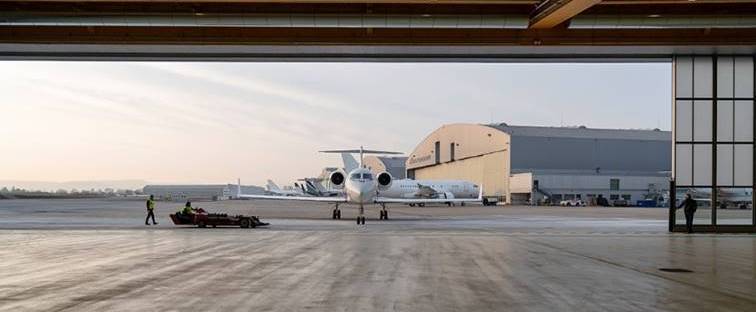
After only 12 months of construction time, the latest hangar of AMAC Aerospace has opened its doors to welcome the first mid-size jets. The new building offers space for up to 7 mid-size jets and adds 4’850mrespectively 30’000m2 of new apron to the four existing hangars at EuroAirport in Basel, Switzerland.

Dedicated to mid-size jets

“We are proud to have managed this project successfully in this demanding time,” commented Bernd Schramm, Group COO of AMAC Aerospace. “The Hangar will be dedicated to mid-size jets maintenance and can accommodate up to 7 midsize jets like Bombardier Global or Challenger series or Gulfstream series or a combination thereof. The maintenance services for these types of aircraft were always high in demand and is steadily increasing due to our highly recognized quality of work.”

List of serviced mid-size jets serviced in Basel

·        Bombardier BD-700 (Global Express/Global Express XRS/Global 5000/Global 5500/Global 6000/Global 6500; as of April: Global 7500) series

·        Bombardier BD-100 series (CL 300/350)

·        Bombardier CL-600-2B16 series (CL 604/605/650)

·        Gulfstream GIV (G650/650ER), G450, GV Series, G550, G650, GVI, GVII (G500/G600)

·        Pilatus PC-12 series

·        Pilatus PC-24 series

Impressive wooden structure

AMAC’s hangars are famous for the wooden structure. The solid wood frame structures consist of several layers of wood; they are specially laminated to increase the rigidity and are harmoniously ecological. The wooden bars were cut and shaped in the factory, so by the time they reached Basel, they were ready to be installed like Lego bricks. The transport of the massive wooden beams was exceptional and impressive: eleven special-purpose trucks had to be organized to bring these wooden elements from Alsace to AMAC’s hangars at the EuroAirport Basel. 

Challenging construction site

To build the hangar construction, a pneumatic crane was needed. Since the crane did interfere with the safety distance of 7% to the runway, it had to be ready to be removed in a very short time. Given an emergency, that the runway had to be cleared, the crane had to be deconstructed within 20 minutes time. Fortunately, this was never the case, the project was spared from any accidents.

Three floors down

“Since Basel lies in a seismic area, safety comes first,” explains Philippe Schurrer, project manager and Director Safety & Security, Facility Management. “Several columns were sunk 6m down in the ground. The hangar is standing on these reinforced foundations which are able to absorb any shocks or vibrations. Hangar 2, 3 and 4 are built after the same principle, even going down to 8m, hangar 1 has the same depth as hangar 5,” he adds.

JetBlue’s transatlantic debut set to disrupt the market, says GlobalData

The much-anticipated launch of JetBlue’s first transatlantic routes has stirred up plenty of interest and has strong potential to be successful. With a new MINT business class and low fares on offer, the carrier will be well positioned to capitalize on rising demand from budget travelers post-COVID-19, says GlobalData, a leading data and analytics company.

Gus Gardner, Travel and Tourism Analyst at GlobalData, comments: “JetBlue has set its sights on cashing in on the busiest city pair in the world: New York to London. Competition was fierce pre-pandemic on this route, however, JetBlue’s low fares will give it an advantage – especially noting the withdrawal of Norwegian Air from long-haul flights and that other airlines in the space are seeing a drop in capacity. These events will be beneficial for JetBlue to establish a foothold in the market.”

More consumers have become cash strapped, and the transatlantic market is in need of low-cost competition. GlobalData’s latest COVID-19 Recovery Survey showed that 87%* of global respondents were concerned about their personal financial position. 

Gardner continues: “Most carriers offer basic economy fares, but JetBlue offers it as standard. The uniformity of the airline’s offering, combined with its friendly service and competitive fares, will see the airline stimulate demand and win customers who may have delayed traveling due to increased financial concerns.”

A poll conducted by GlobalData revealed that 44%** of respondents said their company’s corporate travel budget will significantly be reduced over the next 12 months as a result of the COVID-19 pandemic.

Gardner adds: “Corporate travelers are likely to see JetBlue as a viable, lower-cost alternative going forward. Lower prices will see the airline attract corporate travelers working for companies with depleted budgets. The new MINT business class and elevated service level will allow the airline to compete on a level playing field with existing carriers. This winning combination will see JetBlue become a disruptive carrier that could substantially shake up the corporate transatlantic travel market. 

“However, JetBlue is struggling to secure lucrative slots at London Heathrow. The UK extending its ‘use-it or lose-it’ slot wavier has placed a hurdle in the carrier’s plans. Although it has secured some slots at Gatwick and Stansted, the split of services adds operational costs and complexity the airline will want to avoid. If JetBlue can secure the desired slots at Heathrow, it will be a game changer for the airline’s competitive position.”

* Data taken from GlobalData’s survey of 5,766 global respondents- Fieldwork undertaken 2–6 December 2020. ‘Extremely’, ‘quite’ and ‘slightly’ responses combined.

** GlobalData Poll of 306 respondents, November 2020 to March 2021.

DAE substantially completes Boeing 737 MAX 8 transaction with American Airlines

Dubai Aerospace Enterprise (DAE) Ltd. today announced it had substantially completed the agreement with American Airlines signed in the third quarter of 2020 to deliver 18 new Boeing 737 MAX 8 aircraft.

Firoz Tarapore, Chief Executive Officer of DAE said: “This transaction reflects our agility, our balance sheet strength, our underwriting capability, our ability to assist one of our long-term customers and our belief in the product strength of the 737 MAX 8 aircraft. We are delighted to see an increasing number of global aviation regulators return the MAX to the skies. We wish American and Boeing great success.”

Ihssane Mounir, Senior Vice President of Commercial Sales and Marketing of The Boeing Company, added: “DAE is putting their purchasing strategy and growth plan in action and helping operators during this challenging time in our industry. We are delighted to once again partner with DAE to support a valued customer such as American Airlines and we are honored by their trust and confidence in the Boeing 737 family.”

Abu Dhabi Airports launches the region’s first PCR testing laboratory located within an Airport

Abu Dhabi Airports, in partnership with Pure Health and Tamouh Healthcare, has launched the region’s first PCR testing laboratory within an airport. The new state of the art RT-PCR lab offers fast COVID-19 testing within the Abu Dhabi International Airport (AUH) to facilitate the resumption of air travel and assist with quarantine tracking procedures.

Designed to ensure the health, safety, and wellbeing of travellers and staff at Abu Dhabi International Airport, the new Real Time Polymerase Chain Reaction (RT-PCR) testing process is free for arriving passengers and is one of the fastest in the world, with results available in approximately 90 minutes and the capacity to test more than 20,000 travellers and staff per day.

The establishment of the PCR testing laboratory falls in line with the directives and vision of His Excellency Sheikh Mohammed bin Hamad bin Tahnoon Al Nahyan, Chairman of Abu Dhabi Airports, to contain the spread of COVID-19 while continuing to deliver a smooth and seamless travel experience at Abu Dhabi International Airport.

Shareef Hashim Al Hashmi, Chief Executive Officer of Abu Dhabi Airports, said: “Through partnering with Pure Health and Tamouh Healthcare, Abu Dhabi International Airport is now able to offer travellers state-of-the-art rapid testing services delivered by a dedicated laboratory facility. The introduction of the RT-PCR COVID-19 testing is a milestone achievement in our ongoing efforts to facilitate the safe resumption of international air travel and support the recovery of the aviation industry.”

“The fact that this is the first airport in the region to contain its own dedicated PCR testing laboratory is testament to our commitment at Abu Dhabi Airports to continuously innovate and look for new ways to deliver a safe, smooth and seamless travel experience for all our passengers. The new fast testing facility at Abu Dhabi International Airport, developed in partnership with many of our stakeholders, will not only enable passengers to confidently travel to Abu Dhabi, but significantly enhance the efficiency of our operations while supporting global efforts to curb the spread of COVID-19,” added Al Hashmi.

All passengers arriving at Abu Dhabi International Airport through both terminals 1 and 3 will be tested at the AUH PCR testing facility. Results of the COVID-19 tests will be shared by SMS and WhatsApp, as well as being available on the Alhosn mobile application. Passengers who receive a negative PCR test and are from the list of ‘green’ countries, outlined by the government of Abu Dhabi, will not have to self-isolate. Those not from the list of ‘green’ countries will have to self-isolate for a period of ten days, and will require a quarantine wristband fitted at the PCR testing tent attached to the airport.

Participants in the National Vaccination Programme and Phase III clinical trials who have an identification mark (letter E or golden star) on Al Hosn app are exempted from self-quarantine procedures. Passengers transiting through the airport will not be tested prior to departing for their final destinations.

The lab, being developed and operated by Pure Health – the region’s largest laboratory operator – and the healthcare and passenger facility, being developed by UAE-based Tamouh Healthcare, will provide results in approximately 90 minutes and will have the capacity to test more than 20,000 travellers per day. The 4,000 square metre facility will operate around the clock with up to 190 staff.

The launch of fast COVID-19 testing services follows Abu Dhabi Airports’ introduction of a comprehensive range of health and safety measures at Abu Dhabi International Airport, including a specially trained team of Wellness Ambassadors equipped to support passengers by answering common questions relating to keeping healthy during travel, encouraging social distancing, and providing Personal Protective Equipment (PPE).

In addition, the airport has deployed touch-less elevator technology, SterixEco Gates sterilisation tunnels, thermal scanning cameras, as well cameras with facial recognition capabilities that alert staff if passengers or visitors to the airport are displaying symptoms of COVID-19 or not wearing facemasks.

For the latest COVID-19 information at Abu Dhabi International Airport, please visit: abudhabiairport.ae/en/announcement