Sunreef Yachts are cruising worldwide and considered to be the world’s leading designer and manufacturer of luxury sailing and power multihulls. Each custom-made yacht is designed in great detail for the most demanding customers and delivers the best in comfort, style and safety.
The company is now the world leader in the design and construction of large, customized luxury catamarans and have recently introduced the 40M Sunreef Explorer.
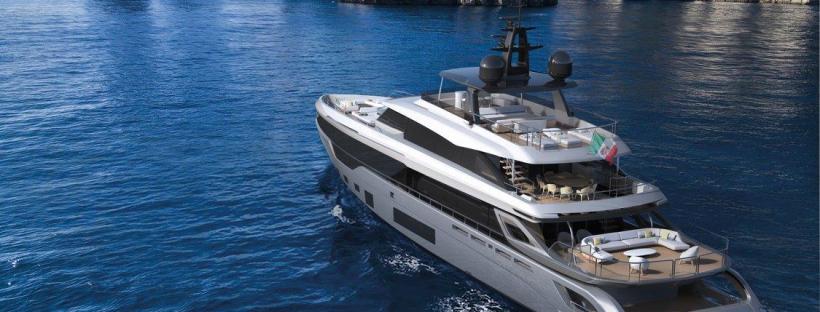
The 40M Sunreef Explorer is a versatile multihull craft dedicated to discovering new horizons. Her propulsion options allow for transoceanic range and solid performance in rough seas.
Blending elegance and modern technology, the 40M Sunreef Explorer can be heavily customized to match ambitious navigation plans. The extended aft deck houses a launching crane, a 7m tender, two jet skis and storage for a variety of water toys. With the hydraulic aft platform lowered, guests can enjoy a full-beam private beach.
The superyacht’s 13,34m beam provides for immense living areas totaling 654m² with accommodation spread across three decks. Custom features available for this concept include a playroom with a self-leveling pool table, a steam room or a master suite with a private fold-out balcony.
Alfresco relaxation areas include a large sun lounge with a spa pool surrounded by oversized sunpads and a bar as well as a vast bow terrace.
With Sunreef Yachts, every yacht boasts high-performance sailing, luxurious accommodation, vast living spaces, extravagant and innovative design features.
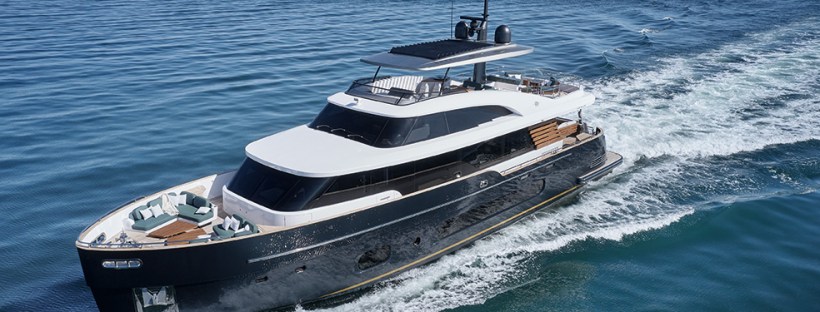
Azimut Yachts new Magellano 25 Metri is created in partnership with the internationally renowned artist and architect Vincenzo De Cotiis, who brings his unmistakable signature style to the interiors, while Ken Freivokh is behind the timeless elegance of the chic and sophisticated exterior lines.
The yacht makes extensive use of carbon fiber and draws on the latest technological developments, including an active air sanitizing system based on a NASA patent and the Hotel Mode option that guarantees prolonged stops at anchor at zero emission.
To offer long-range cruising in the utmost comfort and safety, even in rough seas, Magellano 25 has been designed with a special fuel-efficient Dual Mode hull. The partnership with Vincenzo De Cotiis springs from the brand’s desire to reach a new milestone by creating for the first time ever a yacht that isn’t a container for art, but a work of art in its own right.
For Magellano 25 Metri, De Cotiis used a special type of resin and thanks to an elaborate artisanal process, the result of multiple layers and embellished with a bronze powder, he has given life to surfaces of parchment colour, characterized by a pleasant clouded effect and inclusions that in somehow recall those typical of some precious stones.
The “artistic fiberglass” is joined by other materials and types of wood to create a highly appealing play of contrasts: brushed Verde Alpi marble, dark walnut wood, carpet, polished brass, lacquered wood and ribbed wood. The furnishings feature flowing shapes and a lot of effort has been put into creating a sense of continuity expressed by seamless, curving lines.
The interior furniture recalls the shape of the dry bar outside creating an indoor-outdoor connection in order to get the sensation of a unified space overlooking the sea. Still on the Main Deck, the stairway is clad with mirrors to “dematerialise” it and, by reflecting the light, the view of the sea became an inner part of the yacht.
Artificial light is a key element, with a lighting system designed to create a soft, warm mood. The carefully thought-out light design created by the artist involves not only lamps and classic ceiling spotlights, but also and even the sofa bottoms to give the furniture the appearance of “being suspended”.
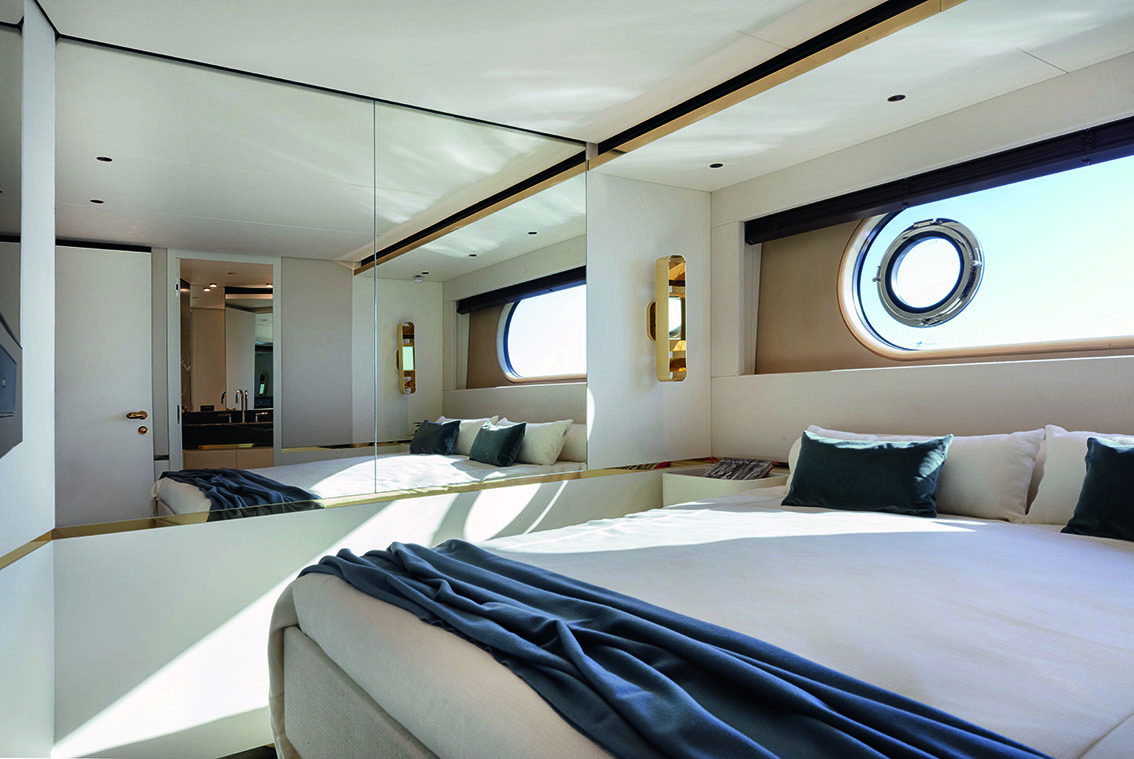
In the night area on the Lower Deck there are four cabins, including two VIPs, one double and one with sliding double beds. In the owner’s suite, thanks to the inclined position of the walk-in closet, the space extends out, while the mirror coating makes the volume disappear and reflects the light and the starboard panorama, creating highly suggestive changing optical effects. All the fabrics on board are by Loro Piana Interiors.
The crew quarters are independent, with direct access from the galley to avoid interference with guests’ movements and ensure a high level of privacy. Ken Freivokh offers his own personal take on exterior styling based on the concept of timelessness, driven by the desire to create an object of evergreen beauty and appeal, far from fleeting fashions and passing trends. The central element around which the entire design revolves is the fully-glazed superstructure, created to convey the feeling of a penthouse overlooking the sea. The standout features include the non-slip surfaces on the transom and the retro-style windows in the hull.
The yacht’s silhouette is given even more personality by the slatted teak panels on either side aft of the deckhouse. The elegant spiral staircase leads up to the Fly Deck, where the hard top is supported by a minimalist central mast. The almost vertical bow underscores the remarkable seaworthiness of this model.
The bow area can be experienced differently depending on the various times of the day as a sunbeds and lounge area, while the stern, thanks to a pivoting hatch mechanism, offers the charm of an Infinity Terrace from which to contemplate the charm of the sunset without any visual impediment.
The Dual Mode hull, designed by the firm led by Pierluigi Ausonio, ensures safe and comfortable cruising even in rough seas. The double shaped chine joint with a skeg reduces consumption at different cruising speeds and cushions wave impact. As these features show, Magellano 25 Metri has been designed for long-range cruising even in unfavourable sea and wind conditions.
The yacht is fitted with two MAN engines rated 1,400 horsepower each (or alternatively 1,550 HP), with V-Drive in-line transmission. Stabilization is provided by a Humphree electric fin system. The yacht has a top speed of around 24/25 knots and a cruising speed of 21 knots.
The new Riva sport-fly, an exciting combination of innovative vision and legendary style is a product of collaboration between Officina Italiana Design, the firm headed by Mauro Micheli and Sergio Beretta that designs the entire Riva range, the Product Strategy Committee led by Piero Ferrari and Ferretti Group’s Engineering Department.
Only Riva has the history, inventiveness, appeal and inspiration to create a boat that anticipates the future but is permeated by the evocative mood of tradition. The production and creative capacity of the shipyard, which has continued to maintain its stability and vitality in 2020, has been exploited to the full to realise a sport-fly of dazzling beauty, a groundbreaking mixture of style, technology and innovative materials.
The 26.92 m (88.4 ft) long and 6.31 m (20.8 ft) wide Riva 88’ Folgore introduces novelties in the exterior and interior design, in the ergonomics, and in the materials used, combining them with the classic hallmarks of Riva’s legendary history.
Built from composite materials, with carbon fiber reinforcements in the superstructure, Riva 88’ Folgore is entirely focused on efficiency, with a design developed specifically to embrace materials like marble, crystal glass and stainless steel, but without affecting performance.
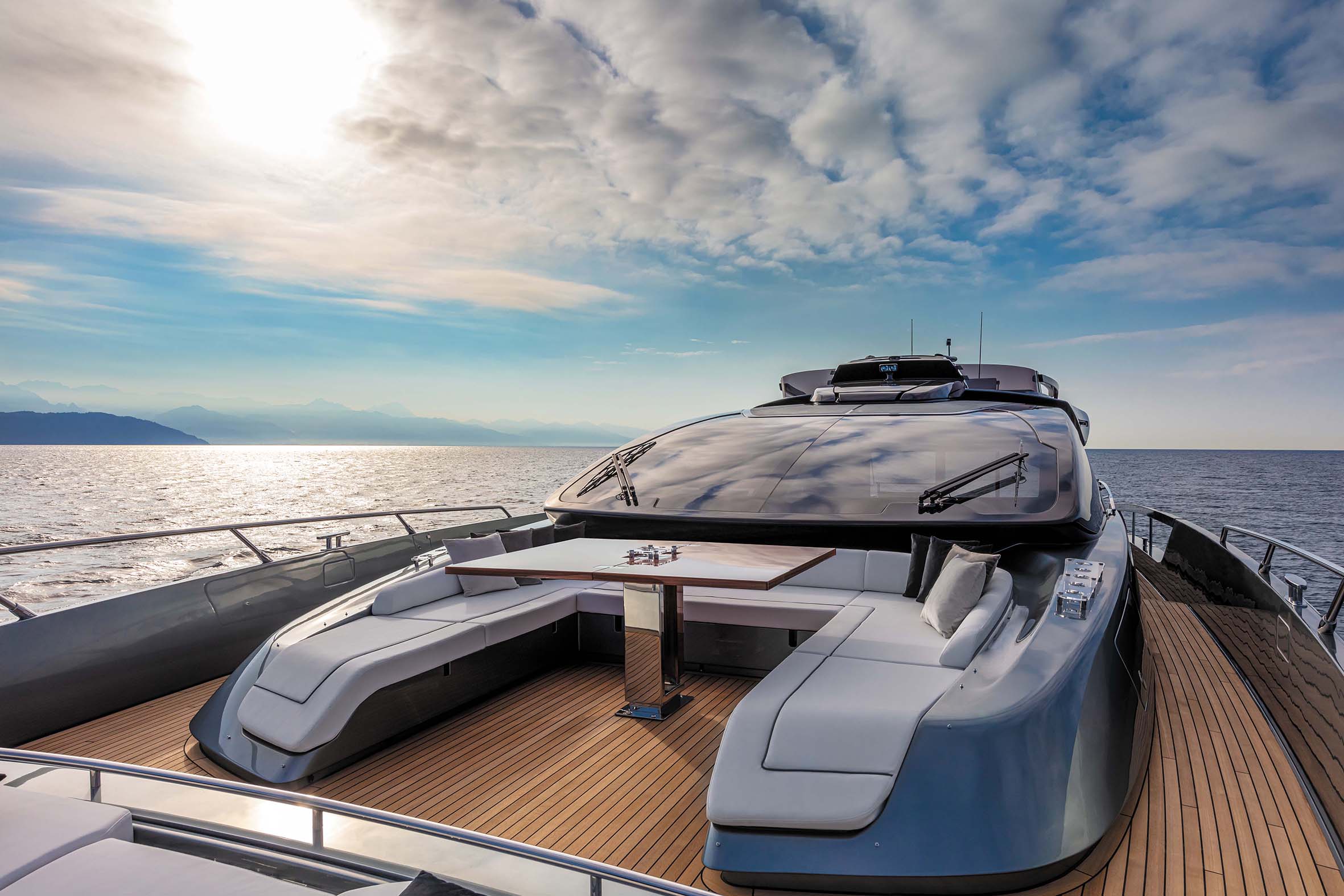
Turning to the design, the course set by Officina Italiana Design with the Dolceriva continues to hold true: the new design of the hull windows, reminiscent of a black brushstroke along the silver side of the yacht, rises towards the deck and meets an original and innovative hull-deck coupling system, where the stern area makes space for a steel-edged air intake.
The iconic mahogany and steel detailing, combined with carbon fiber elements, epitomises the perfect balance between past and present that has typified Riva boats in recent years. This is the merit of a sophisticated functional design, as can be seen in various elements, including the navigation lights framed in polished stainless steel, or the continuous aquamarine waterline.
The walkway handrails are also carbon fiber and steel, with a section on the starboard side that also acts as the handle for the access door to the interior. Making this boat even more unique is the innovative windscreen, manufactured with spherical crystals that result in a slight counter-curvature, a detail that looks set to become a Riva hallmark.
Another innovative style feature is the glass roof in the superstructure, which swings open both towards the stern and the bow, to allow fresh air in either when cruising or at anchor. Under the roof is a slatted structure that separates the interior and exterior spaces if desired. The standard solution is a fixed roof. The first unit has a Shark Grey hull with Bright Black detailing, classic colours in the Riva tradition of recent years.
This first Riva 88’ Folgore unit is fitted with a pair of MTU 16V 2000 M96L engines rated 2,638 mhp, for a top speed of 39 knots and a cruising speed of 33 knots. The standard propulsion solution is a pair of MTU 16V 2000 M96 engines rated 2,435 mhp, which drive the yacht to a top speed of 36 knots and a cruising speed of 30 knots.
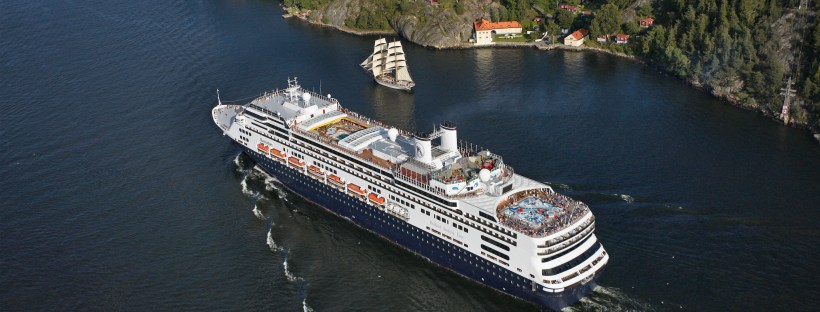
Cruise Baltic looks forward to welcoming cruise guests again all around the Baltic Sea Region, such as in Stockholm, Sweden.
The cruise network, Cruise Baltic, has just published the annual Cruise Baltic Market Review, which not surprisingly shows disappointing figures in 2020 due to the pandemic. The network is now looking forward to more normal conditions in 2021 and to restart cruise tourism.
The newly published 2021 edition of the Cruise Baltic Market Review reveals not surprisingly that 2020 was a challenge. In the past year, the cruise industry all around the world experienced an extraordinary setback due to the outbreak of the COVID-19 virus, and the cruise industry in the Baltic Sea Region was no exception. What was expected to be a record number year with more than 6 million guests in the Baltic Sea Region turned out to be the complete opposite. The cruise network, Cruise Baltic, now looks forward to the world returning to more normal conditions in 2021 and to a restart of cruise tourism.
“The figures are of course disappointing and not at all as we predicted they would look at this time last year. No one could have foreseen what the year 2020 would really be like. We can now only hope for better cruise tourism times and prepare to welcome more cruises in a safe way in 2021,” says Claus Bødker, Director of Cruise Baltic.
Due to the COVID-19 pandemic, the number of cruise guests visiting the Baltic ports in 2020 declined by -99% compared to 2019. The number of calls also decreased -96% and resulted with a total of 109 calls. The number of turnarounds decreased by -98%, from a total of 481 to 11. Despite strict lockdowns and border restrictions, the Baltic ports still managed to welcome some cruise calls. 13 ports in total had cruise calls and guests in 2020.
With the unfortunate results in 2020, expectations are naturally higher for 2021.
“Estimates for 2021 are extremely positive, but we still expect the cruise season to be affected by the pandemic. Together with our destination partners, we work to offer all cruise guests an unforgettable – and not the least safe – experience in the Baltic. We will continue to attract cruise guests by ensuring that it is safe and secure to travel to our destinations,” says Claus Bødker.
Although the industry most likely still will be affected by the pandemic, the cruise network remains optimistic and expects guest numbers to increase with 3,380,936 guests in the Baltic Sea Region in 2021 compared to 2020.
In 2020: – The total number of cruise guests decreased by -99% – The total number of calls decreased by -96% – The total number of turnarounds decreased by -98% In 2021, Cruise Baltic expects guest numbers to increase with 3,380,936 guests compared to 2020.
Founded in 1998 with the aim of designing a range of luxury motor yachts offering voluminous interiors, combined with opulence and design excellence, Pearl Yachts is one of the UK’s most prominent shipyards.The new 18.6m PEARL 62 is the latest addition to Pearl Yachts growing fleet of ocean-going yachts designed in collaboration with Bill Dixon and Kelly Hoppen MBE.
The Pearl 62, with its sporty looks, top performance and four comfortable guest cabins (plus crew cabin or jet-ski garage) is unique in its size range and is sure to please owners who are looking for a yacht that is fun to use with friends and family, with or without crew. Industry leading Pearl’s comprehensive 5 years warranty completes this unique offer on the market.
Starting aft, the yacht can be fitted with an optional bathing platform that also glides outwards to become a terrace on the sea. The transom has a built-in bench that can be used as seating or as a passageway if a tender is stowed on the platform and it lifts to reveal a jet ski garage that can alternatively be fitted as a crew cabin. The bathing platform has runners so that launching a jet ski from the garage is a breeze.
Starboard steps lead to the aft cockpit where there is a large table with banquette seating. The glass doors leading to the saloon slide all the way sideways and a window slides down so that the cockpit opens onto the saloon to become a large indoor/outdoor space. Kelly Hoppen proposes four interior style themes: Modern, Studio, Taupe and Luxury so that owners can personalise the yacht to suit their taste.
The saloon has large glazed areas that sweep upwards so that the interiors are bathed in natural light. Starting aft, there is a fully equipped galley with Miele appliances, a private stairway leading to the owners’ cabin, a dining area and a living area next to the indoor helm station. A second stairway leads down to the VIP and the twin cabins.
Side decks lead to the foredeck where guests will find a large seating area complete with foldaway table that disappears into the seating and sun pads with adjustable backrests. There are plenty of drinks holders and lockers and the area can be fitted with an optional Bedouin style canopy.
The full-length flybridge is accessed via a staircase on the starboard side of the aft cockpit. This large and versatile space has a helm station with joystick controls and Garmin touch screens with controls for everything from the yacht’s anchor to its Fusion entertainment system. Next to the helms there is comfortable seating that can convert to become sun pads.
A hardtop with an opening central section is optional but a wet bar with a cool box, sink and BBQ grill is standard. An icemaker and fridge can be added if owners desire. Across from the wet bar there is banquette seating and a dining table for eight.
The Pearl 62 has four guest cabins. The full beam owners’ cabin is accessed via a private stairway and features a large, centrally placed bed, a desk, a reading corner and his and hers closets. Long hull windows mean that owners can enjoy the view even lying down.
Two twin cabins can both convert to doubles. The port side twin has direct access to a bathroom that is shared with the starboard twin. The VIP cabin is fore and has a large, centrally placed bed, a dressing table, his and hers storage and an en-suite with a walk-in shower. All cabins and bathrooms enjoy excellent light and views through Pearl’s signature hull windows.
Volvo IPS propulsion gives the Pearl 62 optimal performance and efficiency characteristics while joystick controls with dynamic positioning system and an integrated Garmin touch-screen display make helming and accessing all of the yacht’s systems easy and intuitive.
The French marine leisure industry, represented by Fédération des Industries Nautiques (FIN, the French federation for Marine Leisure Actors) has launched an immersive boat show which will be held on March 12th and 13th. More than a hundred brands have already joined the adventure and FIN now calls on international companies to participate.
The French federation wants to make Virtual Nautic the largest virtual boat show ever organized with at least 200 exhibitors and a target audience of 25,000 to 30,000 visitors.
Going beyond barriers: an opportunity to meet, conquer new clients and make business in a pandemic context.
“It is not a replacement for physical boat shows. Although as most of them have been cancelled, the goal of this virtual event is to create a moment of meeting for the marine leisure community in this pandemic context, allowing professionals to meet their clients, and giving them the opportunity to open up to new clients, new commercial dynamics, without the geographical nor the budgetary constraints of a physical boat show.” explains Fabien Metayer, General Delegate of FIN.
FIN also aims to create an opportunity for marine tourism stakeholders to prepare for the 2021 summer season.
An interactive, authentic and innovative experience
To do so, FIN has chosen to partner with Virbela and Laval Virtual which both collaborate to conceive and create immersive virtual event experiences that are deeply social and collaborative.
Virbela’s virtual world platform is easy-to-use, accessible to anyone with Wi-Fi and a computer, and available in several languages, including English, French, Spanish, Portuguese, Chinese, and many others.
“Virbela provides an all-in-one virtual venue with expo halls, auditoriums and social spaces to help organizations replicate the experience you get at an in-person event. We’re excited to partner with Laval Virtual World and Virtual Nautic to host a memorable and engaging event experience that will give attendees an opportunity to explore, learn, and connect with others,” said Alex Howland, president and co-founder of Virbela.
At Virtual Nautic, it will be possible for attendees to move from one booth to another with their avatars, use direct voice chats with exhibitors – connected from all over the world, use presentation tools (videos, brochures…), schedule appointments, look for a product, a service or a destination.
This new experience, based on the latest interactive technologies, will provide high visibility and business opportunities to the international marine leisure industry, while preserving the warmth of a physical show.
Gulf Craft, one of the world’s top seven shipyards, celebrated a significant milestone with its flagship megayacht, Majesty 175, successfully completing her maiden sea trial. The yacht, which is due for delivery later this year, was sold to a prominent UAE businessman.
The highlight of the Majesty 175’s first sea trial was her remarkable maneuverability, speed, robust hull and rigidness. The Majesty 175 undertook a series of inclination experiments for multiple factors at sea in which she reached a top speed of 17 knots powered by her twin heavy duty MTU 12V 4000 M63 engines, delivering 1500kW each.
HE Mohamed Hussein Alshaali, Chairman of Gulf Craft, said the success of Majesty 175’s maiden sea trial highlights the world-class megayacht construction competencies of the company. “When we announced Majesty 175 at the 2016 Monaco Yacht Show, we had a single-minded goal: To create a masterpiece megayacht with exceptional design and performance standards. Our team worked for four years at our facility in Umm Al Quwain to build this magnificent composite megayacht, our largest project to date.”
Built to the specifications outlined by the UK’s Maritime and Coastguard Agency (MCA) for yachts over 500 GT, Majesty 175 has a beam of 31.6 ft (9.62 metres). Despite its gross tonnage (GT) of 780, she can cruise even through low-draft areas, drawing just 2.25 metres of water, as she is built using advanced composite materials such as carbon fibre and vinylester. The shallow draft also enables close beach access.
Majesty 175’s exterior and interior design are by the award-winning Cristiano Gatto Design Studio in Italy. The naval architecture is by Massimo Gregori of the Yankee Delta Studio. Majesty 175’s stand-out features include a 5-metre infinity pool at the forward deck and a hybrid sky-lounge that can be converted to an open sun deck. The smart layout accommodates guests in seven lavish staterooms and a crew of up to 10 members with six large crew cabins and a private captain accommodation.
At the helm during the Majesty 175’s maiden sea trial was Captain Patricia Caswell, Gulf Craft’s Quality Control Manager. She said: “We are excited to have taken this beauty out to sea. She has performed brilliantly on her first sea trial covering multiple factors, including the engines at full speed, the pair of generators, and fin stabilisers as well as the navigation and telecommunication systems. Preliminary noise and vibration levels are outstanding, and these will continue to improve when the entire interior elements are completed.”
With two fixed pitch six-blade propellers, Majesty 175’s electricity supply comes from 175 kW Kohler generators and two pairs of TRAC fin stabilizers. Safety features include a SOLAS rescue boat and an emergency generator.
The eagerly awaited project designed by Antonio Citterio Patricia Viel and Filippo Salvetti unites the architectural language of the maritime tradition, living materials, fine craftsmanship and the power of light, encompassing them in a perfect circle.
Custom Line Navetta 30 marks a new chapter in the brand’s evolution. This romantic yacht is full of charm and makes an extremely elegant and contemporary style statement.
At 28.43 m (93 ft) in length and with a beam of 7.3 m (24 ft), Navetta 30 is a product of collaboration between the Product Strategy Department led by Mr. Piero Ferrari and the Ferretti Group Engineering Department. The yacht is the first project with exteriors designed by Filippo Salvetti and interiors by architecture and design firm Antonio Citterio Patricia Viel. The influence of these top professionals can be seen in every stylistic choice.
An in-depth approach to the design process, referencing stylistic features in the finest tradition, has generated the many unusual elements that make Navetta 30 a new icon of the sea. They range from the choice of natural, living materials like leather, wood and rope, to an unprecedented celebration of light.
The sea metaphor is also clear to see in the colourways, and particularly in the choice of blue. The constant reference to seafaring tradition can also be seen in the rounded lines and curves of the interior spaces, furniture and window frames, combined with the use of natural materials like solid wood, leather and teak, which are free to continue their natural cycle and live a new life at every stage in their story.
The return to the historical memory of “going to sea” is also emphasised by the use of the colour blue for the walls and furnishings, as well as for the fabrics and coatings with their custom textures, all helping to enhance the continuity between interior and exterior at a stylistic level too, in an unfiltered experience with the sea.
Right from the very first glance, the exterior of Navetta 30 stands out for her classic, perfectly poised silhouette. The lines stretch out horizontally, highlighting this aspect of the design so that the vertical connections between the decks almost go unnoticed. The tinted windows and powerfully architectural design aim to reduce vertical contrasts still further and impart an emphatic horizontal movement to how the pale colours are ‘read’.
The design gives an innovative twist to the brand’s heritage values of seaworthiness, comfort, safety and customisation, making it instinctively recognisable while retaining a sense of formal purity. A design made to last. The exteriors maintain seamless continuity of finishes and furnishings and are designed for socialising and relaxation, adding to the convivial and private spaces on board.
All the furniture and furnishings are custom-made using sophisticated handcrafting and cabinetmaking techniques that can clearly be seen at first glance in the stern flag mast, in the curving solid wood window frames and in the teak ceilings. The pairing with natural leather and wood creates a textured mood that is fresh and youthful.
Navetta 30 has three decks with every comfort and a total of over 320 square metres of space in which she can accommodate 10 guests in five cabins, with a master stateroom on the main deck and four guest cabins on the lower deck.
Special care has been lavished on the lighting design to ensure the perfect integration of architecture and light. Decorative wall-mounted lamps enrich the spaces with reflections and light effects, giving them personality. The use of warm dimming technology to adjust the intensity and tone of the light allows guests to create different lighting moods and personalise their living experience.
Overall, the yacht has a dynamic personality expressed by taut, sweeping lines, with volumes, performance and comfort on a par with much larger models and an exterior design in which form and function are perfectly balanced.
Not only the first three-deck yacht built by Azimut Yachts, but also its largest to date, the Grande Trideck exemplifies the Italian brand’s capacity for pushing the boundaries of design, style and construction.
The exterior design by Alberto Mancini introduces a host of innovations in terms of layout, each of which is not only the consequence of a particular design choice, but also inspires or creates further artful and original features. The idea of including an aft raised cockpit, for example, led to the development of new outdoor areas with unexpected concepts, functions and characteristics.
The interiors are designed by Achille Salvagni, who has moved away from the traditional arrangement of on-board spaces to create an environment that reflects the lifestyle of today’s owner who is seeking versatility, informality and somewhere they can truly relax and entertain guests in comfort. On that note, there is also an option of a sixth cabin on the upper deck.
The water lines are by Pierluigi Ausonio’s firm P.l.a.n.a., with a D2P® Displacement to Planing hull designed together with the Azimut Research and Development centre guaranteeing maximum efficiency at all speeds.
When it came to designing the layout of this 38.2-metre long, 7.9-metre wide yacht, the rule book was completely rewritten, and the result is a series of informal, dynamic and versatile spaces, perfect for the contemporary owner who sees their boat as a convivial place for socialising and hosting guests in a relaxed setting.
As one would expect from an Azimut flagship, the exterior lines are elegant and dynamic, but the twist comes in the form of a raised deck in the stern that creates a series of unprecedented new exterior spaces, strategically spaced out around the boat. With so many options, both owner and guests are spoilt for choice, whether they are looking to seek out quiet moments alone or spend time together in a convivial, comfortable setting.
The central idea around which the design develops is clear from the moment you step on board: the Trideck welcomes guests from the central gangway directly onto the Aft Raised Deck, which could be described almost as a mezzanine that sits slightly above the Main Deck. The creation of this raised deck in turn opened the door to a trio of new zones: a Sea View Terrace, Beach Club and Private Patio.
Clever styling gives the exterior lines a lighter feel, creating a sensation of dynamism that is far from easy to achieve on a boat this size. The sides of the yacht are given a sense of movement and tension by the ribbing that runs continuously from the stern right through to the bow, while the exhausts and fairleads become design.
Achille Salvagni has wholeheartedly embraced Azimut’s challenge to redefine the role of space by rethinking the traditional functions of many of the boat’s areas. In completely reconsidering the way many of the internal spaces are used and abandoning preconceptions and established norms, the boat becomes a more fluid, informal environment, and a space that is genuinely conducive to relaxing. This is fostered by the way in which the height and width of the interiors are amplified, and the seamless integration with exterior zones so that they seem to flow into each other.
This atmosphere that encourages owners and guests alike to completely let go of the world outside and give themselves up to total relaxation is also a result of Salvagni’s décor, which builds on the fluidity of space, inhabiting the interiors so that they appear sculpted rather than simply filled.
The interiors also contain surprises from a layout point of view, with a private patio on the main deck fitted out as a sheltered lounge area providing access to an indoor lounge. The cut of the bow at two different angles offers a dynamic look without compromising on space by optimising the interior volumes.
The D2P® Displacement to Planing hull is designed by Pierluigi Ausonio in collaboration with the Azimut Research and Development centre, making use of proprietary CFD software, FEM analysis and tank testing. The double chine hull reduces drag at cruising speed and improves stability during displacement navigation. With two engine options rated 2400 or 2600 mHP, the Trideck delivers a top speed of 23 or 24 knots.
The entire superstructure is laminated in carbon fibre, with added vinylester and epoxy resin. This reduces the yacht’s overall weight significantly, while the combination of the D2P® hull and the carbon fibre superstructure delivers a considerable improvement in performance, with reduced consumption accompanied by greater speed and range.
A third Evo R6 unit, fully personalised for transformation into a “party boat”, has been recently launched. The shipyard and the designer worked together to adapt the layout and décor of this flagship to meet the various requirements of the owner, who received his new custom Evo R6 a few days ago.
December 2020. Maximum comfort when underway combined with all the fun that the R series flagship model can offer. A new unit was recently launched of the Evo R6, the 18-metre yacht that epitomises the long-term vision of the Blu Emme Yachts yard. Compared to her two sisters, this custom EVO R6 features new layouts, both externally and internally, and alternative furnishing solutions developed together with the German owner, who envisaged a boat with a more aggressive look perfect for celebrations and parties.
“Boats by Evo Yachts have always been admired for their transformability,” said the Mercuri brothers, owners of the Blu Emme Yachts shipyard, “but in this case we’ve shown how a model that was already outstanding in terms of its flexibility of style and use can be revolutionised still further to meet all the owner’s requirements”.
The exterior layout has been modified to create a bar with a linear and functional design behind the stern sunpad. The brushed stainless steel structure and apparently suspended teak counter are seamlessly integrated with the unit containing a fridge, freezer and icemaker unit.
The spacious sunpad sofa is a small masterpiece of design. Technological, transformable and extendable, it encapsulates all the brand’s distinctive characteristics. Guests can use this feature to revolutionise the layout of the area in seconds: the backrest can be adjusted manually and transformed into seating for the bar, while the sunpad can be extended in width using an electric mechanism to form a C-shaped sofa overlooking the water.
Even the smallest details have been designed with the greatest care: the sofa seems to hang in the air thanks to its clever structure and, unlike the previous two units in which the sunpad has a 2.8-metre tender housed beneath it, here there’s a special hatch to gain access to the jet boards. The lateral Xtension bulwarks, on the other hand, contain two seabobs, with a sliding system for ease of use.
In the cockpit, the kitchen unit is in the same style as the bar and has been redesigned to accommodate a bigger grill. Also transformable are the new hanging pilot’s seat, the cockpit sofa with a backrest that can be used as an extra seat, and the cockpit table, which has an electric “up and down” mechanism and can be used either for lunch or drinks. The windscreen has two openings at the bottom to allow fresh air to circulate and make the cockpit even more comfortable.
The forward sunpad and sofa have also been revolutionised in this new version of the Evo R6 by adding mobile backrests.
Below deck, the interior design is in a Northern European minimalist style, with clean, simple and squared off lines combined with a palette of pale colours. The owner has chosen a layout with three cabins plus a spacious dinette that can be turned into a fourth cabin. Once again, the Yard and designer Valerio Rivellini have shown their ability to customise the layout of a 58-footer and translate the owner’s needs into a masterpiece of functionality and design.
First presented with two cabins + crew and then revisited in a three-cabin version on the Open model, this third version of the Evo R6 offers four guest cabins and three bathrooms.
The already exceptional technical performance characteristics remain the same, while consumption levels have been kept low. Propulsion is provided by a pair of 725 HP Volvo Penta IPS engines (IPS 950) that take the Evo R6 to a top speed of 35 knots and a cruising speed of around 28 knots.